Amaranthaceae
Alternanthera (Joseph's Coat)
Alternanthera
Give bright light: full sun or light shade outdoors and the brightest window indoors; in low light the plant stretches and the colors fade. Keep the soil lightly moist, letting the top layer dry between waterings, but never soggy. It likes warmth and suffers below 10 °C. Pinch the tips every month to keep it bushy and feed with diluted fertilizer during the growing season. Cuttings root easily in water or soil.
Every 4 days
Bright indirect
10° - 35°C
40% - 80%
Categories
What is Alternanthera?
Alternanthera (Alternanthera) is a easy-care plant from the Amaranthaceae family. Alternanthera is a genus of about 100 species in the amaranth family (Amaranthaceae), most of them native to the tropical and subtropical Americas, with others in Asia, Africa and Australia. In gardens and pots, what people grow are the colorful foliage types sold as Joseph's coat, joyweed or calico...
Alternanthera grows up to 90cm, spread of 60cm, watering every 4 days, 10°C – 35°C, 40–80% humidity. It is suitable for indoor environments and safe for pets.
Unlike many tropical plants, Alternanthera tolerates watering mistakes. Best for beginners. Unlike many popular species, Alternanthera is safe to keep around pets. Without adequate drainage, root rot can develop within 8 days.
How to Care for Alternanthera?
TLDR: Alternanthera needs Bright indirect, watering every 4 days, and temperatures between 10-35°C with 40-80% humidity.
How Often Should You Water Alternanthera?
Water when the top 2-3 cm of soil is dry, usually once or twice a week in hot weather and less in winter. Do not let it dry out completely, as it wilts fast, and empty the saucer after watering so the roots do not rot.
How Much Light Does Alternanthera Need?
Full sun or light shade outdoors; 6 hours of sun gives the strongest colors, though in very hot summers midday sun can bleach the leaves. Indoors, keep it by the brightest window. In low light it gets thin, leggy and greener.
What Is the Best Soil for Alternanthera?
Fertile, well-drained soil rich in organic matter, slightly acidic to neutral. In pots, use houseplant compost with some perlite or coarse grit.
What Pot Should You Use for Alternanthera?
A pot with good drainage holes, plastic or ceramic, a little wider than the plant. It also works well in window boxes and mixed containers with other sun lovers.
Care Schedule
Fertilize
Every 30 days
Repot
Every 365 days
What Is Alternanthera and Where Does It Come From?
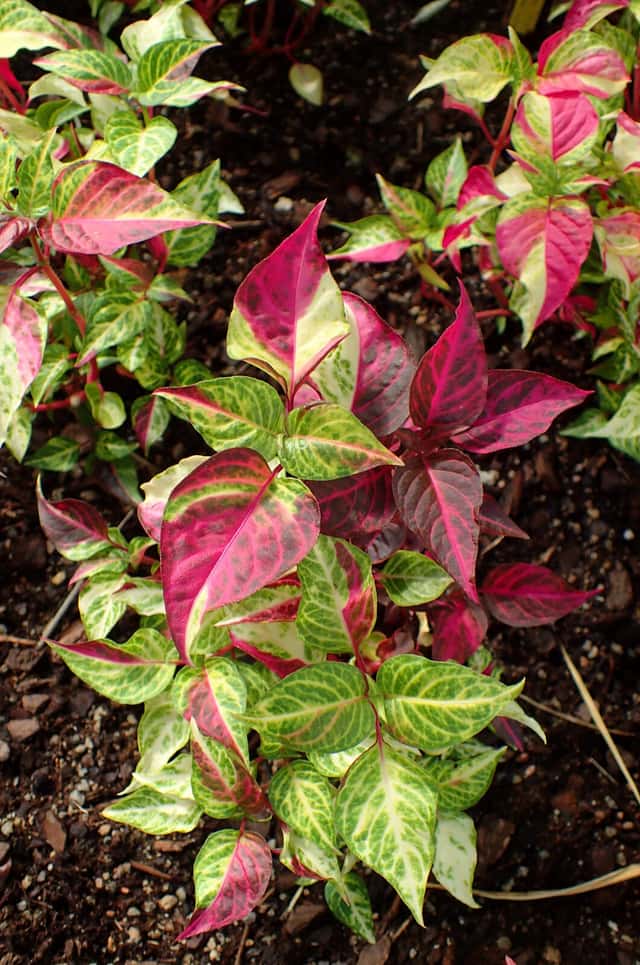
Alternanthera is a genus of about 100 species in the amaranth family (Amaranthaceae), most of them native to the tropical and subtropical Americas, with others in Asia, Africa and Australia. In gardens and pots, what people grow are the colorful foliage types sold as Joseph's coat, joyweed or calico plant: A. ficoidea, A. bettzickiana, A. dentata, A. brasiliana and hybrids such as 'Party Time', 'Red Threads' and 'Purple Knight'. They are soft-stemmed perennials that form low mounds or creep along the ground, with small opposite leaves in green, red, pink, purple, cream or yellow, often splashed together. The flowers are tiny white pompoms tucked in the leaf axils and are easy to miss. They cannot take frost, so outside the tropics they are grown as summer annuals or as houseplants. Some species in the genus are weeds, such as A. philoxeroides (alligator weed), which forms mats on rivers and ponds.
How to Propagate Alternanthera?
Tip cuttings
The tips you pinch off when pruning make good cuttings. Root a few at the end of summer to keep indoors over winter.
- 1 Cut healthy shoot tips 8-10 cm long
- 2 Remove the leaves from the lower half
- 3 Stand them in a glass of water or in moist potting mix
- 4 Keep in bright, indirect light and change the water weekly
- 5 Pot up once the roots are 2-3 cm long
Materials needed:
Ground layering
Creeping types do this on their own, rooting wherever a stem touches the ground.
- 1 Pick a long stem that reaches the soil
- 2 Press a leaf node onto the soil and pin it down
- 3 Keep the spot moist
- 4 Once rooted, cut it from the parent and replant
Materials needed:
How Big Does Alternanthera Grow?
TLDR: Alternanthera can reach up to 90cm tall with Fast growth rate.
Max height
90cm
Spread
60cm
Growth rate
Fast
Foliage
Evergreen
Plant Uses
Ornamental
Great for decoration
Ground Cover
Soil coverage
Is your plant showing symptoms?
Click on the symptom to discover possible causes:
What Diseases Commonly Affect Alternanthera?
TLDR: Alternanthera is susceptible to 11 known diseases. Monitor regularly for early detection.
Root Rot
Root rot is a serious fungal disease that affects the root system of plants, causing them to decay and die. It is primarily caused by overwatering, poor drainage, or soil-borne fungi such as Pythium, Phytophthora, Rhizoctonia, and Fusarium. The disease thrives in waterlogged conditions where roots are deprived of oxygen, making them susceptible to fungal infection.
Grey Mould
Leaf Spot
Leaf spot is a common fungal disease caused by various pathogens including Alternaria, Ascochyta, Colletotrichum, Septoria, and Venturia. It primarily affects leaves, causing discolored spots that can lead to premature leaf drop if left untreated.
Powdery Mildew
Powdery mildew is a common fungal disease caused by various fungi species including Erysiphe, Podosphaera, Oïdium, and Leveillula. It affects over 10,000 plant species worldwide. The disease thrives in warm, dry climates with high humidity and appears as a distinctive white powdery coating on plant surfaces.
Fun Facts
The genus has around 100 species, most of them from the tropical Americas.
One species, A. sessilis, is eaten as a leafy vegetable in parts of Asia.
Alligator weed (A. philoxeroides) forms floating mats that clog rivers and canals on several continents.
The flowers are so small they look like little white paper balls between the leaves.
Frequently asked questions
Does Alternanthera like sun or shade?
Can Alternanthera survive winter?
How do I make Joseph's coat bushier?
Is Alternanthera toxic to cats and dogs?
Why is my Alternanthera losing its color?
Compare with similar plants
| Attribute | Difficulty | Light | Watering | Pet Safe |
|---|---|---|---|---|
| Field Maple | Easy | Bright indirect | 14d | ✓ |
| Iberian Houseleek | Easy | Direct sun | 14d | ✓ |
| Silver Birch | Easy | Direct sun | 14d | ✓ |
| Common Blanketflower | Easy | Direct sun | 10d | ✓ |
Choose & Compare
Sources & References
- Alternanthera - Wikipedia
- Alternanthera: Origin, Varieties and Growing Tips - Laidback Gardener
- Alternanthera ficoidea - NC State Extension Gardener Plant Toolbox
- Alternanthera Ficoidea - Joseph's Coat - UK Houseplants
- The Genus Alternanthera: Phytochemical and Ethnopharmacological Perspectives - PMC
- Alternanthera philoxeroides (lagunilla) - EcuRed