Hamamelidaceae
American witch-hazel: Aromatic Plant
Hamamelis virginiana
This hardy, low-maintenance shrub thrives best in moist, well-drained, slightly acidic soil in full sun to partial shade; it blooms most profusely and displays the brightest fall foliage in full sun.
Every 7 days
Partial shade
-34° - 35°C
40% - 70%
Categories
What is American witch-hazel?
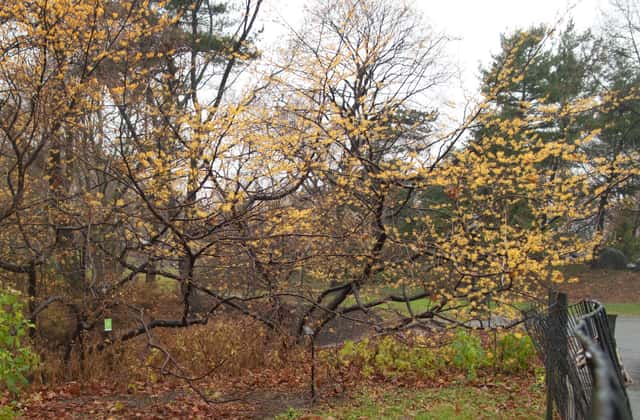
American witch-hazel (Hamamelis virginiana) is a easy-care plant from the Hamamelidaceae family. Hamamelis virginiana, the American witch-hazel, is a large deciduous shrub or small tree (15-30 ft) native to eastern North America. It is notable for its late blooming period: from late fall into winter, thin, thread-like, bright yellow flowers appear, often while the last leaves are still falling....
American witch-hazel grows up to 9.0m, spread of 600cm, watering every 7 days, -34°C – 35°C, 40–70% humidity. It is not suitable for indoor environments and safe for pets.
Unlike many tropical plants, American witch-hazel tolerates watering mistakes. Best for beginners. Unlike many popular species, American witch-hazel is safe to keep around pets.
How to Care for American witch-hazel?
TLDR: American witch-hazel needs Partial shade, watering every 7 days, and temperatures between -34-35°C with 40-70% humidity.
How Often Should You Water American witch-hazel?
Keep the soil evenly moist, especially during dry summers; the plant is sensitive to prolonged drought and benefits from a layer of mulch.
How Much Light Does American witch-hazel Need?
Tolerates shade, but provides the richest bloom and the most beautiful orange-yellow fall colors in full sun to light partial shade.
What Is the Best Soil for American witch-hazel?
Prefers humus-rich, moist, slightly acidic soil (pH 5-6.5); also tolerates heavy clay soil as long as drainage is reasonable.
What Pot Should You Use for American witch-hazel?
Not suitable for container culture due to its ultimate size; preferably plant directly in the ground with sufficient space to grow.
Care Schedule
Fertilize
Every 180 days
What Is American witch-hazel and Where Does It Come From?
Hamamelis virginiana, the American witch-hazel, is a large deciduous shrub or small tree (15-30 ft) native to eastern North America. It is notable for its late blooming period: from late fall into winter, thin, thread-like, bright yellow flowers appear, often while the last leaves are still falling. The species is globally renowned as the source of the classic skincare extract "witch hazel," derived from the bark and twigs, which has been used for centuries by North American indigenous peoples and later the pharmaceutical industry for its astringent and anti-inflammatory properties.
How to Propagate American witch-hazel?
Seeds
- Patience is essential: germination can take one to two years.
- Seeds will hardly germinate without stratification.
- 1 Harvesting
Collect the seeds as soon as the seed pods open in the fall and eject the seeds.
- 2 Double stratification
Seeds require a period of warm stratification followed by cold stratification to break dormancy.
- 3 Sowing
Sow in a mixture of peat and sand and keep constantly moist until germination, which can take a long time.
Materials needed:
How Big Does American witch-hazel Grow?
TLDR: American witch-hazel can reach up to 9.0m tall with Medium growth rate.
Max height
9.0m
Spread
6.0m
Growth rate
Medium
Foliage
Deciduous
Plant Uses
Ornamental
Great for decoration
Medicinal
Medicinal properties
Aromatic
Pleasant fragrance
Medicinal Uses
- Anti-inflammatory care for irritated or inflamed skin
- Astringent agent for hemorrhoids and minor bleeding
- Soothing of insect bites, sunburn, and bruises
- Traditionally used by North American indigenous peoples as an herbal remedy and in eye washes
Is your plant showing symptoms?
Click on the symptom to discover possible causes:
What Diseases Commonly Affect American witch-hazel?
TLDR: American witch-hazel is susceptible to 7 known diseases. Monitor regularly for early detection.
Powdery Mildew
Powdery mildew is a common fungal disease caused by various fungi species including Erysiphe, Podosphaera, Oïdium, and Leveillula. It affects over 10,000 plant species worldwide. The disease thrives in warm, dry climates with high humidity and appears as a distinctive white powdery coating on plant surfaces.
Root Rot
Root rot is a serious fungal disease that affects the root system of plants, causing them to decay and die. It is primarily caused by overwatering, poor drainage, or soil-borne fungi such as Pythium, Phytophthora, Rhizoctonia, and Fusarium. The disease thrives in waterlogged conditions where roots are deprived of oxygen, making them susceptible to fungal infection.
Leaf Spot
Leaf spot is a common fungal disease caused by various pathogens including Alternaria, Ascochyta, Colletotrichum, Septoria, and Venturia. It primarily affects leaves, causing discolored spots that can lead to premature leaf drop if left untreated.
Scale Insects
Scale insects are small sap-sucking pests that appear as brown, shell-like bumps on plant stems and leaves. There are over 25 species, divided into armored (hard) and unarmored (soft) scales. They feed by piercing plant tissue and extracting sap, which weakens the plant and can lead to yellowing, stunted growth, and even death if left untreated. They also excrete honeydew, which attracts ants and promotes sooty mold growth.
Meaning & Symbolism
Associated with protection and mysticism; the forked branches were traditionally used as dowsing rods to locate water and were believed to offer protection against evil.
Compare with similar plants
| Attribute | Difficulty | Light | Watering | Pet Safe |
|---|---|---|---|---|
| Field Maple | Easy | Bright indirect | 14d | ✓ |
| Silver Birch | Easy | Direct sun | 14d | ✓ |
| Common Blanketflower | Easy | Direct sun | 10d | ✓ |
| Cushion Bush | Easy | Direct sun | 14d | ✓ |
Choose & Compare
Sources & References
- Hamamelis virginiana - NC State Extension Gardener Plant Toolbox
- Common witch-hazel - The Morton Arboretum
- Witch Hazel: Plant Care and Growing Guide - Gardenia.net
- Medical Attributes of Hamamelis virginiana - witch hazel
- Hamamelis virginiana L. in Skin Care: A Review of Its Pharmacological Properties and Cosmetological Applications





