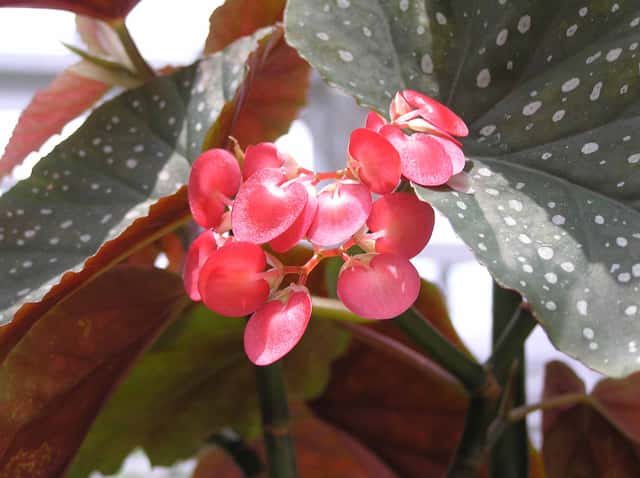
Begoniaceae
Angel Wing Begonia (Begonia corallina)
Begonia corallina
Grow in bright indirect light, water when the top 2-3 cm of soil dries out, and keep humidity moderate to high. Use a well-draining, organically rich potting mix, feed every 2 weeks during spring and summer, and prune tall canes periodically to keep the plant from becoming leggy.
Every 7 days
Bright indirect
18° - 24°C
50% - 70%
Categories
What is Angel Wing Begonia?
Angel Wing Begonia (Begonia corallina) is a medium-care plant from the Begoniaceae family. The Angel Wing Begonia (Begonia corallina) is a tall, upright cane-type begonia with bamboo-like jointed stems. Its asymmetrical, wing-shaped leaves are olive-green, sometimes speckled with silver, and it produces pendulous clusters of coral, pink, or red flowers mainly in spring and summer. It is a...
Angel Wing Begonia grows up to 2.5m, spread of 60cm, watering every 7 days, 18°C – 24°C, 50–70% humidity. It is suitable for indoor environments and not safe for pets.
Without precautions, ingestion can cause irritation in pets. Keep out of reach of cats and dogs. Without adequate drainage, root rot can develop within 14 days.
How to Care for Angel Wing Begonia?
TLDR: Angel Wing Begonia needs Bright indirect, watering every 7 days, and temperatures between 18-24°C with 50-70% humidity.
How Often Should You Water Angel Wing Begonia?
Water when the top of the soil feels dry to the touch (roughly every 5-7 days in summer, 10-14 days in winter). Avoid waterlogging, as roots rot easily in soggy soil.
How Much Light Does Angel Wing Begonia Need?
Prefers bright indirect light near a sheer-curtained window. Direct sun scorches the leaves, while low light causes leggy stems and poor flowering.
What Is the Best Soil for Angel Wing Begonia?
Use a light, well-draining mix based on potting soil, peat, and sand or perlite, with a slightly acidic to neutral pH.
What Pot Should You Use for Angel Wing Begonia?
Terracotta or ceramic pot with drainage holes, sized to match the tall, upright growth habit.
Care Schedule
Fertilize
Every 14 days
Rotate
Every 14 days
Repot
Every 730 days
What Is Angel Wing Begonia and Where Does It Come From?
The Angel Wing Begonia (Begonia corallina) is a tall, upright cane-type begonia with bamboo-like jointed stems. Its asymmetrical, wing-shaped leaves are olive-green, sometimes speckled with silver, and it produces pendulous clusters of coral, pink, or red flowers mainly in spring and summer. It is a classic houseplant prized for both its ornamental foliage and generous blooms.
How to Propagate Angel Wing Begonia?
Stem Cutting
Change the water every 3-4 days if propagating in water. Use clean, sharp tools to avoid contamination.
- 1 Cut a stem section with 2-3 nodes, just below a node
- 2 Remove the lower leaves, leaving 1-2 at the top
- 3 Place in water or moist potting mix in bright indirect light
- 4 Wait for roots to develop before transplanting to a permanent pot
Materials needed:
How Big Does Angel Wing Begonia Grow?
TLDR: Angel Wing Begonia can reach up to 2.5m tall with Fast growth rate.
Max height
2.5m
Spread
60cm
Growth rate
Fast
Foliage
Evergreen
Warning: Toxic Plant
This plant can be toxic if ingested. Keep out of reach of:
Plant Uses
Ornamental
Great for decoration
Is your plant showing symptoms?
Click on the symptom to discover possible causes:
What Diseases Commonly Affect Angel Wing Begonia?
TLDR: Angel Wing Begonia is susceptible to 4 known diseases. Monitor regularly for early detection.
Powdery Mildew
Powdery mildew is a common fungal disease caused by various fungi species including Erysiphe, Podosphaera, Oïdium, and Leveillula. It affects over 10,000 plant species worldwide. The disease thrives in warm, dry climates with high humidity and appears as a distinctive white powdery coating on plant surfaces.
Grey Mould
Root Rot
Root rot is a serious fungal disease that affects the root system of plants, causing them to decay and die. It is primarily caused by overwatering, poor drainage, or soil-borne fungi such as Pythium, Phytophthora, Rhizoctonia, and Fusarium. The disease thrives in waterlogged conditions where roots are deprived of oxygen, making them susceptible to fungal infection.
Mealybugs
Mealybugs are small, soft-bodied insects covered with a white, waxy, cottony material. They are common pests of houseplants and outdoor plants in mild climates. These sap-sucking insects feed on plant tissue, causing damage, stunted growth, and can lead to plant death if left untreated. They produce sticky honeydew which attracts sooty mold.
Meaning & Symbolism
Symbolizes individuality and resilience: its asymmetrical wing-shaped leaves reflect a balance between strength and grace.
Fun Facts
Its asymmetrical, wing-shaped leaves inspired the common name "Angel Wing Begonia".
It is a cane-type begonia with jointed, bamboo-like stems.
It can grow up to 2.5 m tall under ideal conditions.
Frequently asked questions
How often should I water Angel Wing Begonia?
Is Angel Wing Begonia toxic to cats and dogs?
Why are my begonia leaves dropping or yellowing?
How do I keep the plant from getting leggy?
Compare with similar plants
| Attribute | Difficulty | Light | Watering | Pet Safe |
|---|---|---|---|---|
| Dark Fieldcap | Medium | Low light | 2d | ⚠️ |
| Azalea | Medium | Partial shade | 3d | ⚠️ |
| Muriel's Bamboo | Medium | Partial shade | 3d | ✓ |
| Bougainvillea | Medium | Direct sun | 7d | ⚠️ |




