Malvaceae
Arrowleaf Sida (Sida rhombifolia)
Sida rhombifolia
Tough outdoor wild plant that usually turns up on its own. Give it full sun; it copes with any soil and little water. In temperate climates it behaves as a summer annual. If you do not want it, pull it out with the root before it sets seed.
Every 7 days
Direct sun
° - °C
% - %
Categories
What is Arrowleaf Sida?
Arrowleaf Sida (Sida rhombifolia) is a easy-care plant from the Malvaceae family. Arrowleaf sida (Sida rhombifolia) is a subshrub in the mallow family (Malvaceae) that now grows in almost every tropical and subtropical region. It reaches 50 cm to 1.2 m, with tough, fibrous stems that turn woody at the base. Its diamond-shaped leaves, 4 to 8 cm long, are dark green above and greyi...
Arrowleaf Sida grows up to 1.2m, watering every 7 days. It is not suitable for indoor environments and safe for pets.
Unlike many tropical plants, Arrowleaf Sida tolerates watering mistakes. Best for beginners. Unlike many popular species, Arrowleaf Sida is safe to keep around pets.
How to Care for Arrowleaf Sida?
TLDR: Arrowleaf Sida needs Direct sun, watering every 7 days, and temperatures between 15-30°C with 40-70% humidity.
How Often Should You Water Arrowleaf Sida?
Water once a week when it does not rain; its deep taproot gets it through dry spells. Avoid waterlogging.
How Much Light Does Arrowleaf Sida Need?
Full sun. It tolerates some shade but grows weak and flowers less there. Not a houseplant.
What Is the Best Soil for Arrowleaf Sida?
Grows in almost any soil, even poor, stony or compacted ground, as long as it does not stay waterlogged.
What Pot Should You Use for Arrowleaf Sida?
Rarely grown in pots. If you do, use a medium, deep pot (it has a taproot) with a drainage hole.
What Is Arrowleaf Sida and Where Does It Come From?
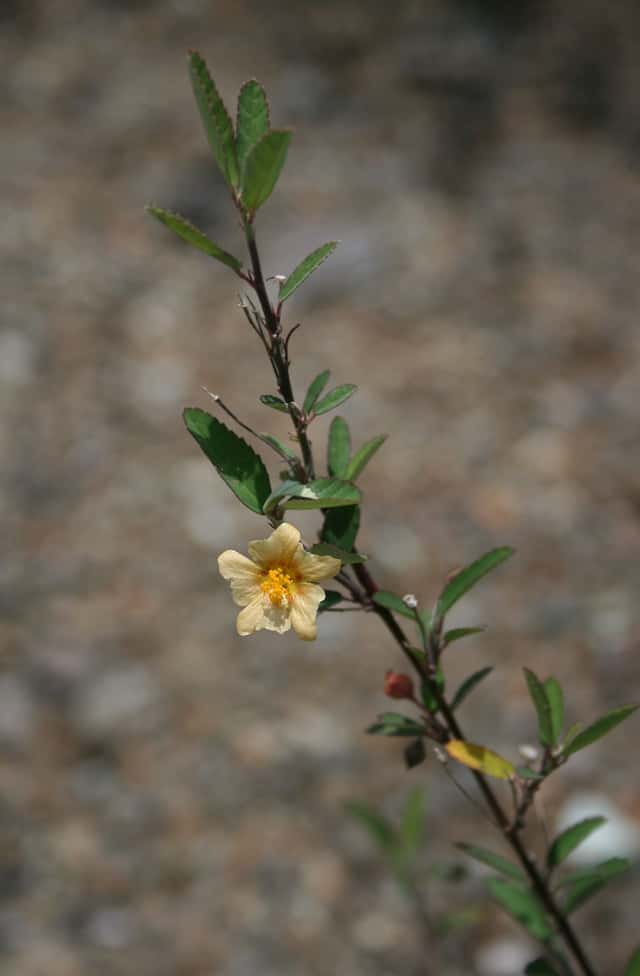
Arrowleaf sida (Sida rhombifolia) is a subshrub in the mallow family (Malvaceae) that now grows in almost every tropical and subtropical region. It reaches 50 cm to 1.2 m, with tough, fibrous stems that turn woody at the base. Its diamond-shaped leaves, 4 to 8 cm long, are dark green above and greyish and finely hairy beneath, toothed only on the upper half; this sets it apart from Sida acuta, with narrow leaves, and Sida cordifolia, with velvety heart-shaped leaves. Single flowers grow from the leaf axils, with five cream to orange-yellow petals, sometimes reddish at the centre, and in the tropics they appear all year. It is a common weed of roadsides, waste ground and pastures, where it thrives because cattle avoid it. Its stems were used for brooms, rough cordage and sacking.
How to Propagate Arrowleaf Sida?
Seed
It self-seeds easily. Soaking the seed in warm water for a few hours helps it germinate evenly.
- 1 Collect dry capsules when they split into segments
- 2 Sow the seeds shallowly in loose soil
- 3 Keep moist in full sun
- 4 Thin seedlings if they come up crowded
Materials needed:
How Big Does Arrowleaf Sida Grow?
TLDR: Arrowleaf Sida can reach up to 1.2m tall with Fast growth rate.
Max height
1.2m
Growth rate
Fast
Foliage
Evergreen
Plant Uses
Medicinal
Medicinal properties
Medicinal Uses
- In Ayurvedic medicine (kurumthotti) the leaves are used for swelling, the root for rheumatism and the mucilage as an emollient
- In the Americas, from the Caribbean to Brazil and Argentina, a tea of the plant is used for sore throat and cough
- The root contains alkaloids including ephedrine: do not take it without medical advice
Is your plant showing symptoms?
Click on the symptom to discover possible causes:
What Diseases Commonly Affect Arrowleaf Sida?
TLDR: Arrowleaf Sida is susceptible to 2 known diseases. Monitor regularly for early detection.
Whiteflies
Whiteflies are small, soft-bodied, winged insects closely related to aphids and mealybugs. They are moth-like in appearance, about 1/16 inch long, triangular in shape, and gray-white in color. These sap-sucking pests feed on plant tissue, causing yellowing, stunted growth, and wilting. They also excrete honeydew, which attracts ants and promotes sooty mold growth. Whiteflies can transmit serious plant viruses.
Mosaic Virus
Mosaic virus is a group of plant viruses that cause mottled, patchy patterns on leaves and can affect a wide variety of plants. The virus creates characteristic yellow, white, and green mosaic patterns, often accompanied by stunted growth and deformed plant parts. This highly contagious disease spreads rapidly through insect vectors and contaminated tools.
Fun Facts
Its fibre was once exported from India as hemp
Cattle will not eat it, which is why it spreads in pastures
Each petal has one lobe longer than the other, like a propeller blade
Frequently asked questions
How do I tell arrowleaf sida from other Sida?
Is it toxic?
Does it need care?
What was it used for?
Compare with similar plants
| Attribute | Difficulty | Light | Watering | Pet Safe |
|---|---|---|---|---|
| Field Maple | Easy | Bright indirect | 14d | ✓ |
| Iberian Houseleek | Easy | Direct sun | 14d | ✓ |
| Silver Birch | Easy | Direct sun | 14d | ✓ |
| Common Blanketflower | Easy | Direct sun | 10d | ✓ |
Choose & Compare
Sources & References
- Sida rhombifolia - Wikipedia
- CTAHR University of Hawaii - Weeds of Hawaii: Sida rhombifolia
- Flora of North America - Sida rhombifolia
- StuartXchange - Escobilla (Sida rhombifolia)
- Sida L.: Ethnobotany, Pharmacology, and Phytochemistry: A Review (2025)
- Virus-Host DB - Sida mosaic Sinaloa virus (host Sida rhombifolia)





