Lamiaceae
Autumn Sage (Salvia greggii)
Salvia greggii
Easy and tough: give it full sun (afternoon shade in very hot climates), sharp drainage and little water once established. It tolerates drought, wind and rocky soil but not soggy roots. Cut back in late winter or early spring and trim through the season to keep it compact. Handles moderate frost.
Every 10 days
Direct sun
-15° - °C
% - %
Categories
What is Autumn sage?
Autumn sage (Salvia greggii) is a easy-care plant from the Lamiaceae family. Salvia greggii is an aromatic subshrub in the mint family (Lamiaceae), native to a narrow band from southwest Texas through the Chihuahuan Desert to San Luis Potosí in Mexico, where it grows on rocky slopes at 1,500-2,700 m. It forms a bushy mound 50 cm to 1 m tall, with thin stems that turn woody a...
Autumn sage grows up to 1.0m, spread of 90cm, watering every 10 days. It is not suitable for indoor environments and safe for pets.
Unlike many tropical plants, Autumn sage tolerates watering mistakes. Best for beginners. Unlike many popular species, Autumn sage is safe to keep around pets.
How to Care for Autumn sage?
TLDR: Autumn sage needs Direct sun, watering every 10 days, and temperatures between -15-30°C with 40-70% humidity.
How Often Should You Water Autumn sage?
Once established, water every 7 to 14 days in summer when the top of the soil is dry, and very little in winter. Water more regularly in the first year. Standing water around the roots leads to rot.
How Much Light Does Autumn sage Need?
Full sun, at least 6 hours a day, for the best flowering. In regions with very hot summers, light afternoon shade helps.
What Is the Best Soil for Autumn sage?
Well-drained soil, from sandy or rocky to loam; acid, neutral or alkaline pH and poor soil are fine. In clay, plant on a mound or work in coarse sand and gravel.
What Pot Should You Use for Autumn sage?
Clay or terracotta pot of 30-40 cm with good drainage holes, filled with a gritty, free-draining mix (soil with coarse sand or perlite).
Care Schedule
Fertilize
Every 365 days
What Is Autumn sage and Where Does It Come From?
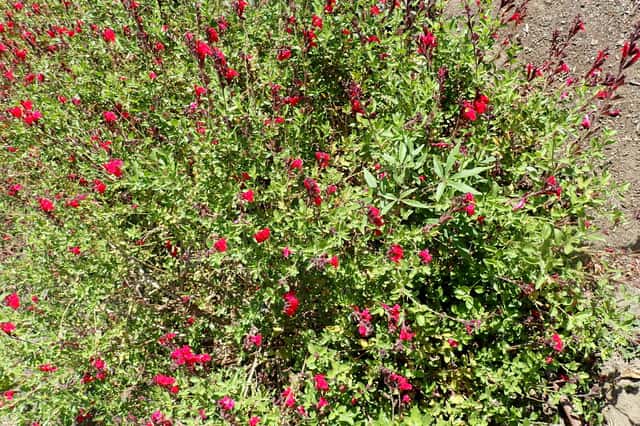
Salvia greggii is an aromatic subshrub in the mint family (Lamiaceae), native to a narrow band from southwest Texas through the Chihuahuan Desert to San Luis Potosí in Mexico, where it grows on rocky slopes at 1,500-2,700 m. It forms a bushy mound 50 cm to 1 m tall, with thin stems that turn woody at the base and small leaves, under 2.5 cm long, with a spicy scent. It flowers from spring to the first frosts, carrying spikes of two-lipped tubular flowers. Scarlet is the most common color in the wild, and forms and cultivars come in pink, magenta, purple, white and salmon.
How to Propagate Autumn sage?
Stem cuttings
Roots easily. Use softwood or basal cuttings in spring, or semi-ripe cuttings in late summer with bottom heat.
- 1 Take 8-10 cm tip cuttings from new or semi-ripe shoots, just below a node
- 2 Strip the leaves from the lower half
- 3 Dip the base in rooting hormone (optional)
- 4 Insert in a light, free-draining mix, keep it slightly moist and in bright, indirect light
Materials needed:
Seeds
Seedlings may vary in color because the species crosses readily with Salvia microphylla; propagate cultivars from cuttings to keep them true.
- 1 Sow on the surface of moist seed mix and cover very lightly
- 2 Keep warm and in bright light
- 3 Transplant seedlings once they have 2-3 pairs of leaves
Materials needed:
How Big Does Autumn sage Grow?
TLDR: Autumn sage can reach up to 1.0m tall with Medium growth rate.
Max height
1.0m
Spread
90cm
Growth rate
Medium
Foliage
Evergreen
Plant Uses
Ornamental
Great for decoration
Aromatic
Pleasant fragrance
Is your plant showing symptoms?
Click on the symptom to discover possible causes:
What Diseases Commonly Affect Autumn sage?
TLDR: Autumn sage is susceptible to 10 known diseases. Monitor regularly for early detection.
Powdery Mildew
Powdery mildew is a common fungal disease caused by various fungi species including Erysiphe, Podosphaera, Oïdium, and Leveillula. It affects over 10,000 plant species worldwide. The disease thrives in warm, dry climates with high humidity and appears as a distinctive white powdery coating on plant surfaces.
Root Rot
Root rot is a serious fungal disease that affects the root system of plants, causing them to decay and die. It is primarily caused by overwatering, poor drainage, or soil-borne fungi such as Pythium, Phytophthora, Rhizoctonia, and Fusarium. The disease thrives in waterlogged conditions where roots are deprived of oxygen, making them susceptible to fungal infection.
Crown Rot
Crown rot is a serious fungal disease that attacks the crown (base) of the plant where the stem meets the soil. It is caused by various fungal pathogens including Phytophthora, Fusarium, and Rhizoctonia. The disease thrives in waterlogged conditions and can quickly spread to kill the entire plant if not addressed promptly.
Verticillium Wilt
Verticillium wilt is a soil-borne fungal disease caused primarily by the fungi Verticillium dahliae and V. albo-atrum. These pathogens infect plant roots and grow within the vascular tissues, blocking water and nutrient transport, resulting in wilting and eventual plant death. The disease affects over 350 plant species including vegetables, fruits, ornamental flowers, and trees. The fungi can survive in soil for more than 10 years as resistant structures called microsclerotia.
Fun Facts
It is named after Josiah Gregg, a trader and naturalist who collected it in Texas; Asa Gray described it in 1870
Despite the name autumn sage, it blooms from spring until frost
It crosses naturally with Salvia microphylla; hybrids found in Mexico in 1991 were named Salvia × jamensis after the village of Jame
Frequently asked questions
How often should I water Salvia greggii?
When should I prune autumn sage?
Can Salvia greggii grow in a pot?
Is autumn sage toxic to cats and dogs?
Compare with similar plants
| Attribute | Difficulty | Light | Watering | Pet Safe |
|---|---|---|---|---|
| Field Maple | Easy | Bright indirect | 14d | ✓ |
| Iberian Houseleek | Easy | Direct sun | 14d | ✓ |
| Silver Birch | Easy | Direct sun | 14d | ✓ |
| Common Blanketflower | Easy | Direct sun | 10d | ✓ |
Choose & Compare
Sources & References
- NC State Extension Plant Toolbox - Salvia greggii (Autumn Sage)
- RHS - Salvia greggii (autumn sage)
- Salvia greggii - Wikipedia
- UC Master Gardeners - Small-leaf salvias (S. greggii vs S. microphylla)
- POWO - Salvia greggii A.Gray
- GBIF Backbone - Salvia greggii A.Gray (accepted)
- ASPCA - Sage (Salvia officinalis) non-toxic





