Crassulaceae
Baby Burro's Tail (Sedum burritum)
Sedum burritum
Give it bright light, let the soil dry out completely between waterings, and avoid handling the trailing stems -- the plump little leaves drop off very easily.
Every 14 days
Bright indirect
10° - 26°C
30% - 50%
Categories
What is Baby Burro's Tail?
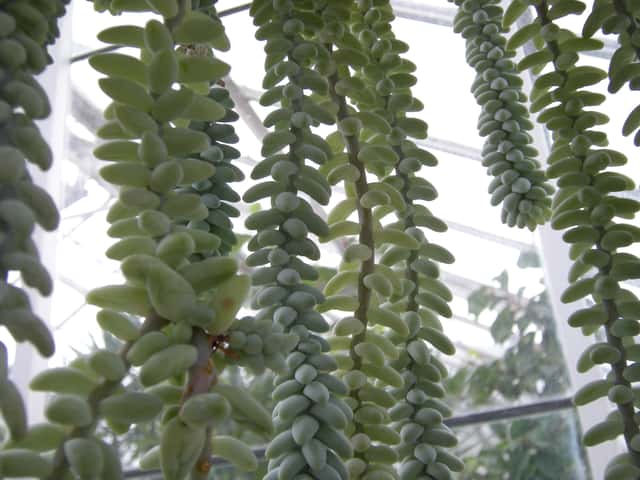
Baby Burro's Tail (Sedum burritum) is a easy-care plant from the Crassulaceae family. Baby Burro's Tail is a compact, trailing succulent in the Crassulaceae family, closely related to the larger Sedum morganianum. It forms dense ropes of tiny, plump, blue-green leaves that overlap like beads along pendulous stems, making it a favorite for hanging baskets and shelves where its foliage...
Baby Burro's Tail grows up to 15cm, spread of 60cm, watering every 14 days, 10°C – 26°C, 30–50% humidity. It is suitable for indoor environments and safe for pets.
Unlike many tropical plants, Baby Burro's Tail tolerates watering mistakes. Best for beginners. Unlike many popular species, Baby Burro's Tail is safe to keep around pets. Without adequate drainage, root rot can develop within 28 days.
How to Care for Baby Burro's Tail?
TLDR: Baby Burro's Tail needs Bright indirect, watering every 14 days, and temperatures between 10-26°C with 30-50% humidity.
How Often Should You Water Baby Burro's Tail?
Water deeply only when the soil is fully dry, roughly every 2 weeks in the growing season and even less in winter. Never let the pot sit in water.
How Much Light Does Baby Burro's Tail Need?
Provide bright, indirect light with a few hours of gentle direct morning sun; intense afternoon sun can scorch the leaves.
What Is the Best Soil for Baby Burro's Tail?
Use a fast-draining cactus or succulent mix, ideally amended with extra perlite or pumice.
What Pot Should You Use for Baby Burro's Tail?
Shallow, wide pot or hanging basket with drainage holes
Care Schedule
Fertilize
Every 45 days
Repot
Every 730 days
What Is Baby Burro's Tail and Where Does It Come From?
Baby Burro's Tail is a compact, trailing succulent in the Crassulaceae family, closely related to the larger Sedum morganianum. It forms dense ropes of tiny, plump, blue-green leaves that overlap like beads along pendulous stems, making it a favorite for hanging baskets and shelves where its foliage can cascade freely. Native to the arid regions of southern Mexico, it is extremely drought-tolerant and thrives on benign neglect, needing only bright light and infrequent, deep watering. Mature plants may produce small star-shaped pink to red flowers at the stem tips in summer. The leaves are delicate and detach easily at the slightest touch, so the plant is best kept somewhere it will not be brushed against.
How to Propagate Baby Burro's Tail?
Stem cutting
Handle the stems gently to avoid dropping the delicate leaves; fallen leaves can also be propagated.
- 1 Cut a healthy stem section about 5-10 cm long using clean, sharp scissors
- 2 Let the cut end callus over for 2-3 days in a dry, shaded spot
- 3 Lay the stem on top of well-draining succulent soil or insert the cut end lightly into the mix
- 4 Mist lightly and keep in bright, indirect light until roots form
Materials needed:
Leaf cutting
Only intact leaves with the full base will root; damaged leaves usually fail.
- 1 Gently twist a plump, healthy leaf off the stem, keeping it intact
- 2 Let the leaf callus over for 1-2 days
- 3 Place the leaf on top of dry succulent soil without burying it
- 4 Mist sparingly once small roots and a new rosette appear
Materials needed:
How Big Does Baby Burro's Tail Grow?
TLDR: Baby Burro's Tail can reach up to 15cm tall with Slow growth rate.
Max height
15cm
Spread
60cm
Growth rate
Slow
Foliage
Evergreen
Warning: Toxic Plant
This plant can be toxic if ingested. Keep out of reach of:
Plant Uses
Ornamental
Great for decoration
Is your plant showing symptoms?
Click on the symptom to discover possible causes:
What Diseases Commonly Affect Baby Burro's Tail?
TLDR: Baby Burro's Tail is susceptible to 12 known diseases. Monitor regularly for early detection.
Root Rot
Root rot is a serious fungal disease that affects the root system of plants, causing them to decay and die. It is primarily caused by overwatering, poor drainage, or soil-borne fungi such as Pythium, Phytophthora, Rhizoctonia, and Fusarium. The disease thrives in waterlogged conditions where roots are deprived of oxygen, making them susceptible to fungal infection.
Leaf Spot
Leaf spot is a common fungal disease caused by various pathogens including Alternaria, Ascochyta, Colletotrichum, Septoria, and Venturia. It primarily affects leaves, causing discolored spots that can lead to premature leaf drop if left untreated.
Grey Mould
Rust
Rust is a common fungal disease caused by fungi in the order Pucciniales that affects a wide variety of plants. The disease gets its name from the characteristic orange, yellow, or reddish-brown pustules that appear on leaves, resembling metal rust. This obligate fungal parasite requires living plants to survive and can cause significant economic losses in agricultural crops.
Meaning & Symbolism
The bead-like trailing stems symbolize resilience and abundance, thriving where little else can.
Fun Facts
Its plump leaves can each grow into an entirely new plant if they fall and root on their own
The trailing stems can reach up to 60 cm long over several years even though the plant stays low-growing
It is closely related to, and often confused with, the classic Burro's Tail, Sedum morganianum
Frequently asked questions
How often should I water Baby Burro's Tail?
Why are the leaves falling off my plant?
Is Baby Burro's Tail toxic to pets?
How do I propagate it?
Compare with similar plants
| Attribute | Difficulty | Light | Watering | Pet Safe |
|---|---|---|---|---|
| Field Maple | Easy | Bright indirect | 14d | ✓ |
| Silver Birch | Easy | Direct sun | 14d | ✓ |
| Common Blanketflower | Easy | Direct sun | 10d | ✓ |
| Cushion Bush | Easy | Direct sun | 14d | ✓ |
Choose & Compare
Sources & References
- Burro Tail: Ultimate Care And Growing Guide - Gardening Know How
- The COMPLETE Care-Guide for Burro Tail (Sedum morganianum/Burrito) - UK Houseplants
- Burro Tail Plant Care Guide - Almanac.com
- Notes on Sedum burrito Moran and S. morganianum E.Walther (Crassulaceae) and reinstatement of S. burrito - Bradleya
- Sedum morganianum - Wikipedia





