Bromeliaceae
Ball Moss (Tillandsia recurvata)
Tillandsia recurvata
An easy air plant that grows without soil. Give it bright indirect light, water by rinsing or soaking, and let it dry fully within 4 hours. Cold, stagnant damp makes it rot, and it cannot take frost.
Every 7 days
Bright indirect
10° - 29°C
% - %
Categories
What is Ball moss?
Ball moss (Tillandsia recurvata) is a easy-care plant from the Bromeliaceae family. Tillandsia recurvata is an epiphytic bromeliad in the family Bromeliaceae that clings to tree branches, fences and even power lines, from the warm southern United States down to northern Argentina and Chile. It forms gray balls from golf-ball to soccer-ball size, which are really many small plants j...
Ball moss grows up to watering every 7 days, 10°C – 29°C. It is suitable for indoor environments and safe for pets.
Unlike many tropical plants, Ball moss tolerates watering mistakes. Best for beginners. Unlike many popular species, Ball moss is safe to keep around pets. Without adequate drainage, root rot can develop within 14 days.
How to Care for Ball moss?
TLDR: Ball moss needs Bright indirect, watering every 7 days, and temperatures between 10-29°C with 40-70% humidity.
How Often Should You Water Ball moss?
Rinse under lukewarm running water twice a week, or soak for 20 to 60 minutes once a week. Then shake it, hang it upside down to drain and let it dry where air moves. Curled leaves mean it needs water; brown tips mean it has been too dry.
How Much Light Does Ball moss Need?
Bright, indirect light near an east- or west-facing window. Avoid strong summer sun and dark corners or north-facing windows (in the northern hemisphere).
What Is the Best Soil for Ball moss?
No soil. Attach it to wood, bark, cork or wire, or rest it in an open holder where air can circulate.
What Pot Should You Use for Ball moss?
No pot needed. Use open mounts (wood, cork, wire) or open containers; a closed terrarium holds too much moisture.
Care Schedule
Fertilize
Every 30 days
Misting
Every 3 days
What Is Ball moss and Where Does It Come From?
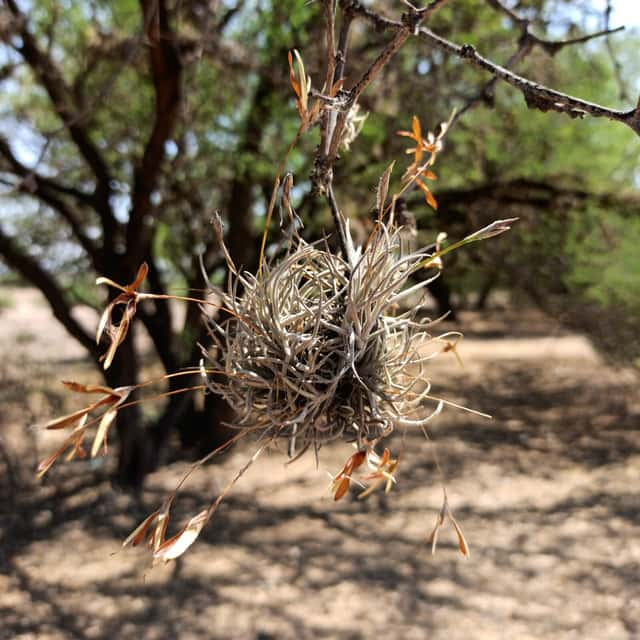
Tillandsia recurvata is an epiphytic bromeliad in the family Bromeliaceae that clings to tree branches, fences and even power lines, from the warm southern United States down to northern Argentina and Chile. It forms gray balls from golf-ball to soccer-ball size, which are really many small plants joined together. The leaves are thin (3 mm), covered in silvery scales and curved backward, up to 18 cm long. The flowers are small, pale violet to white. Despite its name it is not a moss, and it is not a parasite: it makes its own food, drinks the water that lands on its leaves and takes minerals from dust.
How to Propagate Ball moss?
Offsets (pups)
You can also leave the pups on: they build the full ball shape typical of the species.
- 1 Wait for the plant to flower; afterward it makes pups at its base
- 2 When a pup is about a third of the mother's size, gently pull or cut it off
- 3 Attach the pup to an airy mount and care for it like an adult
Materials needed:
Seed
Seedlings grow very slowly; separating pups is much faster.
- 1 Collect the hairy seeds when the capsule splits
- 2 Scatter them on bark or damp mesh
- 3 Mist often and keep in bright indirect light
Materials needed:
How Big Does Ball moss Grow?
TLDR: Ball moss can reach up to ?cm tall with Medium growth rate.
Foliage
Evergreen
Plant Uses
Ornamental
Great for decoration
Is your plant showing symptoms?
Click on the symptom to discover possible causes:
What Diseases Commonly Affect Ball moss?
TLDR: Ball moss is susceptible to 4 known diseases. Monitor regularly for early detection.
Crown Rot
Crown rot is a serious fungal disease that attacks the crown (base) of the plant where the stem meets the soil. It is caused by various fungal pathogens including Phytophthora, Fusarium, and Rhizoctonia. The disease thrives in waterlogged conditions and can quickly spread to kill the entire plant if not addressed promptly.
Overwatering
Overwatering occurs when plants receive too much water, depriving roots of oxygen and causing root rot. This environmental stress is one of the most common causes of houseplant death, as waterlogged soil prevents roots from breathing and functioning properly.
Underwatering
Underwatering or drought stress is a physiological disorder that occurs when the amount of water a plant loses through transpiration exceeds the amount its roots can absorb from the soil. This leads to cellular dehydration and various visible symptoms that can compromise plant health and productivity.
Cold Damage
Cold damage, also known as frost injury, occurs when plants are exposed to freezing or near-freezing temperatures. This environmental stress can cause cellular damage as ice crystals form within plant tissues, rupturing cells and disrupting normal plant functions. Chilling injury can also occur in sensitive species at temperatures between 32-55°F (0-10°C), even without actual freezing.
Fun Facts
Each ball is really a colony of small plants joined together.
Its seeds carry fine hairs and ride the wind until they snag on rough bark.
It even grows on power lines, since it takes nothing from what it sits on.
Frequently asked questions
Does ball moss kill trees?
How do I water ball moss indoors?
Does it need soil?
Why did my ball moss rot?
Compare with similar plants
| Attribute | Difficulty | Light | Watering | Pet Safe |
|---|---|---|---|---|
| Field Maple | Easy | Bright indirect | 14d | ✓ |
| Iberian Houseleek | Easy | Direct sun | 14d | ✓ |
| Silver Birch | Easy | Direct sun | 14d | ✓ |
| Common Blanketflower | Easy | Direct sun | 10d | ✓ |





