Pinaceae
Balsam Fir (Abies balsamea)
Abies balsamea
A cold-climate tree for large gardens: full sun to part shade, acidic, moist, well-drained soil and water in dry spells. It struggles with hot, humid summers, drought and urban pollution. Not a houseplant; as a cut Christmas tree it lasts a few weeks indoors.
Every 7 days
Bright indirect
-40° - °C
% - %
Categories
What is Balsam fir?
Balsam fir (Abies balsamea) is a medium-care plant from the Pinaceae family. Abies balsamea is an evergreen conifer of eastern and central Canada and the northeastern United States, from Newfoundland to Alberta and from the Great Lakes down the Appalachians. It usually grows 14-20 m tall, rarely close to 30 m, with a narrow, spire-shaped crown. The flat needles are 1.5-2.5 c...
Balsam fir grows up to 20.0m, spread of 750cm, watering every 7 days. It is not suitable for indoor environments and not safe for pets.
Without precautions, ingestion can cause irritation in pets. Keep out of reach of cats and dogs.
How to Care for Balsam fir?
TLDR: Balsam fir needs Bright indirect, watering every 7 days, and temperatures between -40-30°C with 40-70% humidity.
How Often Should You Water Balsam fir?
For the first 2-3 years, water deeply once a week in dry weather. Once established, rain is usually enough in cool climates. A bark mulch keeps the shallow roots moist.
How Much Light Does Balsam fir Need?
Full sun to part shade. Young trees take a lot of shade; mature trees grow denser and fuller in sun. In warm regions, afternoon shade helps.
What Is the Best Soil for Balsam fir?
Acidic soil (pH 4-6.5), rich in organic matter, moist and well-drained. Tolerates wet ground but not chalky, dry or compacted soil.
What Pot Should You Use for Balsam fir?
Not a container tree. Dwarf cultivars such as 'Nana' and 'Hudson' (about 1 m) can live a few years in a large terracotta pot with drainage, outdoors in a cool spot.
What Is Balsam fir and Where Does It Come From?
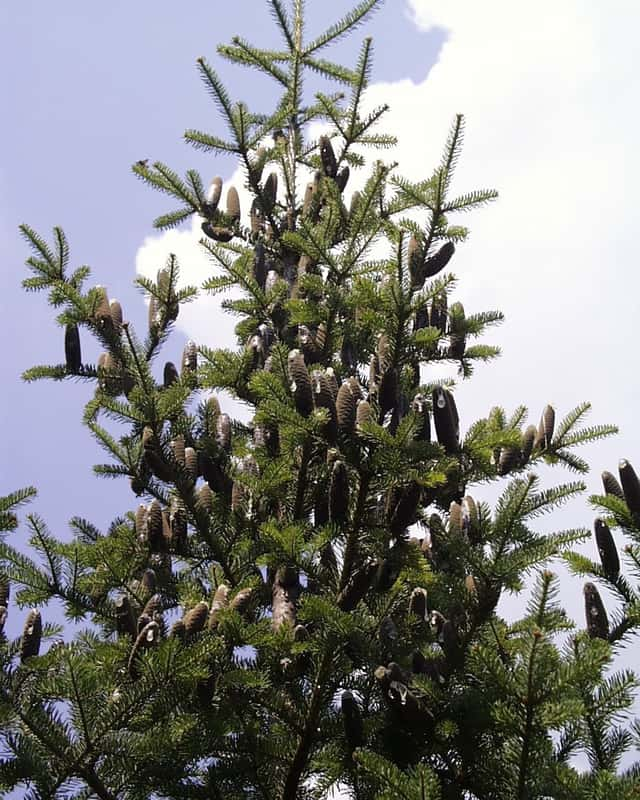
Abies balsamea is an evergreen conifer of eastern and central Canada and the northeastern United States, from Newfoundland to Alberta and from the Great Lakes down the Appalachians. It usually grows 14-20 m tall, rarely close to 30 m, with a narrow, spire-shaped crown. The flat needles are 1.5-2.5 cm long, dark green above with two pale bands beneath, and release a strong resin scent when crushed. The smooth bark carries resin blisters. The cones stand upright on the branches, dark purple when young and brown when ripe, and break apart on the tree in September. It is one of the most cold-hardy trees known, surviving about -45 °C. Prized as a Christmas tree and for wreaths because its scent lasts, it is the source of Canada balsam resin. It is the provincial tree of New Brunswick.
How to Propagate Balsam fir?
Seed
Young seedlings grow slowly and like part shade, which protects them from hot sun and drought.
- 1 Pick cones in late summer, before they shatter on the tree, and dry them until the seeds drop
- 2 Mix the seed with damp sand and chill in the fridge for 4-8 weeks
- 3 Sow shallowly in spring in acidic, well-drained mix
- 4 Keep in part shade and moist for the first year; transplant at 2-3 years
Materials needed:
How Big Does Balsam fir Grow?
TLDR: Balsam fir can reach up to 20.0m tall with Medium growth rate.
Max height
20.0m
Spread
7.5m
Foliage
Evergreen
Warning: Toxic Plant
This plant can be toxic if ingested. Keep out of reach of:
Plant Uses
Ornamental
Great for decoration
Aromatic
Pleasant fragrance
Medicinal
Medicinal properties
Medicinal Uses
- The resin (Canada balsam) was a traditional remedy for colds and coughs
- Many Native American peoples used the resin and needles in home remedies
Culinary Uses
- Young needles contain vitamin C and have been brewed as tea
- The Innu grated and ate the inner bark
Is your plant showing symptoms?
Click on the symptom to discover possible causes:
What Diseases Commonly Affect Balsam fir?
TLDR: Balsam fir is susceptible to 8 known diseases. Monitor regularly for early detection.
Caterpillars
Caterpillars are the larval stage of moths and butterflies that feed voraciously on plant foliage, stems, flowers, and fruits. Common species include cabbage loopers, tomato hornworms, armyworms, and cutworms. These pests can cause extensive damage by consuming large amounts of plant tissue in a short time. They vary in size from small (1/4 inch) to large (5 inches), with colors ranging from green to brown, often featuring stripes or spots. Caterpillars are highly mobile and can quickly spread throughout gardens, making them one of the most destructive common pests.
sap-sucking pests
Group of pests including aphids and scales, feeding on sugary sap on leaves, twigs, and branches. These pests often produce honeydew, which can later be infected by a fungal disease
Aphids
Aphids are small, soft-bodied, pear-shaped insects (1/16 to 1/8 inch long) that feed by sucking nutrient-rich sap from plants. They reproduce rapidly and can quickly weaken plants, causing distorted growth and transmitting plant viruses. Aphids come in various colors including green, black, red, yellow, brown, and gray. They secrete honeydew, a sticky substance that attracts ants and encourages sooty mold growth.
Scale Insects
Scale insects are small sap-sucking pests that appear as brown, shell-like bumps on plant stems and leaves. There are over 25 species, divided into armored (hard) and unarmored (soft) scales. They feed by piercing plant tissue and extracting sap, which weakens the plant and can lead to yellowing, stunted growth, and even death if left untreated. They also excrete honeydew, which attracts ants and promotes sooty mold growth.
Meaning & Symbolism
Provincial tree of New Brunswick and one of the classic Christmas trees of North America, valued for a scent that lasts for weeks.
Fun Facts
In tests it survived being dipped in liquid nitrogen at -196 °C.
Its resin, Canada balsam, was long used to glue lenses and mount microscope slides.
It served as the US Capitol Christmas Tree six times between 1964 and 2019.
Frequently asked questions
Will balsam fir grow in a warm climate?
Is balsam fir toxic to cats and dogs?
How do I keep a cut balsam fir fresh?
What is its main pest?
Compare with similar plants
| Attribute | Difficulty | Light | Watering | Pet Safe |
|---|---|---|---|---|
| Dark Fieldcap | Medium | Low light | 2d | ⚠️ |
| Azalea | Medium | Partial shade | 3d | ⚠️ |
| Muriel's Bamboo | Medium | Partial shade | 3d | ✓ |
| Bougainvillea | Medium | Direct sun | 7d | ⚠️ |
Choose & Compare
Sources & References
- Wikipedia - Abies balsamea
- Brooklyn Botanic Garden - Balsam fir
- University of Minnesota Extension - Balsam fir
- NC State Extension Gardener Plant Toolbox - Abies balsamea
- University of Alaska Fairbanks Cooperative Extension - Abies balsamea cultivar profile
- The Ferret - Are Christmas trees toxic to pets? (fact check)




