Begoniaceae
Bearded Begonia (Begonia hirtella)
Begonia hirtella
An easy, fast-growing plant: bright indirect light or partial shade, a light, moist but well-draining mix, medium to high humidity and 15-30 °C. It is short-lived and renews itself from its own seed.
Every 4 days
Partial shade
15° - 30°C
50% - 80%
Categories
What is Bearded Begonia?
Bearded Begonia (Begonia hirtella) is a easy-care plant from the Begoniaceae family. Begonia hirtella is a small, succulent herb in the Begoniaceae family, native to South America (including southern and southeastern Brazil, Bolivia, Colombia, Peru, Venezuela) and Jamaica. Its red-tinged stems, 10-60 cm tall, and lopsided pale green leaves are covered in fine white hairs. It bears t...
Bearded Begonia grows up to 60cm, watering every 4 days, 15°C – 30°C, 50–80% humidity. It is suitable for indoor environments and not safe for pets.
Unlike many tropical plants, Bearded Begonia tolerates watering mistakes. Best for beginners. Without precautions, ingestion can cause irritation in pets. Keep out of reach of cats and dogs. Without adequate drainage, root rot can develop within 8 days.
How to Care for Bearded Begonia?
TLDR: Bearded Begonia needs Partial shade, watering every 4 days, and temperatures between 15-30°C with 50-80% humidity.
How Often Should You Water Bearded Begonia?
Water when the top 1 cm of mix is dry, usually every 3-5 days in warm weather. Keep the soil lightly moist, never soggy, and water the soil rather than the hairy leaves.
How Much Light Does Bearded Begonia Need?
Prefers partial shade or bright indirect light. Strong direct sun scorches the thin leaves; too much shade makes it leggy with few flowers.
What Is the Best Soil for Bearded Begonia?
Use a light, humus-rich, well-draining mix (potting soil with coir or peat and perlite), slightly acidic at pH 5.5-6.5.
What Pot Should You Use for Bearded Begonia?
A small to medium plastic or ceramic pot with drainage holes; shallow pots suit its fine roots.
Care Schedule
Fertilize
Every 30 days
What Is Bearded Begonia and Where Does It Come From?
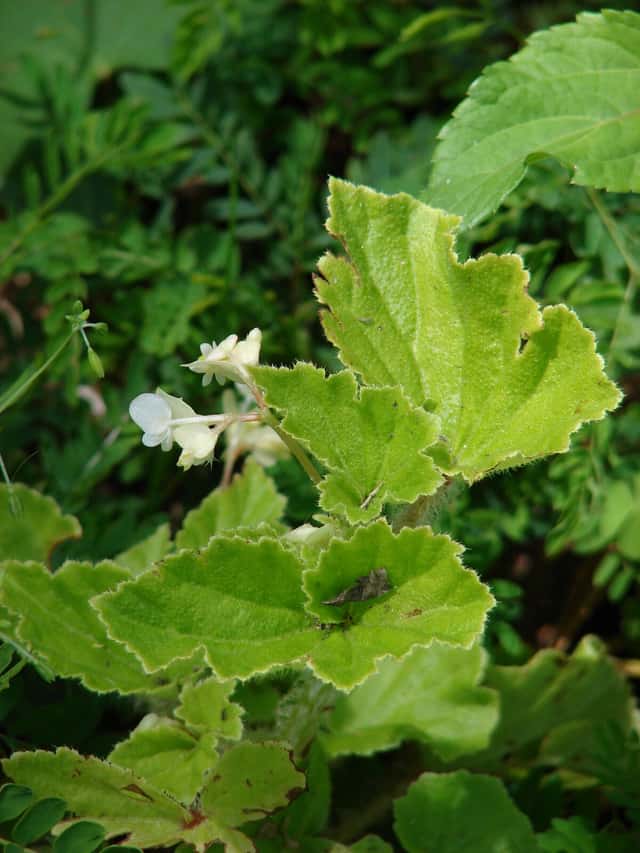
Begonia hirtella is a small, succulent herb in the Begoniaceae family, native to South America (including southern and southeastern Brazil, Bolivia, Colombia, Peru, Venezuela) and Jamaica. Its red-tinged stems, 10-60 cm tall, and lopsided pale green leaves are covered in fine white hairs. It bears tiny, nodding white flowers nearly all year and winged seed capsules full of dust-like seeds, so it self-sows freely.
How to Propagate Bearded Begonia?
Seed
The plant self-sows: often you can simply transplant the seedlings that pop up in nearby pots.
- 1 Sprinkle the dust-fine seeds on moist mix without covering them
- 2 Cover the container with clear plastic to hold humidity
- 3 Keep in bright light without direct sun at 20-25 °C
- 4 Prick out seedlings once they have 2-3 leaves
Materials needed:
Stem cutting
Use clean scissors and avoid overwatering so the succulent stem does not rot.
- 1 Cut a healthy shoot with 2-3 leaves
- 2 Remove the lower leaves
- 3 Place in water or moist mix
- 4 Keep in a bright, humid spot until roots form
Materials needed:
How Big Does Bearded Begonia Grow?
TLDR: Bearded Begonia can reach up to 60cm tall with Fast growth rate.
Max height
60cm
Growth rate
Fast
Foliage
Evergreen
Warning: Toxic Plant
This plant can be toxic if ingested. Keep out of reach of:
Plant Uses
Ornamental
Great for decoration
Medicinal
Medicinal properties
Medicinal Uses
- Leaf juice is applied to the skin in folk use to relieve itching from insect bites
Is your plant showing symptoms?
Click on the symptom to discover possible causes:
What Diseases Commonly Affect Bearded Begonia?
TLDR: Bearded Begonia is susceptible to 7 known diseases. Monitor regularly for early detection.
Root Rot
Root rot is a serious fungal disease that affects the root system of plants, causing them to decay and die. It is primarily caused by overwatering, poor drainage, or soil-borne fungi such as Pythium, Phytophthora, Rhizoctonia, and Fusarium. The disease thrives in waterlogged conditions where roots are deprived of oxygen, making them susceptible to fungal infection.
Gray Mold (Botrytis Blight)
Gray mold, caused by the fungus Botrytis cinerea, is a widespread necrotrophic pathogen affecting over 1,400 plant species. It thrives in cool, humid conditions and attacks weakened or aging plant tissues, causing soft rot and characteristic gray fuzzy growth.
Powdery Mildew
Powdery mildew is a common fungal disease caused by various fungi species including Erysiphe, Podosphaera, Oïdium, and Leveillula. It affects over 10,000 plant species worldwide. The disease thrives in warm, dry climates with high humidity and appears as a distinctive white powdery coating on plant surfaces.
Bacterial Leaf Spot
Bacterial leaf spot is a plant disease caused by bacteria in the Xanthomonas and Pseudomonas genera that affects various ornamental and edible plants. The bacteria infect leaves through wounds or natural openings, causing characteristic lesions that can lead to premature leaf drop and plant weakening.
Fun Facts
It can flower when only about 3 cm tall
It was described in 1822 by German botanist Johann Heinrich Friedrich Link from Brazilian material
Outside South America it has naturalised in many tropical places, including Hawaii, Singapore and north-eastern Australia
Frequently asked questions
How often should I water Begonia hirtella?
Is Begonia hirtella toxic to cats and dogs?
Why are begonia seedlings appearing in my other pots?
Does the bearded begonia like sun?
Compare with similar plants
| Attribute | Difficulty | Light | Watering | Pet Safe |
|---|---|---|---|---|
| Field Maple | Easy | Bright indirect | 14d | ✓ |
| Iberian Houseleek | Easy | Direct sun | 14d | ✓ |
| Silver Birch | Easy | Direct sun | 14d | ✓ |
| Common Blanketflower | Easy | Direct sun | 10d | ✓ |
Choose & Compare
Sources & References
- Begonia hirtella - Wikipedia
- NParks Flora & Fauna Web - Begonia hirtella
- HortFlora (RBG Victoria) - Begonia hirtella Link
- Australian Tropical Rainforest Plants - Begonia hirtella
- Jardim Botanico UTAD - Begonia hirtella
- ASPCA - Begonia (toxic plants)
- Penn State Extension - Begonia Diseases
- Clemson HGIC - Begonia
- GBIF Backbone - Begonia hirtella Link (accepted)