Davalliaceae
Bear's Foot Fern: Complete Care Guide
Davallia tyermanii
Grow in bright indirect light with good humidity, in an airy, fast-draining mix. Let the top of the mix dry slightly between waterings and never bury or soak the furry rhizomes.
Every 7 days
Partial shade
10° - °C
50% - 80%
Categories
What is Bear's Foot Fern?
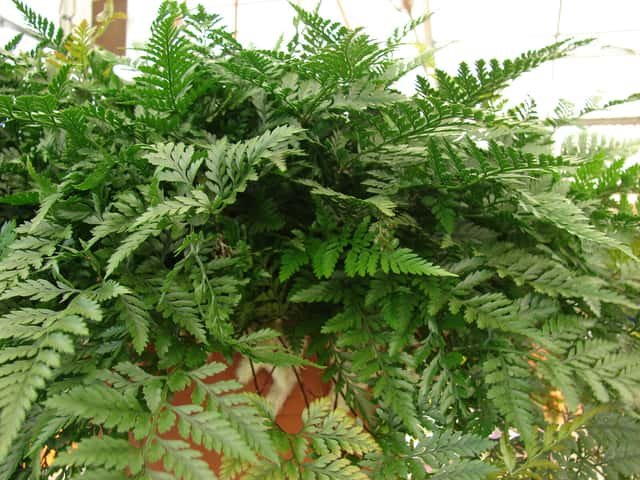
Bear's Foot Fern (Davallia tyermanii) is a easy-care plant from the Davalliaceae family. Bear's foot fern (Davallia tyermanii, syn. Humata tyermanii) is a small epiphytic fern from southern China, northern Myanmar and Taiwan. Its finely divided, lacy green fronds, up to about 30 cm long, grow from furry, silvery-white rhizomes that creep over the soil and spill down the sides of the pot...
Bear's Foot Fern grows up to 30cm, spread of 60cm, watering every 7 days, 50–80% humidity. It is suitable for indoor environments and safe for pets.
Unlike many tropical plants, Bear's Foot Fern tolerates watering mistakes. Best for beginners. Unlike many popular species, Bear's Foot Fern is safe to keep around pets. Without adequate drainage, root rot can develop within 14 days.
How to Care for Bear's Foot Fern?
TLDR: Bear's Foot Fern needs Partial shade, watering every 7 days, and temperatures between 10-30°C with 50-80% humidity.
How Often Should You Water Bear's Foot Fern?
Water when the top 2-3 cm of the mix starts to dry, roughly once a week. Keep it lightly moist but never soggy, and water the mix rather than the rhizomes. Reduce watering in winter.
How Much Light Does Bear's Foot Fern Need?
Moderate to bright indirect light. Keep it out of direct midday sun, which scorches the fronds; a few metres from a bright window is ideal.
What Is the Best Soil for Bear's Foot Fern?
A loose, airy, well-draining mix such as orchid bark with peat or coir and perlite. Plant the rhizomes on the surface, not buried.
What Pot Should You Use for Bear's Foot Fern?
Shallow pot or hanging basket with drainage, which lets the rhizomes creep over the edges; also grows mounted on cork or wood
Care Schedule
Fertilize
Every 30 days
Misting
Every 3 days
Rotate
Every 14 days
Repot
Every 730 days
What Is Bear's Foot Fern and Where Does It Come From?
Bear's foot fern (Davallia tyermanii, syn. Humata tyermanii) is a small epiphytic fern from southern China, northern Myanmar and Taiwan. Its finely divided, lacy green fronds, up to about 30 cm long, grow from furry, silvery-white rhizomes that creep over the soil and spill down the sides of the pot like little animal paws. It is a popular hanging-basket and shelf plant.
How to Propagate Bear's Foot Fern?
Rhizome division
A clear bag or propagation box keeps humidity high while the division establishes.
- 1 Cut a 5-8 cm piece of rhizome that has at least one frond or growing tip
- 2 Pin it onto the surface of moist, airy potting mix with a bent wire
- 3 Do not bury the rhizome
- 4 Keep warm and humid in bright indirect light until new roots anchor it
Materials needed:
Spores
Slow and best for patient growers; rhizome division is much faster.
- 1 Collect ripe spores from the underside of a mature frond on paper
- 2 Sprinkle them on sterile, moist peat-based mix
- 3 Cover to keep humidity near 100% and place in indirect light
- 4 Transplant the small ferns once they are a few centimetres tall
Materials needed:
How Big Does Bear's Foot Fern Grow?
TLDR: Bear's Foot Fern can reach up to 30cm tall with Medium growth rate.
Max height
30cm
Spread
60cm
Growth rate
Medium
Foliage
Evergreen
Plant Uses
Ornamental
Great for decoration
Is your plant showing symptoms?
Click on the symptom to discover possible causes:
What Diseases Commonly Affect Bear's Foot Fern?
TLDR: Bear's Foot Fern is susceptible to 5 known diseases. Monitor regularly for early detection.
Root Rot
Root rot is a serious fungal disease that affects the root system of plants, causing them to decay and die. It is primarily caused by overwatering, poor drainage, or soil-borne fungi such as Pythium, Phytophthora, Rhizoctonia, and Fusarium. The disease thrives in waterlogged conditions where roots are deprived of oxygen, making them susceptible to fungal infection.
Low Humidity Stress
Low humidity stress occurs when indoor air becomes too dry, causing plants to lose moisture faster than they can absorb it through their roots. This is especially common during winter heating periods, near radiators and heating vents, or in air-conditioned spaces. Tropical plants are particularly susceptible to low humidity damage.
Chemical Burn
Chemical burn (phytotoxicity) occurs when plants are damaged by misapplication or misuse of pesticides, herbicides, fertilizers, or other chemicals. Environmental conditions like high temperatures, humidity, and plant stress increase vulnerability. Unlike diseases, chemical damage is not contagious but can severely harm or kill plants if not addressed promptly.
Scale Insects
Scale insects are small sap-sucking pests that appear as brown, shell-like bumps on plant stems and leaves. There are over 25 species, divided into armored (hard) and unarmored (soft) scales. They feed by piercing plant tissue and extracting sap, which weakens the plant and can lead to yellowing, stunted growth, and even death if left untreated. They also excrete honeydew, which attracts ants and promotes sooty mold growth.
Meaning & Symbolism
Associated with good luck because its furry rhizomes look like a lucky rabbit's foot.
Fun Facts
The correct spelling is tyermanii, but it is often sold as Davallia tyermannii or Humata tyermanii.
In nature it grows on mossy tree trunks and rocks, taking water from rain and humid air.
Its rhizomes can grow down the outside of the pot and cover it completely.
Frequently asked questions
Should I bury the furry rhizomes?
How often should I water Davallia tyermanii?
Is bear's foot fern safe for cats and dogs?
Why are the fronds turning brown?
Compare with similar plants
| Attribute | Difficulty | Light | Watering | Pet Safe |
|---|---|---|---|---|
| Field Maple | Easy | Bright indirect | 14d | ✓ |
| Iberian Houseleek | Easy | Direct sun | 14d | ✓ |
| Silver Birch | Easy | Direct sun | 14d | ✓ |
| Common Blanketflower | Easy | Direct sun | 10d | ✓ |





