Euphorbiaceae
Bellyache bush
Jatropha gossypiifolia
It copes with almost anything: sun, drought and poor soil. The real care point is safety. The whole plant is toxic, so keep it away from children, dogs, cats and livestock, and wear gloves when pruning because of the sap. It sets a lot of seed and is a declared weed in several places, including Australia, so pick the capsules before they split.
Every 10 days
Direct sun
° - °C
% - %
Categories
What is Bellyache bush?
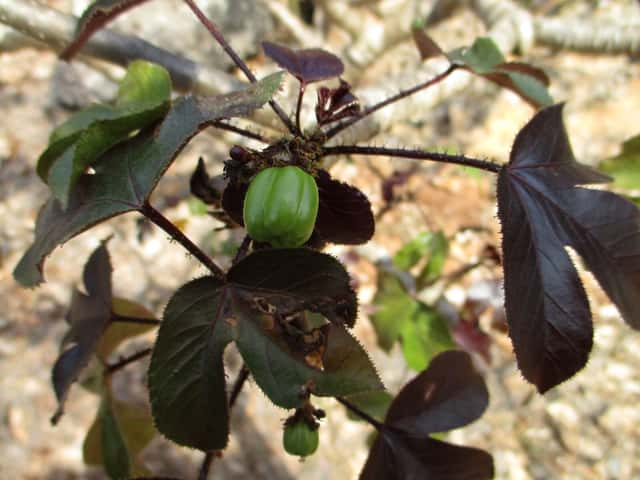
Bellyache bush (Jatropha gossypiifolia) is a easy-care plant from the Euphorbiaceae family. Bellyache bush is a shrub in the spurge family (Euphorbiaceae), native to tropical America and now found throughout the tropics. It grows fast to 2–3 m, occasionally 4 m. The three-lobed leaves are purple and sticky when young and turn green with age, and the leaf stalks carry coarse, sticky hairs....
Bellyache bush grows up to 4.0m, watering every 10 days. It is not suitable for indoor environments and not safe for pets.
Unlike many tropical plants, Bellyache bush tolerates watering mistakes. Best for beginners. Without precautions, ingestion can cause irritation in pets. Keep out of reach of cats and dogs.
How to Care for Bellyache bush?
TLDR: Bellyache bush needs Direct sun, watering every 10 days, and temperatures between 15-30°C with 40-70% humidity.
How Often Should You Water Bellyache bush?
Water regularly only for the first few months. Once established it handles drought well, dropping its leaves and regrowing when rain returns. In a pot, water when the soil is dry, roughly every 10 days in hot weather.
How Much Light Does Bellyache bush Need?
Give it an open, sunny spot, where it stays more compact and the leaves colour better.
What Is the Best Soil for Bellyache bush?
Not fussy: it grows in a wide range of soils. Just avoid ground that stays waterlogged.
What Pot Should You Use for Bellyache bush?
A large, heavy pot with drainage holes; it does better in the ground. Keep it out of reach of children and pets.
What Is Bellyache bush and Where Does It Come From?
Bellyache bush is a shrub in the spurge family (Euphorbiaceae), native to tropical America and now found throughout the tropics. It grows fast to 2–3 m, occasionally 4 m. The three-lobed leaves are purple and sticky when young and turn green with age, and the leaf stalks carry coarse, sticky hairs. Small dark red flowers with yellow centres appear in clusters, followed by cherry-sized capsules that split open and throw out 2 or 3 seeds. Every part of the plant is poisonous, the seeds most of all, and the sap irritates skin. It drops its leaves in the dry season.
How to Propagate Bellyache bush?
Seed
The seeds are the most poisonous part: handle them with gloves and store them away from children and pets. Do not sow near bushland or pasture, as the plant spreads.
- 1 Wearing gloves, pick ripe capsules before they split
- 2 Let them dry in a paper bag until the seeds drop out
- 3 Sow 1–2 cm deep in free-draining mix
- 4 Keep moist and warm until they germinate
Materials needed:
How Big Does Bellyache bush Grow?
TLDR: Bellyache bush can reach up to 4.0m tall with Fast growth rate.
Max height
4.0m
Growth rate
Fast
Foliage
Deciduous
Warning: Toxic Plant
This plant can be toxic if ingested. Keep out of reach of:
Plant Uses
Ornamental
Great for decoration
Medicinal
Medicinal properties
Medicinal Uses
- Used in folk medicine as an anti-inflammatory, for wound healing and for high blood pressure, but the plant is toxic and these uses are not proven safe
Is your plant showing symptoms?
Click on the symptom to discover possible causes:
What Diseases Commonly Affect Bellyache bush?
TLDR: Bellyache bush is susceptible to 3 known diseases. Monitor regularly for early detection.
Rust
Rust is a common fungal disease caused by fungi in the order Pucciniales that affects a wide variety of plants. The disease gets its name from the characteristic orange, yellow, or reddish-brown pustules that appear on leaves, resembling metal rust. This obligate fungal parasite requires living plants to survive and can cause significant economic losses in agricultural crops.
leaf miners
Larval stages of leaf-mining insects are feeding on the leaf tissue of plants, building little tunnels under the leaf surface.
Powdery Mildew
Powdery mildew is a common fungal disease caused by various fungi species including Erysiphe, Podosphaera, Oïdium, and Leveillula. It affects over 10,000 plant species worldwide. The disease thrives in warm, dry climates with high humidity and appears as a distinctive white powdery coating on plant surfaces.
Fun Facts
The capsules burst open as they dry and fling the seeds away from the plant
In Australia it is a declared weed and has killed cattle, goats and horses
Frequently asked questions
Is bellyache bush poisonous?
Why did my bellyache bush drop its leaves?
Can I use it as a herbal remedy?
Does it spread?
Compare with similar plants
| Attribute | Difficulty | Light | Watering | Pet Safe |
|---|---|---|---|---|
| Field Maple | Easy | Bright indirect | 14d | ✓ |
| Iberian Houseleek | Easy | Direct sun | 14d | ✓ |
| Silver Birch | Easy | Direct sun | 14d | ✓ |
| Common Blanketflower | Easy | Direct sun | 10d | ✓ |
Choose & Compare
Sources & References
- Jatropha gossypiifolia (Wikipedia)
- Jatropha gossypiifolia (Wikipedia ES)
- Bellyache bush (NSW WeedWise)
- Bellyache bush (Queensland Poisons Information Centre)
- Jatropha gossypiifolia (Plant Pono / HPWRA)
- Biological control of bellyache bush (MLA)
- Jatropha gossypiifolia: entre o terapêutico e o tóxico (Rev. Bras. Plantas Med.)





