Bromeliaceae
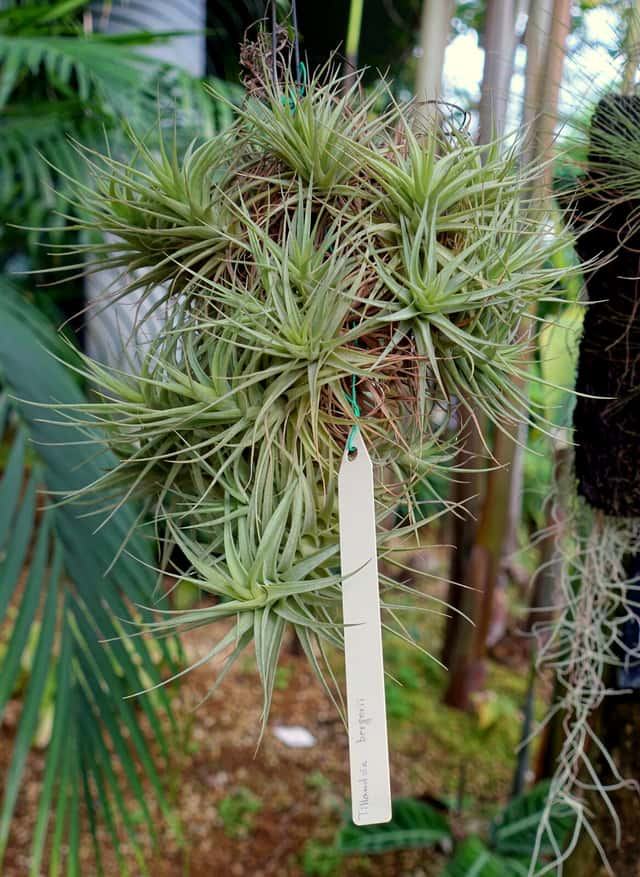
Berger's Airplant (Tillandsia bergeri)
Tillandsia bergeri
An easy, cold-tolerant air plant: bright light without harsh midday summer sun, soak or mist about once a week, fast drying and good airflow. It produces pups all year and clumps up quickly.
Every 7 days
Bright indirect
-5° - 32°C
40% - 70%
Categories
What is Berger's Airplant?
Berger's Airplant (Tillandsia bergeri) is a easy-care plant from the Bromeliaceae family. Tillandsia bergeri is an epiphytic and rock-dwelling bromeliad in the family Bromeliaceae, native to southern Brazil (Rio Grande do Sul), Uruguay and Argentina down to Buenos Aires, where it grows on trees and granite cliffs. It forms dense clumps of rosettes with narrow, grey-green, scaly leaves up...
Berger's Airplant grows up to 18cm, watering every 7 days, -5°C – 32°C, 40–70% humidity. It is suitable for indoor environments and safe for pets.
Unlike many tropical plants, Berger's Airplant tolerates watering mistakes. Best for beginners. Unlike many popular species, Berger's Airplant is safe to keep around pets. Without adequate drainage, root rot can develop within 14 days.
How to Care for Berger's Airplant?
TLDR: Berger's Airplant needs Bright indirect, watering every 7 days, and temperatures between -5-32°C with 40-70% humidity.
How Often Should You Water Berger's Airplant?
Soak the plant in chlorine-free water (rain, filtered or distilled) for 20 to 30 minutes once a week, or mist thoroughly 2 to 3 times a week. Water more often in dry air or heat. Shake off the excess and let it dry upside down within about 4 hours: water trapped between the leaves rots the centre.
How Much Light Does Berger's Airplant Need?
Likes plenty of light. Indoors, keep it near a bright window; outdoors, give it morning sun and light shade in the hottest hours of summer. Low light leaves it soft and flowerless.
What Is the Best Soil for Berger's Airplant?
No soil. Tie it to wood, cork or stone with nylon line or wire (never glue), or set it loose in an airy holder.
What Pot Should You Use for Berger's Airplant?
No pot needed. It does best mounted on wood, cork or stone, or hung from wire, always somewhere airy where it dries quickly after watering.
Care Schedule
Fertilize
Every 30 days
What Is Berger's Airplant and Where Does It Come From?
Tillandsia bergeri is an epiphytic and rock-dwelling bromeliad in the family Bromeliaceae, native to southern Brazil (Rio Grande do Sul), Uruguay and Argentina down to Buenos Aires, where it grows on trees and granite cliffs. It forms dense clumps of rosettes with narrow, grey-green, scaly leaves up to 14 cm long. In spring it produces a short spike of rose-pink bracts with pale lilac flowers with wavy petals. It needs no soil: it takes up water and nutrients through its leaves.
How to Propagate Berger's Airplant?
Pups (offsets)
You can also leave the pups attached: the clump looks better and flowers all together.
- 1 Wait until the pup is one third to half the size of the mother plant
- 2 Hold the base of the pup and twist gently until it comes away
- 3 Mount the pup on wood or cork
- 4 Water it like an adult plant
Materials needed:
Clump division
Do it after flowering, while the plant is in active growth.
- 1 Pull the clump apart by hand into groups of 3 to 5 rosettes
- 2 Remove dry leaves from the base
- 3 Mount each group on its own support
Materials needed:
How Big Does Berger's Airplant Grow?
TLDR: Berger's Airplant can reach up to 18cm tall with Medium growth rate.
Max height
18cm
Growth rate
Medium
Foliage
Evergreen
Plant Uses
Ornamental
Great for decoration
Is your plant showing symptoms?
Click on the symptom to discover possible causes:
What Diseases Commonly Affect Berger's Airplant?
TLDR: Berger's Airplant is susceptible to 7 known diseases. Monitor regularly for early detection.
Crown Rot
Crown rot is a serious fungal disease that attacks the crown (base) of the plant where the stem meets the soil. It is caused by various fungal pathogens including Phytophthora, Fusarium, and Rhizoctonia. The disease thrives in waterlogged conditions and can quickly spread to kill the entire plant if not addressed promptly.
Overwatering
Overwatering occurs when plants receive too much water, depriving roots of oxygen and causing root rot. This environmental stress is one of the most common causes of houseplant death, as waterlogged soil prevents roots from breathing and functioning properly.
Underwatering
Underwatering or drought stress is a physiological disorder that occurs when the amount of water a plant loses through transpiration exceeds the amount its roots can absorb from the soil. This leads to cellular dehydration and various visible symptoms that can compromise plant health and productivity.
Low Humidity Stress
Low humidity stress occurs when indoor air becomes too dry, causing plants to lose moisture faster than they can absorb it through their roots. This is especially common during winter heating periods, near radiators and heating vents, or in air-conditioned spaces. Tropical plants are particularly susceptible to low humidity damage.
Fun Facts
In the wild it grows on granite cliffs near Buenos Aires
Unlike many tillandsias, it puts out pups all year without waiting to flower
It is often sold as Tillandsia aeranthos 'Bergeri', but it is a separate species
Frequently asked questions
How often should I water Tillandsia bergeri?
Is Tillandsia bergeri cold hardy?
Does Tillandsia bergeri need soil?
Is Tillandsia bergeri toxic to cats?
Compare with similar plants
| Attribute | Difficulty | Light | Watering | Pet Safe |
|---|---|---|---|---|
| Field Maple | Easy | Bright indirect | 14d | ✓ |
| Iberian Houseleek | Easy | Direct sun | 14d | ✓ |
| Silver Birch | Easy | Direct sun | 14d | ✓ |
| Common Blanketflower | Easy | Direct sun | 10d | ✓ |





