Piperaceae
Black Pepper (Piper nigrum)
Piper nigrum
A tropical climber that needs warmth (ideally 23-32 C, never below about 12 C), a support to climb, light shade or filtered sun, and evenly moist but well-drained, humus-rich acidic soil. In cool climates grow it in a large pot indoors or in a greenhouse.
Every 4 days
Partial shade
12° - 35°C
% - %
Categories
What is Black pepper?
Black pepper (Piper nigrum) is a medium-care plant from the Piperaceae family. Piper nigrum is the plant behind the peppercorn: a perennial evergreen vine from the warm, wet forests of South and Southeast Asia, native to the Western Ghats of India. It climbs trees, posts or trellises with small roots along the stems and can reach 10 m in the wild, though farmers keep it at 3-4...
Black pepper grows up to 10.0m, watering every 4 days, 12°C – 35°C. It is suitable for indoor environments and safe for pets.
Unlike many popular species, Black pepper is safe to keep around pets. Without adequate drainage, root rot can develop within 8 days.
How to Care for Black pepper?
TLDR: Black pepper needs Partial shade, watering every 4 days, and temperatures between 12-35°C with 40-70% humidity.
How Often Should You Water Black pepper?
Keep the soil evenly moist, watering when the surface starts to dry, roughly every few days in warm weather. Never leave it waterlogged: in wet, airless soil Phytophthora root and foot rot can kill a vine within days. Water less in cool weather.
How Much Light Does Black pepper Need?
Light shade or bright filtered light. Young vines need protection from strong direct sun; mature vines tolerate partial to full sun but fruit less in deep shade. Indoors, place near a bright window out of harsh midday sun.
What Is the Best Soil for Black pepper?
Deep, loose soil rich in organic matter, with good drainage and aeration and a slightly acidic pH of about 5.5-6.5. Mulch around the base to keep the roots moist and fed. Avoid heavy clay that stays wet.
What Pot Should You Use for Black pepper?
A large, deep pot with drainage holes and a sturdy moss pole or trellis; use a loose, organic mix and never let the pot stand in water.
Care Schedule
Fertilize
Every 30 days
What Is Black pepper and Where Does It Come From?
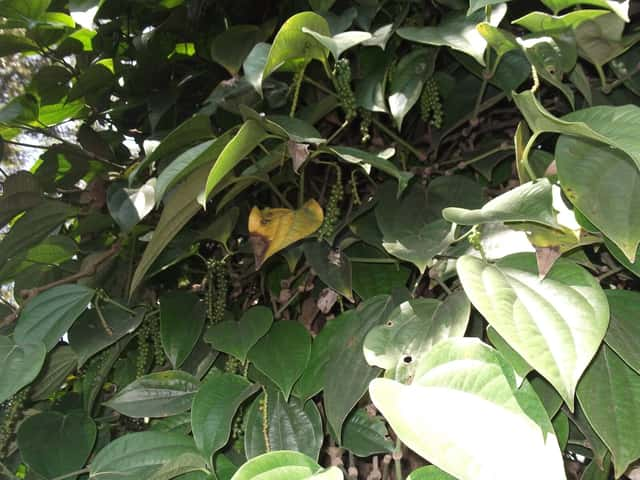
Piper nigrum is the plant behind the peppercorn: a perennial evergreen vine from the warm, wet forests of South and Southeast Asia, native to the Western Ghats of India. It climbs trees, posts or trellises with small roots along the stems and can reach 10 m in the wild, though farmers keep it at 3-4 m. The leaves are glossy, oval and pointed. Hanging spikes carry 50 to 150 tiny white flowers that turn into small round berries, green at first and red when ripe. Black, green and white pepper all come from the same fruit, picked at different stages and processed differently. A vine can live for more than 30 years.
How to Propagate Black pepper?
Runner cuttings
Never take cuttings from vines with signs of disease, as foot rot travels with infected runners and soil.
- 1 Take a cutting with two or three nodes from a healthy runner or upper climbing stem
- 2 Remove the lowest leaf and bury one node in moist, well-drained mix
- 3 Keep warm, shaded and humid until new leaves appear
- 4 Transplant next to a support once the plant has 4-7 new leaves
Materials needed:
Seed
Dried kitchen peppercorns rarely germinate. Seedlings vary and take longer to fruit than cuttings.
- 1 Use fresh, fully ripe red berries
- 2 Remove the pulp and sow the seeds shallowly in moist mix
- 3 Keep warm, around 25-30 C, and shaded
- 4 Pot on seedlings and give them a stake
Materials needed:
Layering of runners
Simple way to get a few new plants without a propagator.
- 1 Bend a low runner down to the soil or into a pot of mix
- 2 Pin a node under the surface
- 3 Keep moist until it roots
- 4 Cut it from the mother plant and grow it on
Materials needed:
How Big Does Black pepper Grow?
TLDR: Black pepper can reach up to 10.0m tall with Medium growth rate.
Max height
10.0m
Foliage
Evergreen
Plant Uses
Edible
Can be consumed
Aromatic
Pleasant fragrance
Culinary Uses
- Dried whole or ground fruit as black peppercorns
- Seeds without the skin as white pepper
- Unripe fruit as green peppercorns, dried or pickled
Is your plant showing symptoms?
Click on the symptom to discover possible causes:
What Diseases Commonly Affect Black pepper?
TLDR: Black pepper is susceptible to 8 known diseases. Monitor regularly for early detection.
Phytophthora Root Rot
Disease caused by fungus-like organisms (oomycetes) that live in soil and can survive for years. It affects roots, stem, and crown of plants, being especially severe in waterlogged or poorly drained soils. It is the second most common cause of root rot in trees and shrubs.
Fusarium Wilt
Fusarium is a soil-borne fungus that primarily attacks the roots and vascular tissues of plants. It enters through small wounds or stressed roots, is favored by warm temperatures and waterlogging, and then obstructs the flow of sap. Symptoms include yellowing, often on only one side of the plant, wilting even with moist soil, stunted growth, and, when cutting the stem, internal brown streaks. It frequently affects tomatoes, peppers, eggplants, basil, cucumbers, and zucchini, as well as ornamentals like carnations and cyclamen. In potted plants, it can manifest as root rot with a darkened crown.
Mosaic Virus
Mosaic virus is a group of plant viruses that cause mottled, patchy patterns on leaves and can affect a wide variety of plants. The virus creates characteristic yellow, white, and green mosaic patterns, often accompanied by stunted growth and deformed plant parts. This highly contagious disease spreads rapidly through insect vectors and contaminated tools.
Root-Knot Nematodes
Root-knot nematodes (Meloidogyne species) are microscopic roundworms that parasitize plant roots, causing characteristic galls or knots. These soil-borne pests are among the most economically damaging plant pathogens worldwide, affecting a wide range of ornamental and edible plants. The nematodes inject enzymes into root cells, causing abnormal swelling and disrupting water and nutrient uptake.
Fun Facts
Black, green and white pepper all come from the same berry, picked and processed differently.
The sharp taste comes from piperine, an alkaloid in the fruit.
A single vine can keep producing for 12 to 20 years and live for more than 30.
Frequently asked questions
Can I grow black pepper indoors?
What is the difference between black, green and white pepper?
Why is my pepper plant wilting and turning black at the base?
Can I plant peppercorns from the kitchen?
Compare with similar plants
| Attribute | Difficulty | Light | Watering | Pet Safe |
|---|---|---|---|---|
| Dark Fieldcap | Medium | Low light | 2d | ⚠️ |
| Azalea | Medium | Partial shade | 3d | ⚠️ |
| Muriel's Bamboo | Medium | Partial shade | 3d | ✓ |
| Bougainvillea | Medium | Direct sun | 7d | ⚠️ |




