Convolvulaceae
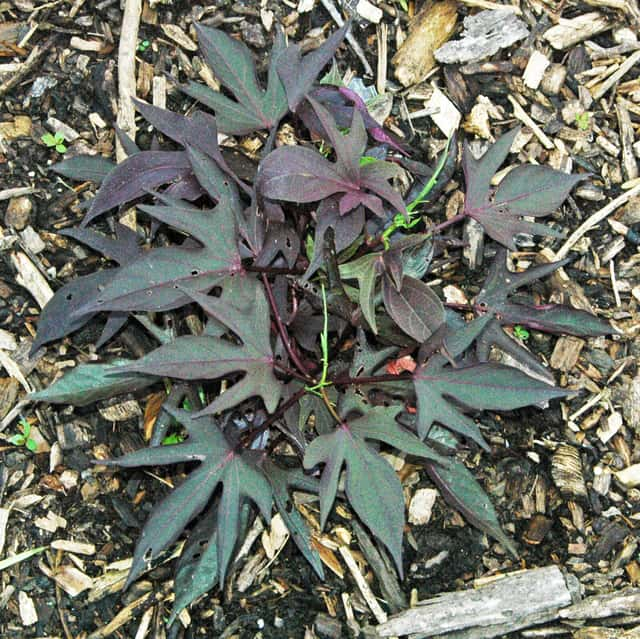
Blackie Sweet Potato Vine (Ipomoea batatas 'Blackie')
Ipomoea batatas 'Blackie'
An easy plant with moderate growth. Plant in full sun or part shade in well-drained soil, and water whenever the soil starts to dry. It hardly needs feeding. It cannot take frost: in cold climates, store the tubers over winter or keep rooted cuttings indoors.
Every 4 days
Bright indirect
° - °C
% - %
Categories
What is Blackie sweet potato vine?
Blackie sweet potato vine (Ipomoea batatas 'Blackie') is a easy-care plant from the Convolvulaceae family. 'Blackie' is an ornamental cultivar of sweet potato (Ipomoea batatas), in the family Convolvulaceae, bred for its foliage rather than its tubers. The deeply lobed leaves are a purple so dark they look black. The stems spread across the ground or spill from pots and window boxes, setting off pale fol...
Blackie sweet potato vine grows up to 25cm, spread of 60cm, watering every 4 days. It is not suitable for indoor environments and safe for pets.
Unlike many tropical plants, Blackie sweet potato vine tolerates watering mistakes. Best for beginners. Unlike many popular species, Blackie sweet potato vine is safe to keep around pets.
How to Care for Blackie sweet potato vine?
TLDR: Blackie sweet potato vine needs Bright indirect, watering every 4 days, and temperatures between 15-30°C with 40-70% humidity.
How Often Should You Water Blackie sweet potato vine?
Water when the top few centimeters of soil dry out, about twice a week in hot weather and more often in pots. The leaves wilt when it is dry and perk up soon after watering. Avoid soggy soil.
How Much Light Does Blackie sweet potato vine Need?
Full sun to part shade (4 to 6 hours of sun). More sun gives darker, richer color.
What Is the Best Soil for Blackie sweet potato vine?
Moderately fertile, well-drained soil. In containers, use regular potting mix.
What Pot Should You Use for Blackie sweet potato vine?
Great in window boxes, large pots and hanging baskets with drainage holes, mixed with other plants.
What Is Blackie sweet potato vine and Where Does It Come From?
'Blackie' is an ornamental cultivar of sweet potato (Ipomoea batatas), in the family Convolvulaceae, bred for its foliage rather than its tubers. The deeply lobed leaves are a purple so dark they look black. The stems spread across the ground or spill from pots and window boxes, setting off pale foliage and bright flowers. Now and then it bears lavender, trumpet-shaped flowers in summer and fall. It is a tender tuberous perennial grown as an annual in most places.
How to Propagate Blackie sweet potato vine?
Stem cutting
The quickest way to keep the plant for next year: hold rooted cuttings indoors over winter.
- 1 Cut a trailing stem with several nodes
- 2 Remove the lower two-thirds of the leaves
- 3 Place the cutting in a glass of water
- 4 Plant after two or three weeks, once roots are well formed
Materials needed:
Stored tubers
Discard soft or moldy tubers before planting.
- 1 After the first frost, dig up the tubers
- 2 Store them in a paper bag or box in a cool spot that does not freeze
- 3 Replant after the last frost
- 4 They often sprout before planting
Materials needed:
How Big Does Blackie sweet potato vine Grow?
TLDR: Blackie sweet potato vine can reach up to 25cm tall with Medium growth rate.
Max height
25cm
Spread
60cm
Growth rate
Medium
Plant Uses
Ornamental
Great for decoration
Ground Cover
Soil coverage
Culinary Uses
- The tubers are edible, but they were bred for foliage and do not taste good.
Is your plant showing symptoms?
Click on the symptom to discover possible causes:
What Diseases Commonly Affect Blackie sweet potato vine?
TLDR: Blackie sweet potato vine is susceptible to 6 known diseases. Monitor regularly for early detection.
White Rust
Rust
Rust is a common fungal disease caused by fungi in the order Pucciniales that affects a wide variety of plants. The disease gets its name from the characteristic orange, yellow, or reddish-brown pustules that appear on leaves, resembling metal rust. This obligate fungal parasite requires living plants to survive and can cause significant economic losses in agricultural crops.
Leaf Spot
Leaf spot is a common fungal disease caused by various pathogens including Alternaria, Ascochyta, Colletotrichum, Septoria, and Venturia. It primarily affects leaves, causing discolored spots that can lead to premature leaf drop if left untreated.
Fusarium Wilt
Fusarium wilt is a serious fungal disease caused by the soil-borne fungus Fusarium oxysporum. The fungus invades roots and blocks the water-conducting vessels (xylem) of the plant, causing progressive wilting and eventual death. Host-specific forms of the pathogen exist that attack different plant species.
Fun Facts
It is the same species as the sweet potato sold at the grocery store.
A cutting in water grows roots in about 10 days.
Frequently asked questions
Are Blackie tubers edible?
Is Blackie toxic?
Why do the leaves wilt in the heat?
How do I keep it over winter?
Compare with similar plants
| Attribute | Difficulty | Light | Watering | Pet Safe |
|---|---|---|---|---|
| Field Maple | Easy | Bright indirect | 14d | ✓ |
| Iberian Houseleek | Easy | Direct sun | 14d | ✓ |
| Silver Birch | Easy | Direct sun | 14d | ✓ |
| Common Blanketflower | Easy | Direct sun | 10d | ✓ |





