Musaceae
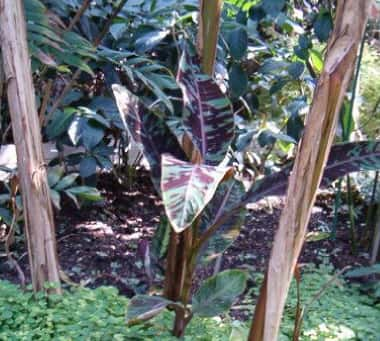
Blood Banana (Musa zebrina)
Musa zebrina
A fast-growing tropical plant. Give it strong light, rich soil kept evenly moist but well drained, feeding every 2 weeks in the growing season, humidity above 45%, and shelter from wind and cold (leaves collapse near 0 °C).
Every 4 days
Bright indirect
0° - °C
45% - %
Categories
What is Blood Banana?
Blood Banana (Musa zebrina) is a medium-care plant from the Musaceae family. Blood banana is an ornamental banana from Southeast Asia, associated with Sumatra and Java. It is now treated as Musa acuminata subsp. zebrina and sold as Musa acuminata 'Zebrina'. Its large, smooth leaves are green to blue-green, splashed with blood-red blotches, with reddish undersides. In a pot i...
Blood Banana grows up to 2.4m, spread of 240cm, watering every 4 days. It is suitable for indoor environments and safe for pets.
Unlike many popular species, Blood Banana is safe to keep around pets. Without adequate drainage, root rot can develop within 8 days.
How to Care for Blood Banana?
TLDR: Blood Banana needs Bright indirect, watering every 4 days, and temperatures between 0-30°C with 45-70% humidity.
How Often Should You Water Blood Banana?
Keep the soil evenly moist. In containers, water when the top 2-3 cm is dry, usually every 3-5 days in warm weather. Never let it sit soggy or in a saucer of water. In winter, when growth slows, water much less.
How Much Light Does Blood Banana Need?
Bright light to full sun. In hot, dry climates, light afternoon shade protects the red markings. Indoors, give it the brightest window with a few hours of sun and turn the pot now and then.
What Is the Best Soil for Blood Banana?
Rich, organic soil that holds moisture but drains quickly, pH 5.5 to 7.0. For pots, mix potting soil, compost and perlite.
What Pot Should You Use for Blood Banana?
A large, deep pot (40 L or more for mature plants) with drainage holes; plastic or terracotta both work as long as water does not collect.
Care Schedule
Fertilize
Every 14 days
Rotate
Every 14 days
What Is Blood Banana and Where Does It Come From?
Blood banana is an ornamental banana from Southeast Asia, associated with Sumatra and Java. It is now treated as Musa acuminata subsp. zebrina and sold as Musa acuminata 'Zebrina'. Its large, smooth leaves are green to blue-green, splashed with blood-red blotches, with reddish undersides. In a pot it stays around 1-1.8 m; planted out in a warm climate it reaches 1.5-2.4 m tall and wide. Mature plants can produce a flower stalk with red to orange bracts and small, seedy fruits that rarely ripen outside the humid tropics. It is grown for its foliage.
How to Propagate Blood Banana?
Dividing pups
Very small or rootless pups tend to rot. The bigger the pup, the faster it establishes. Divide in warm weather, never in cold.
- 1 Wait until a pup is 30-45 cm tall with its own roots
- 2 Clear the soil and cut it from the parent with a clean spade or knife, keeping a piece of rhizome with roots
- 3 Plant it in a pot or hole with rich, well-drained soil at the same depth
- 4 Water well and keep it in part shade for a few days before moving it back to bright light
Materials needed:
How Big Does Blood Banana Grow?
TLDR: Blood Banana can reach up to 2.4m tall with Fast growth rate.
Max height
2.4m
Spread
2.4m
Growth rate
Fast
Foliage
Evergreen
Plant Uses
Ornamental
Great for decoration
Is your plant showing symptoms?
Click on the symptom to discover possible causes:
What Diseases Commonly Affect Blood Banana?
TLDR: Blood Banana is susceptible to 13 known diseases. Monitor regularly for early detection.
Spider Mites
Spider mites are tiny arachnids (less than 1/20 inch long) related to spiders and ticks that feed on plant sap. They thrive in hot, dry conditions and can cause significant damage to ornamental and vegetable plants. During severe infestations, crop losses can reach 14% or higher as these pests disrupt vital plant processes including photosynthesis, carbon dioxide absorption, and transpiration.
Aphids
Aphids are small, soft-bodied, pear-shaped insects (1/16 to 1/8 inch long) that feed by sucking nutrient-rich sap from plants. They reproduce rapidly and can quickly weaken plants, causing distorted growth and transmitting plant viruses. Aphids come in various colors including green, black, red, yellow, brown, and gray. They secrete honeydew, a sticky substance that attracts ants and encourages sooty mold growth.
Scale Insects
Scale insects are small sap-sucking pests that appear as brown, shell-like bumps on plant stems and leaves. There are over 25 species, divided into armored (hard) and unarmored (soft) scales. They feed by piercing plant tissue and extracting sap, which weakens the plant and can lead to yellowing, stunted growth, and even death if left untreated. They also excrete honeydew, which attracts ants and promotes sooty mold growth.
Mealybugs
Mealybugs are small, soft-bodied insects covered with a white, waxy, cottony material. They are common pests of houseplants and outdoor plants in mild climates. These sap-sucking insects feed on plant tissue, causing damage, stunted growth, and can lead to plant death if left untreated. They produce sticky honeydew which attracts sooty mold.
Fun Facts
The red blotches differ on every leaf, so no two leaves look the same.
A banana 'trunk' is not wood: it is a pseudostem made of tightly rolled leaf sheaths.
It is a wild relative within Musa acuminata, one of the species behind the bananas we eat.
Frequently asked questions
Does the blood banana produce edible bananas?
Can I grow a blood banana indoors?
How cold-hardy is it?
Is the blood banana toxic to pets?
Compare with similar plants
| Attribute | Difficulty | Light | Watering | Pet Safe |
|---|---|---|---|---|
| Dark Fieldcap | Medium | Low light | 2d | ⚠️ |
| Azalea | Medium | Partial shade | 3d | ⚠️ |
| Muriel's Bamboo | Medium | Partial shade | 3d | ✓ |
| Bougainvillea | Medium | Direct sun | 7d | ⚠️ |




