Lamiaceae
Blue Catmint (Nepeta × faassenii)
Nepeta × faassenii
A very easy perennial for sunny borders. It needs sun, well-drained soil and little water once established. Skip the fertiliser: rich soil makes stems floppy. Cut it back by half after the first flush to get another, and clear dead stems in late winter.
Every 7 days
Bright indirect
-30° - 35°C
30% - 60%
Categories
What is Blue Catmint?
Blue Catmint (Nepeta × faassenii) is a easy-care plant from the Lamiaceae family. Nepeta × faassenii, blue catmint, is a sterile hybrid perennial between Nepeta racemosa and Nepeta nepetella, first raised at Faassen Nurseries in the Netherlands. It forms rounded mounds 45-60 cm tall and up to 90 cm wide, with small, aromatic gray-green leaves. From spring into summer it is covere...
Blue Catmint grows up to 60cm, spread of 90cm, watering every 7 days, -30°C – 35°C, 30–60% humidity. It is not suitable for indoor environments and safe for pets.
Unlike many tropical plants, Blue Catmint tolerates watering mistakes. Best for beginners. Unlike many popular species, Blue Catmint is safe to keep around pets.
How to Care for Blue Catmint?
TLDR: Blue Catmint needs Bright indirect, watering every 7 days, and temperatures between -30-35°C with 30-60% humidity.
How Often Should You Water Blue Catmint?
Water weekly during the first year. Once established it is drought tolerant and only needs water in long dry spells. Soggy soil leads to root rot.
How Much Light Does Blue Catmint Need?
Plant in full sun, with at least 6 hours of direct sun. In very hot climates, a little afternoon shade helps.
What Is the Best Soil for Blue Catmint?
Grows in sandy, clay, loamy or rocky soil as long as it drains well. It prefers lean to average soil; avoid feeding established plants.
What Pot Should You Use for Blue Catmint?
A wide terracotta pot with drainage holes, or a window box. Drainage matters more than size.
What Is Blue Catmint and Where Does It Come From?
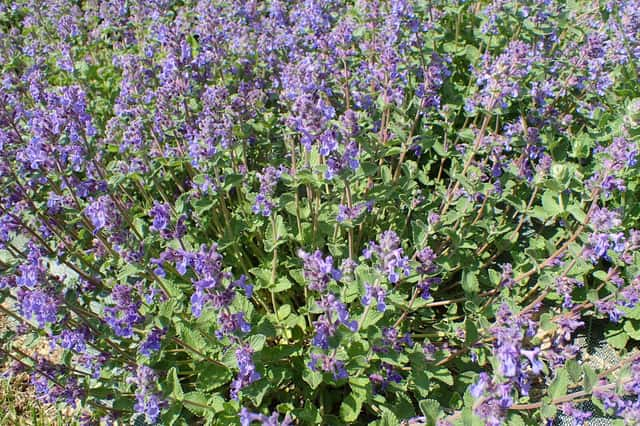
Nepeta × faassenii, blue catmint, is a sterile hybrid perennial between Nepeta racemosa and Nepeta nepetella, first raised at Faassen Nurseries in the Netherlands. It forms rounded mounds 45-60 cm tall and up to 90 cm wide, with small, aromatic gray-green leaves. From spring into summer it is covered in spikes of lavender-blue to violet-blue flowers, and it reblooms after a trim. It draws bees and other pollinators, deer avoid the scent, and cats love it. Being sterile, it does not self-seed. Well-known cultivars include 'Six Hills Giant', 'Walker's Low' and white 'Alba'.
How to Propagate Blue Catmint?
Division
Divide every 3-4 years, when the centre of the clump starts to die out. Because the hybrid is sterile, division and cuttings are the way to propagate it.
- 1 Lift the clump in early spring as new shoots appear
- 2 Split into pieces with roots and shoots using a spade or knife
- 3 Replant at the same depth in well-drained soil
- 4 Water well and keep lightly moist until established
Materials needed:
Stem cuttings
Spring and early summer cuttings root quickly. Do not let the mix stay soggy.
- 1 Take 8-10 cm tips from new, non-flowering shoots
- 2 Strip the lower leaves
- 3 Insert into light, moist cutting mix
- 4 Keep in bright light out of strong sun until rooted
Materials needed:
How Big Does Blue Catmint Grow?
TLDR: Blue Catmint can reach up to 60cm tall with Medium growth rate.
Max height
60cm
Spread
90cm
Growth rate
Medium
Foliage
Deciduous
Plant Uses
Ornamental
Great for decoration
Aromatic
Pleasant fragrance
Ground Cover
Soil coverage
Is your plant showing symptoms?
Click on the symptom to discover possible causes:
What Diseases Commonly Affect Blue Catmint?
TLDR: Blue Catmint is susceptible to 5 known diseases. Monitor regularly for early detection.
Root Rot
Root rot is a serious fungal disease that affects the root system of plants, causing them to decay and die. It is primarily caused by overwatering, poor drainage, or soil-borne fungi such as Pythium, Phytophthora, Rhizoctonia, and Fusarium. The disease thrives in waterlogged conditions where roots are deprived of oxygen, making them susceptible to fungal infection.
Pythium Root Rot
Pythium root rot is a serious fungal disease caused by various Pythium species including P. aphanidermatum, P. ultimum, and P. irregulare. These water molds are present in practically all cultivated soils and attack plant roots under wet conditions, causing rapid wet rot that can extend into the stem. The disease is favored by poor drainage, overwatering, and specific temperatures depending on the species.
Powdery Mildew
Powdery mildew is a common fungal disease caused by various fungi species including Erysiphe, Podosphaera, Oïdium, and Leveillula. It affects over 10,000 plant species worldwide. The disease thrives in warm, dry climates with high humidity and appears as a distinctive white powdery coating on plant surfaces.
Aphids
Aphids are small, soft-bodied, pear-shaped insects (1/16 to 1/8 inch long) that feed by sucking nutrient-rich sap from plants. They reproduce rapidly and can quickly weaken plants, causing distorted growth and transmitting plant viruses. Aphids come in various colors including green, black, red, yellow, brown, and gray. They secrete honeydew, a sticky substance that attracts ants and encourages sooty mold growth.
Meaning & Symbolism
Catmint stands for calm and playfulness: its scent delights cats and its haze of blue flowers softens any border. As a sterile hybrid, it also stands for reliability, staying where it is planted.
Fun Facts
It is a hybrid of Nepeta racemosa and Nepeta nepetella
It is named after Faassen Nurseries in the Netherlands, where it was first grown
Its scent deters deer but attracts cats
It sets no viable seed, so it never becomes weedy
Frequently asked questions
How often should I water catmint?
How do I get it to bloom again?
Does Nepeta × faassenii spread?
Is it safe for cats?
Compare with similar plants
| Attribute | Difficulty | Light | Watering | Pet Safe |
|---|---|---|---|---|
| Field Maple | Easy | Bright indirect | 14d | ✓ |
| Iberian Houseleek | Easy | Direct sun | 14d | ✓ |
| Silver Birch | Easy | Direct sun | 14d | ✓ |
| Common Blanketflower | Easy | Direct sun | 10d | ✓ |





