Asparagaceae
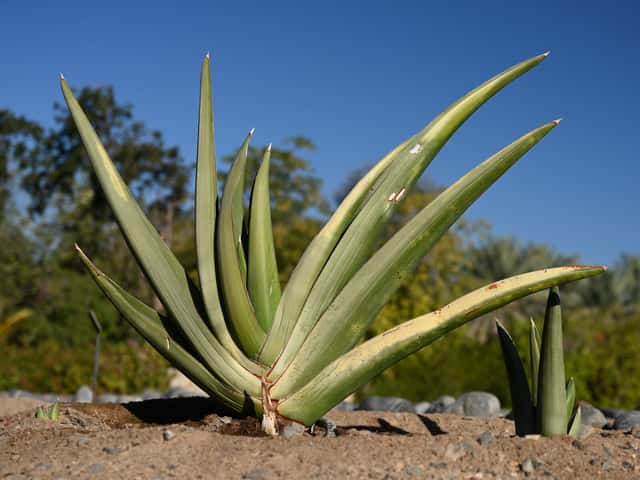
Blue Sansevieria (Dracaena hanningtonii)
Dracaena hanningtonii
Very low maintenance: give it plenty of light (direct sun or strong light), a fast-draining mix and water only when the soil is completely dry. It dislikes cold: long spells below 10 °C damage the leaves and frost leaves soft spots. Feed lightly in spring and summer. Overwatering, which rots the base, is the main risk.
Every 14 days
Bright indirect
10° - °C
% - %
Categories
What is Blue sansevieria?
Blue sansevieria (Dracaena hanningtonii) is a easy-care plant from the Asparagaceae family. Dracaena hanningtonii, still widely sold as Sansevieria ehrenbergii, is a rhizomatous succulent in the asparagus family (Asparagaceae), native to north-east and east tropical Africa (Sudan and Ethiopia south to Kenya and Tanzania) and the Arabian Peninsula (Oman, Yemen, Saudi Arabia). It grows on ro...
Blue sansevieria grows up to 1.5m, watering every 14 days. It is suitable for indoor environments and not safe for pets.
Unlike many tropical plants, Blue sansevieria tolerates watering mistakes. Best for beginners. Without precautions, ingestion can cause irritation in pets. Keep out of reach of cats and dogs. Without adequate drainage, root rot can develop within 28 days.
How to Care for Blue sansevieria?
TLDR: Blue sansevieria needs Bright indirect, watering every 14 days, and temperatures between 10-30°C with 40-70% humidity.
How Often Should You Water Blue sansevieria?
Water deeply, then wait until the mix is completely dry: about every 2 weeks in the growing season (weekly in hot, sunny weather) and no more than once a month in winter. Keep water off the leaves and empty the saucer. Soft or mushy leaf bases mean too much water.
How Much Light Does Blue sansevieria Need?
Best in bright light or direct sun for several hours a day; indoors, by your brightest window. It tolerates part shade and lower light but grows more slowly. Move plants from shade into sun gradually to avoid scorch.
What Is the Best Soil for Blue sansevieria?
Cactus and succulent mix, or potting soil cut with plenty of pumice, perlite or coarse sand (for example half soil, half pumice). Avoid peat-heavy mixes that stay wet.
What Pot Should You Use for Blue sansevieria?
A terracotta or clay pot with a drainage hole, only slightly larger than the clump; for big plants, a wide, heavy pot that won't tip over under the long leaves. Repot only when the roots fill the pot.
Care Schedule
Fertilize
Every 42 days
What Is Blue sansevieria and Where Does It Come From?
Dracaena hanningtonii, still widely sold as Sansevieria ehrenbergii, is a rhizomatous succulent in the asparagus family (Asparagaceae), native to north-east and east tropical Africa (Sudan and Ethiopia south to Kenya and Tanzania) and the Arabian Peninsula (Oman, Yemen, Saudi Arabia). It grows on rocky ground from sea level to about 1,900 m, often in the shade of thickets. Its stiff, dark to bluish-green leaves are rounded in cross-section with a groove along the inner face and are held in two opposite rows, forming a fan. In the wild they reach 50 cm to 1.5 m; the dwarf cultivar 'Samurai' stays 10-15 cm tall. It spreads by rhizomes into dense clumps. The flowers, rare in cultivation, are greyish-white or grey-green tinged with purple and open at night in spring on long, branched stalks.
How to Propagate Blue sansevieria?
Offsets
The most reliable method: leave the offset attached until it has roots.
- 1 Wait until the offset has its own roots
- 2 Cut it from the parent through the rhizome with a clean knife
- 3 Let the cut dry for a day or two
- 4 Pot in succulent mix and water lightly after a week
Materials needed:
Division
Can be done at any time of year, but spring gives the fastest rooting.
- 1 Take the plant out of its pot and shake off loose soil
- 2 Split the clump into pieces that each have leaves and roots, cutting the rhizomes
- 3 Let the cuts dry for a day
- 4 Pot each piece separately and water sparingly at first
Materials needed:
Leaf cuttings
Slower: the new plant grows from a rhizome that forms at the cut edge of the leaf.
- 1 Cut a leaf section at least 10 cm long
- 2 Let it callus for a few days
- 3 Insert about 2.5 cm deep in moist sand or succulent mix, right way up
- 4 Keep barely moist until a new rhizome appears at the base
Materials needed:
How Big Does Blue sansevieria Grow?
TLDR: Blue sansevieria can reach up to 1.5m tall with Slow growth rate.
Max height
1.5m
Growth rate
Slow
Foliage
Evergreen
Warning: Toxic Plant
This plant can be toxic if ingested. Keep out of reach of:
Plant Uses
Ornamental
Great for decoration
Medicinal
Medicinal properties
Medicinal Uses
- The Maasai used the sap of a snapped leaf as an antiseptic and the leaf as a natural bandage on sores
Is your plant showing symptoms?
Click on the symptom to discover possible causes:
What Diseases Commonly Affect Blue sansevieria?
TLDR: Blue sansevieria is susceptible to 5 known diseases. Monitor regularly for early detection.
Root Rot
Root rot is a serious fungal disease that affects the root system of plants, causing them to decay and die. It is primarily caused by overwatering, poor drainage, or soil-borne fungi such as Pythium, Phytophthora, Rhizoctonia, and Fusarium. The disease thrives in waterlogged conditions where roots are deprived of oxygen, making them susceptible to fungal infection.
Mealybugs
Mealybugs are small, soft-bodied insects covered with a white, waxy, cottony material. They are common pests of houseplants and outdoor plants in mild climates. These sap-sucking insects feed on plant tissue, causing damage, stunted growth, and can lead to plant death if left untreated. They produce sticky honeydew which attracts sooty mold.
Spider Mites
Spider mites are tiny arachnids (less than 1/20 inch long) related to spiders and ticks that feed on plant sap. They thrive in hot, dry conditions and can cause significant damage to ornamental and vegetable plants. During severe infestations, crop losses can reach 14% or higher as these pests disrupt vital plant processes including photosynthesis, carbon dioxide absorption, and transpiration.
Cold Damage
Cold damage, also known as frost injury, occurs when plants are exposed to freezing or near-freezing temperatures. This environmental stress can cause cellular damage as ice crystals form within plant tissues, rupturing cells and disrupting normal plant functions. Chilling injury can also occur in sensitive species at temperatures between 32-55°F (0-10°C), even without actual freezing.
Fun Facts
The Maasai made rope, baskets and slingshots from the leaf fibre
It grows abundantly in Olduvai Gorge, Tanzania, one of the key sites of human paleoanthropology, and one of its synonyms is Dracaena oldupai
Its flowers open at night
Frequently asked questions
How often should I water blue sansevieria?
Is Dracaena hanningtonii the same as Sansevieria ehrenbergii?
Is blue sansevieria toxic to cats and dogs?
Can it grow indoors?
Compare with similar plants
| Attribute | Difficulty | Light | Watering | Pet Safe |
|---|---|---|---|---|
| Field Maple | Easy | Bright indirect | 14d | ✓ |
| Iberian Houseleek | Easy | Direct sun | 14d | ✓ |
| Silver Birch | Easy | Direct sun | 14d | ✓ |
| Common Blanketflower | Easy | Direct sun | 10d | ✓ |
Choose & Compare
Sources & References
- POWO - Dracaena hanningtonii Baker
- Dracaena hanningtonii - Wikipedia
- LLIFLE - Sansevieria ehrenbergii
- Epic Gardening - How to plant, grow and care for Sword Sansevieria
- The Belmont Rooster - Dracaena hanningtonii (syn. Sansevieria ehrenbergii) 'Samurai'
- RHS - Sansevieria ehrenbergii (blue sansevieria)
- Folia Collective - Plant know-how: Sansevieria ehrenbergii





