Bignoniaceae
Bower Vine (Pandorea): Complete Growing Guide
Pandorea
Grow Pandorea in full sun to part shade, in well-draining soil enriched with organic matter. Water regularly during the first growing season to establish roots; once established it tolerates short dry spells. Provide a sturdy support such as a trellis or pergola for the twining stems, and prune lightly after flowering to keep a tidy shape.
Every 7 days
Bright indirect
10° - 35°C
40% - 70%
Categories
What is Bower Vine?
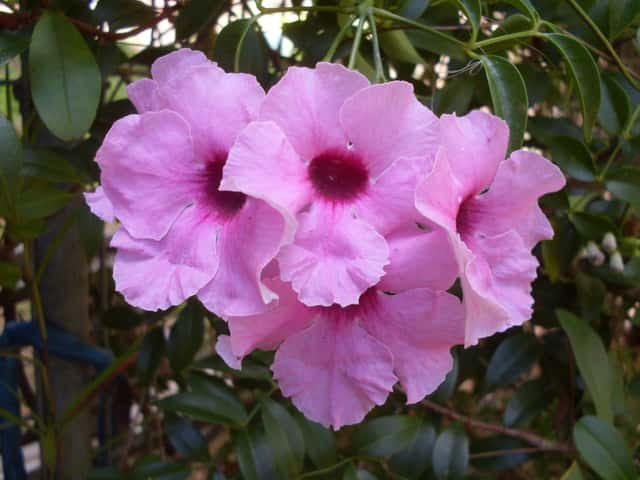
Bower Vine (Pandorea) is a easy-care plant from the Bignoniaceae family. Pandorea is a genus of woody evergreen climbers native to Australia, belonging to the family Bignoniaceae. Twining stems scramble over trellises, fences and pergolas, forming a dense curtain of glossy foliage studded with trumpet-shaped flowers in shades of white, pink and purple, often with a contr...
Bower Vine grows up to 10.0m, spread of 300cm, watering every 7 days, 10°C – 35°C, 40–70% humidity. It is not suitable for indoor environments and safe for pets.
Unlike many tropical plants, Bower Vine tolerates watering mistakes. Best for beginners. Unlike many popular species, Bower Vine is safe to keep around pets.
How to Care for Bower Vine?
TLDR: Bower Vine needs Bright indirect, watering every 7 days, and temperatures between 10-35°C with 40-70% humidity.
How Often Should You Water Bower Vine?
Water when the top few centimeters of soil feel dry, keeping the soil consistently moist during the first months after planting; avoid waterlogging, which quickly leads to root rot.
How Much Light Does Bower Vine Need?
Prefers full sun for the best flowering display but tolerates part shade; in very hot climates, some afternoon shade helps protect the foliage from scorching.
What Is the Best Soil for Bower Vine?
Needs well-draining, slightly acidic to neutral soil enriched with compost; if planting in heavy clay, work in coarse sand to improve drainage.
What Pot Should You Use for Bower Vine?
A large, deep container with excellent drainage if grown in a pot; in-ground planting is preferred for full root development.
Care Schedule
Fertilize
Every 60 days
What Is Bower Vine and Where Does It Come From?
Pandorea is a genus of woody evergreen climbers native to Australia, belonging to the family Bignoniaceae. Twining stems scramble over trellises, fences and pergolas, forming a dense curtain of glossy foliage studded with trumpet-shaped flowers in shades of white, pink and purple, often with a contrasting streaked throat. It is a vigorous, fast-growing plant popular for screening and shading in mild-to-warm gardens, though it is frost-tender and needs protection in cold climates.
How to Propagate Bower Vine?
Semi-hardwood stem cutting
Keep cuttings in a warm, shaded spot and air out the plastic cover daily to prevent mold.
- 1 Cut a 10-15 cm semi-hardwood stem segment with at least two nodes
- 2 Strip leaves from the lower half of the cutting
- 3 Dip the cut end in rooting hormone
- 4 Plant in a light, well-draining potting mix and keep it moist
- 5 Cover with a clear plastic bag to retain humidity until roots form
Materials needed:
How Big Does Bower Vine Grow?
TLDR: Bower Vine can reach up to 10.0m tall with Fast growth rate.
Max height
10.0m
Spread
3.0m
Growth rate
Fast
Foliage
Evergreen
Plant Uses
Ornamental
Great for decoration
Aromatic
Pleasant fragrance
Is your plant showing symptoms?
Click on the symptom to discover possible causes:
What Diseases Commonly Affect Bower Vine?
TLDR: Bower Vine is susceptible to 5 known diseases. Monitor regularly for early detection.
Aphids
Aphids are small, soft-bodied, pear-shaped insects (1/16 to 1/8 inch long) that feed by sucking nutrient-rich sap from plants. They reproduce rapidly and can quickly weaken plants, causing distorted growth and transmitting plant viruses. Aphids come in various colors including green, black, red, yellow, brown, and gray. They secrete honeydew, a sticky substance that attracts ants and encourages sooty mold growth.
Scale Insects
Scale insects are small sap-sucking pests that appear as brown, shell-like bumps on plant stems and leaves. There are over 25 species, divided into armored (hard) and unarmored (soft) scales. They feed by piercing plant tissue and extracting sap, which weakens the plant and can lead to yellowing, stunted growth, and even death if left untreated. They also excrete honeydew, which attracts ants and promotes sooty mold growth.
Spider Mites
Spider mites are tiny arachnids (less than 1/20 inch long) related to spiders and ticks that feed on plant sap. They thrive in hot, dry conditions and can cause significant damage to ornamental and vegetable plants. During severe infestations, crop losses can reach 14% or higher as these pests disrupt vital plant processes including photosynthesis, carbon dioxide absorption, and transpiration.
Root Rot
Root rot is a serious fungal disease that affects the root system of plants, causing them to decay and die. It is primarily caused by overwatering, poor drainage, or soil-borne fungi such as Pythium, Phytophthora, Rhizoctonia, and Fusarium. The disease thrives in waterlogged conditions where roots are deprived of oxygen, making them susceptible to fungal infection.
Meaning & Symbolism
Represents welcome, resilience and natural grace, traditionally trained over entrances and arbors in Australian gardens.
Fun Facts
Some Pandorea species can climb over 10 meters tall in the wild under ideal conditions.
The common name "wonga wonga vine" comes from an Australian Aboriginal word.
Pandorea flowers attract bees and butterflies, making it a great choice for pollinator gardens.
Frequently asked questions
Is Bower Vine toxic to cats and dogs?
How often should I water Pandorea?
Can Bower Vine survive frost?
How do I get Pandorea to flower more?
Compare with similar plants
| Attribute | Difficulty | Light | Watering | Pet Safe |
|---|---|---|---|---|
| Field Maple | Easy | Bright indirect | 14d | ✓ |
| Silver Birch | Easy | Direct sun | 14d | ✓ |
| Common Blanketflower | Easy | Direct sun | 10d | ✓ |
| Cushion Bush | Easy | Direct sun | 14d | ✓ |
Choose & Compare
Sources & References
- Bowerplant (Pandorea Jasminoides) Care Guide - Plantiary
- Pandorea jasminoides: how to grow the Australian bower vine - Better Homes and Gardens Australia
- Pandorea pandorana - Wonga Wonga Vine - Gardening With Angus
- Pandorea pandorana | wonga-wonga vine - RHS
- Pandorea jasminoides - Wikipedia
- Identify and Treat Bower Vine Diseases (Pandorea jasminoides) - Cultivating Flora
- Wonga-wonga Vine - Burke's Backyard





