Rosaceae
Scotch Rose: Ground Cover Plant
Rosa spinosissima
The Scotch Rose is an exceptionally undemanding and frost-hardy plant, ideal for dry, poor, and sandy locations. It grows best in full sun, where it blooms profusely and is less prone to disease; it also tolerates light partial shade. Once established, it practically requires no watering – it is very drought-tolerant. In spring, it is worth fertilizing it with rose fertilizer and repeating the dose in early summer. Pruning is limited to removing damaged shoots after flowering; if you want ornamental fruits, do not remove spent flowers.
Every 10 days
Direct sun
-35° - 35°C
30% - 70%
Categories
What is Scotch Rose?
Scotch Rose (Rosa spinosissima) is a easy-care plant from the Rosaceae family. The Scotch Rose (Rosa spinosissima, syn. Rosa pimpinellifolia) is a low-growing, densely leaved shrub from the rose family (Rosaceae). It is also known as the burnet rose. It originates from Europe, southwestern Siberia, northwestern Iran, and Algeria; in Poland, it is found mainly in the south of t...
Scotch Rose grows up to 1.0m, spread of 150cm, watering every 10 days, -35°C – 35°C, 30–70% humidity. It is not suitable for indoor environments and safe for pets.
Unlike many tropical plants, Scotch Rose tolerates watering mistakes. Best for beginners. Unlike many popular species, Scotch Rose is safe to keep around pets.
How to Care for Scotch Rose?
TLDR: Scotch Rose needs Direct sun, watering every 10 days, and temperatures between -35-35°C with 30-70% humidity.
How Often Should You Water Scotch Rose?
Water young seedlings regularly during the first season until they are well-established. Mature plants are very drought-tolerant and only require watering during prolonged heatwaves – too much water in heavy, moist soil is more harmful than too little.
How Much Light Does Scotch Rose Need?
Plant in a location with full sun (minimum 6 hours of direct sunlight per day) – this ensures the most abundant flowering and greatest resistance to fungal diseases. The plant also tolerates lightly shaded spots, but then it blooms more modestly.
What Is the Best Soil for Scotch Rose?
Prefers well-draining, sandy or stony soil with a pH from slightly acidic to alkaline (it readily grows on limestone); it also tolerates clay and chalky soils, provided they are well-drained. Avoid waterlogged locations and overly fertile, heavy soils.
What Pot Should You Use for Scotch Rose?
This is a ground species, primarily intended for cultivation in the ground as a low hedge or ground cover in dry, sunny locations. Young nursery plants can be temporarily kept in a wide, deep pot with drainage holes and a well-draining, sandy substrate, but ultimately it thrives best when planted in the ground.
Care Schedule
Fertilize
Every 180 days
What Is Scotch Rose and Where Does It Come From?
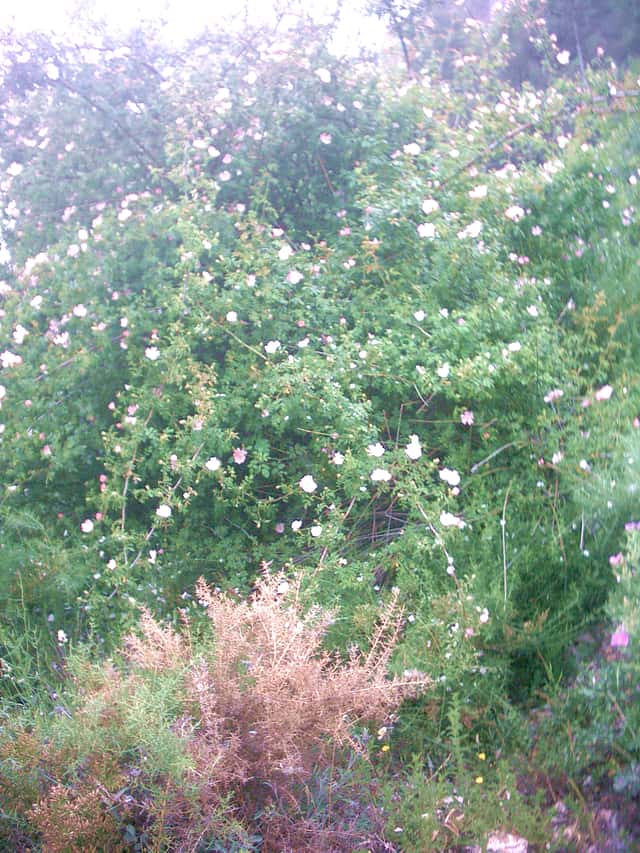
The Scotch Rose (Rosa spinosissima, syn. Rosa pimpinellifolia) is a low-growing, densely leaved shrub from the rose family (Rosaceae). It is also known as the burnet rose. It originates from Europe, southwestern Siberia, northwestern Iran, and Algeria; in Poland, it is found mainly in the south of the country, on dry, stony hills and in warm thickets, often on calcareous soil. It typically reaches 50–100 cm in height, forming compact, heavily thorny clumps with dark brown shoots densely covered with straight thorns and stiff bristles. The leaves are pinnate, composed of 5–11 small, rounded leaflets, often with a reddish tinge. From May to June, single, creamy-white (less often pink), fragrant flowers with five petals appear, followed in autumn by spherical, dark brown to black fruit clusters (hips).
How to Propagate Scotch Rose?
Hardwood Cuttings
Choose healthy, mature shoots from the current season; rooting takes until spring.
- 1 In autumn, after the leaves have fallen, cut hardwood shoots about 20–25 cm long.
- 2 Remove the lower thorns and leaves, leaving 2–3 buds above the surface.
- 3 Dip the bottom end in rooting hormone.
- 4 Plant the cuttings in sandy, well-draining soil in a sheltered spot in the garden.
- 5 Maintain slight soil moisture until spring, when new shoots and roots appear.
Materials needed:
Division of Root Suckers
The plant spreads extensively via root suckers, which makes it easy to obtain ready-to-plant seedlings with their own roots.
- 1 During dormancy (late autumn or early spring), locate root suckers growing next to the mother plant.
- 2 Cut off the sucker with a sharp spade, including a piece of the root.
- 3 Replant immediately in the desired location or into a pot with well-draining substrate.
- 4 Water thoroughly after transplanting and maintain moisture until rooted.
Materials needed:
How Big Does Scotch Rose Grow?
TLDR: Scotch Rose can reach up to 1.0m tall with Medium growth rate.
Max height
1.0m
Spread
1.5m
Growth rate
Medium
Foliage
Deciduous
Plant Uses
Ornamental
Great for decoration
Edible
Can be consumed
Medicinal
Medicinal properties
Ground Cover
Soil coverage
Medicinal Uses
- The fruits (hips) are rich in vitamin C and flavonoids, traditionally used in infusions to boost immunity.
- Infusions and syrups from the fruits were used as an auxiliary treatment for colds and as mild anti-inflammatory support for joint ailments.
Culinary Uses
- Ripe fruits (hips) are used for syrups, jams, and fruit teas after removing the irritating hairs from the inside.
- The fruits are also suitable for tinctures and liqueurs with a spicy, slightly tart taste.
Is your plant showing symptoms?
Click on the symptom to discover possible causes:
What Diseases Commonly Affect Scotch Rose?
TLDR: Scotch Rose is susceptible to 7 known diseases. Monitor regularly for early detection.
Black Spot
Black spot is the most serious fungal disease affecting roses, caused by the fungus Diplocarpon rosae. It is characterized by dark circular spots on leaves that progress to yellowing and premature leaf drop. The disease thrives in humid and cool conditions, especially early in the growing season.
Powdery Mildew
Powdery mildew is a common fungal disease caused by various fungi species including Erysiphe, Podosphaera, Oïdium, and Leveillula. It affects over 10,000 plant species worldwide. The disease thrives in warm, dry climates with high humidity and appears as a distinctive white powdery coating on plant surfaces.
Rust
Rust is a common fungal disease caused by fungi in the order Pucciniales that affects a wide variety of plants. The disease gets its name from the characteristic orange, yellow, or reddish-brown pustules that appear on leaves, resembling metal rust. This obligate fungal parasite requires living plants to survive and can cause significant economic losses in agricultural crops.
Aphids
Aphids are small, soft-bodied, pear-shaped insects (1/16 to 1/8 inch long) that feed by sucking nutrient-rich sap from plants. They reproduce rapidly and can quickly weaken plants, causing distorted growth and transmitting plant viruses. Aphids come in various colors including green, black, red, yellow, brown, and gray. They secrete honeydew, a sticky substance that attracts ants and encourages sooty mold growth.
Meaning & Symbolism
In Scottish culture, the Scotch rose symbolizes perseverance, wild beauty, and attachment to its rugged, coastal homeland – it is sometimes called the humbler sister of the thistle, Scotland's national symbol. Its numerous thorns are associated with defense and resilience, and its ability to survive on barren dunes and dry slopes makes it a symbol of fortitude.
Compare with similar plants
| Attribute | Difficulty | Light | Watering | Pet Safe |
|---|---|---|---|---|
| Field Maple | Easy | Bright indirect | 14d | ✓ |
| Silver Birch | Easy | Direct sun | 14d | ✓ |
| Common Blanketflower | Easy | Direct sun | 10d | ✓ |
| Cushion Bush | Easy | Direct sun | 14d | ✓ |
Choose & Compare
Sources & References
- Rosa spinosissima | Scotch rose - RHS
- Rosa spinosissima - NC State Extension Gardener Plant Toolbox
- Rosa spinosissima (róża gęstokolczasta) - Atlas roślin polskich
- Róża gęstokolczasta - Zielnik Karpacki
- Rosa pimpinellifolia (Burnet Rose) - Backyard Gardener
- Category:Rosa spinosissima - Wikimedia Commons





