Cactaceae
Candy Cactus (Ferocactus macrodiscus)
Ferocactus macrodiscus
An easy cactus: full sun, very free-draining mix and little water, less than other Ferocactus. Keep it dry and cool in winter (about 10 °C); it tolerates light frost to about -4 °C, but cold and damp rot it.
Every 14 days
Bright indirect
-4° - °C
% - %
Categories
What is Candy cactus?
Candy cactus (Ferocactus macrodiscus) is a easy-care plant from the Cactaceae family. Ferocactus macrodiscus, the candy cactus (biznaga de dulce in Mexico), is endemic to central and southern Mexico (San Luis Potosí, Querétaro, Guanajuato and Oaxaca), where it grows in dry grassland and oak forest at 2,300–2,600 m, often half buried in the ground during drought. Unlike most barrel ca...
Candy cactus grows up to 10cm, spread of 45cm, watering every 14 days. It is suitable for indoor environments and safe for pets.
Unlike many tropical plants, Candy cactus tolerates watering mistakes. Best for beginners. Unlike many popular species, Candy cactus is safe to keep around pets. Without adequate drainage, root rot can develop within 28 days.
How to Care for Candy cactus?
TLDR: Candy cactus needs Bright indirect, watering every 14 days, and temperatures between -4-30°C with 40-70% humidity.
How Often Should You Water Candy cactus?
In spring and summer, water about every 2 weeks and only once the mix is completely dry. No water in winter. Water the soil, not the body, to avoid sunburn scars in strong sun.
How Much Light Does Candy cactus Need?
Full sun year round. In very hot climates, some afternoon shade in summer prevents scorching.
What Is the Best Soil for Candy cactus?
A rich but very free-draining cactus mix with plenty of coarse sand or pumice, slightly acidic (pH around 6).
What Pot Should You Use for Candy cactus?
A wide, shallow terracotta pan with a drainage hole, suited to its flat body.
What Is Candy cactus and Where Does It Come From?
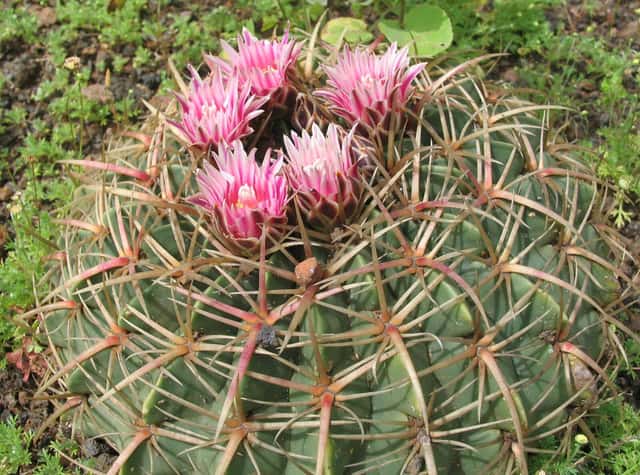
Ferocactus macrodiscus, the candy cactus (biznaga de dulce in Mexico), is endemic to central and southern Mexico (San Luis Potosí, Querétaro, Guanajuato and Oaxaca), where it grows in dry grassland and oak forest at 2,300–2,600 m, often half buried in the ground during drought. Unlike most barrel cacti it is flat: up to 10 cm tall and 30 to 45 cm across (sometimes 60 cm), with a blue-green body, 16 to 21 ribs and curved yellow or reddish spines. From spring to summer it opens a ring of white flowers striped pinkish purple, followed by red fruits. It blooms young, at only 8 to 12 cm across. The name comes from the candy made from its flesh.
How to Propagate Candy cactus?
Seed
It is propagated only from seed. Seedlings are slow at first, then speed up, and can flower within a few years.
- 1 Scatter the seed over fine, moist cactus mix
- 2 Cover with a light layer of fine sand
- 3 Keep warm and bright, out of direct sun, under a clear cover
- 4 Remove the cover gradually and transplant once seedlings are sturdy
Materials needed:
How Big Does Candy cactus Grow?
TLDR: Candy cactus can reach up to 10cm tall with Slow growth rate.
Max height
10cm
Spread
45cm
Growth rate
Slow
Foliage
Evergreen
Plant Uses
Ornamental
Great for decoration
Edible
Can be consumed
Culinary Uses
- In Mexico the core is cut out, candied in sugar and eaten as a sweet.
Is your plant showing symptoms?
Click on the symptom to discover possible causes:
What Diseases Commonly Affect Candy cactus?
TLDR: Candy cactus is susceptible to 4 known diseases. Monitor regularly for early detection.
Spider Mites
Spider mites are tiny arachnids (less than 1/20 inch long) related to spiders and ticks that feed on plant sap. They thrive in hot, dry conditions and can cause significant damage to ornamental and vegetable plants. During severe infestations, crop losses can reach 14% or higher as these pests disrupt vital plant processes including photosynthesis, carbon dioxide absorption, and transpiration.
Root Rot
Root rot is a serious fungal disease that affects the root system of plants, causing them to decay and die. It is primarily caused by overwatering, poor drainage, or soil-borne fungi such as Pythium, Phytophthora, Rhizoctonia, and Fusarium. The disease thrives in waterlogged conditions where roots are deprived of oxygen, making them susceptible to fungal infection.
Sunburn (Sun Scorch)
Sunburn or sun scorch is an environmental condition that occurs when plants are exposed to intense, direct sunlight beyond their tolerance level. This causes the breakdown of chlorophyll in the leaves, resulting in bleached, dried, and damaged foliage. The damage can happen rapidly, sometimes within just a few hours of exposure.
Cold Damage
Cold damage, also known as frost injury, occurs when plants are exposed to freezing or near-freezing temperatures. This environmental stress can cause cellular damage as ice crystals form within plant tissues, rupturing cells and disrupting normal plant functions. Chilling injury can also occur in sensitive species at temperatures between 32-55°F (0-10°C), even without actual freezing.
Fun Facts
Its Spanish name, biznaga de dulce, comes from the Mexican candy made from its flesh.
In the wild it sits half buried in the soil during drought.
It is wider than tall: up to 45 cm across but only 10 cm high.
Frequently asked questions
How often should I water a candy cactus?
Is it cold hardy?
When does the candy cactus bloom?
Why does it have brown marks on the body?
Compare with similar plants
| Attribute | Difficulty | Light | Watering | Pet Safe |
|---|---|---|---|---|
| Field Maple | Easy | Bright indirect | 14d | ✓ |
| Iberian Houseleek | Easy | Direct sun | 14d | ✓ |
| Silver Birch | Easy | Direct sun | 14d | ✓ |
| Common Blanketflower | Easy | Direct sun | 10d | ✓ |





