Amaryllidaceae
Cardwell lily (Proiphys amboinensis)
Proiphys amboinensis
An easy bulb for part shade, in a sheltered bed or a pot. While in leaf, water generously and give it rich, open soil. When the leaves die down, keep the bulb almost dry and undisturbed until it shoots again. It is not frost hardy.
Every 3 days
Partial shade
° - °C
% - %
Categories
What is Cardwell lily?
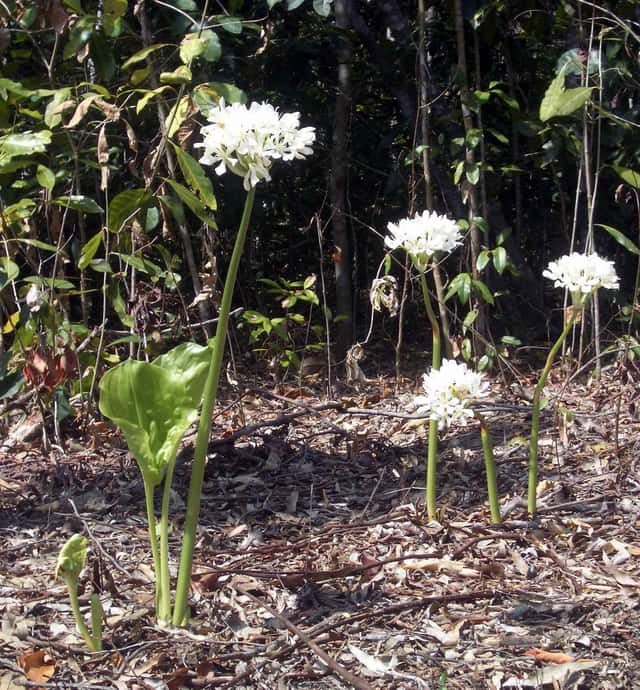
Cardwell lily (Proiphys amboinensis) is a easy-care plant from the Amaryllidaceae family. The Cardwell lily (Proiphys amboinensis) is a bulb in the Amaryllidaceae family, native to Southeast Asia, New Guinea and northern Australia, where it grows in lightly shaded rainforest openings and near the coast. The leaves are large and almost round, 20 to 35 cm across, with deep curved veins and...
Cardwell lily grows up to 90cm, watering every 3 days. It is suitable for indoor environments and safe for pets.
Unlike many tropical plants, Cardwell lily tolerates watering mistakes. Best for beginners. Unlike many popular species, Cardwell lily is safe to keep around pets. Without adequate drainage, root rot can develop within 7 days.
How to Care for Cardwell lily?
TLDR: Cardwell lily needs Partial shade, watering every 3 days, and temperatures between 15-30°C with 40-70% humidity.
How Often Should You Water Cardwell lily?
While in leaf, water generously, every 2 or 3 days in hot weather, without waterlogging. When the leaves yellow and die back, stop nearly all watering until the bulb shoots again: a wet bulb rots during dormancy.
How Much Light Does Cardwell lily Need?
Light shade or filtered light, such as under trees. Strong direct sun scorches the broad leaves.
What Is the Best Soil for Cardwell lily?
Rich, open soil with plenty of organic matter and some sand, so it drains well. Plant the bulb with its tip just below the surface.
What Pot Should You Use for Cardwell lily?
A medium to large pot, wider than deep, with good drainage holes; the leaves are big and need room.
What Is Cardwell lily and Where Does It Come From?
The Cardwell lily (Proiphys amboinensis) is a bulb in the Amaryllidaceae family, native to Southeast Asia, New Guinea and northern Australia, where it grows in lightly shaded rainforest openings and near the coast. The leaves are large and almost round, 20 to 35 cm across, with deep curved veins and long stalks. They appear with the wet season and die back in the dry season, when the plant survives as a bulb underground. In the warm months a stem up to 90 cm tall carries a cluster of 5 to 25 fragrant, white trumpet flowers with a yellowish throat. In Australia it flowers around Christmas, hence its other name, northern Christmas lily. The seeds sometimes sprout while still on the plant.
How to Propagate Cardwell lily?
Seeds
Seedlings can take several years to flower.
- 1 Collect ripe fruit, or seeds that have already started to sprout on the plant
- 2 Lay the seeds on moist mix without burying them deep
- 3 Keep warm and shaded, with the mix moist
- 4 Protect the seedlings from slugs and snails
Materials needed:
Offsets
Disturb the roots as little as possible: a bulb that loses its roots can take two or three seasons to recover.
- 1 At the end of dormancy, carefully lift the bulb
- 2 Separate the offsets growing beside the main bulb
- 3 Plant each with its tip just below the surface
- 4 Start watering again when leaves appear
Materials needed:
How Big Does Cardwell lily Grow?
TLDR: Cardwell lily can reach up to 90cm tall with Medium growth rate.
Max height
90cm
Foliage
Deciduous
Plant Uses
Ornamental
Great for decoration
Is your plant showing symptoms?
Click on the symptom to discover possible causes:
What Diseases Commonly Affect Cardwell lily?
TLDR: Cardwell lily is susceptible to 2 known diseases. Monitor regularly for early detection.
Slugs and Snails
Slugs and snails are mollusks that feed on plant tissue, causing irregular holes in leaves and damage to young seedlings. They are most active at night and in moist conditions, leaving characteristic silvery slime trails. These pests can quickly devastate gardens, especially during wet seasons.
Root Rot
Root rot is a serious fungal disease that affects the root system of plants, causing them to decay and die. It is primarily caused by overwatering, poor drainage, or soil-borne fungi such as Pythium, Phytophthora, Rhizoctonia, and Fusarium. The disease thrives in waterlogged conditions where roots are deprived of oxygen, making them susceptible to fungal infection.
Fun Facts
In Australia it is called the northern Christmas lily because it flowers around Christmas.
The seeds sometimes start to sprout while still attached to the parent plant.
Cardwell is a town on the Queensland coast.
Frequently asked questions
Why have my Cardwell lily's leaves died?
Does the Cardwell lily like sun?
How do I get a Cardwell lily to flower?
Compare with similar plants
| Attribute | Difficulty | Light | Watering | Pet Safe |
|---|---|---|---|---|
| Field Maple | Easy | Bright indirect | 14d | ✓ |
| Iberian Houseleek | Easy | Direct sun | 14d | ✓ |
| Silver Birch | Easy | Direct sun | 14d | ✓ |
| Common Blanketflower | Easy | Direct sun | 10d | ✓ |
Choose & Compare
Sources & References
- Wikipedia - Proiphys amboinensis
- Australian National Botanic Gardens - Proiphys
- Some Magnetic Island Plants - Cardwell lily
- TopTropicals - Proiphys amboinensis (Cardwell Lily)
- Pacific Bulb Society list - Cardwell Lily (growers)
- LLIFLE - Eurycles nuda (cultivation)
- Gardino Nursery - Proiphys amboinensis





