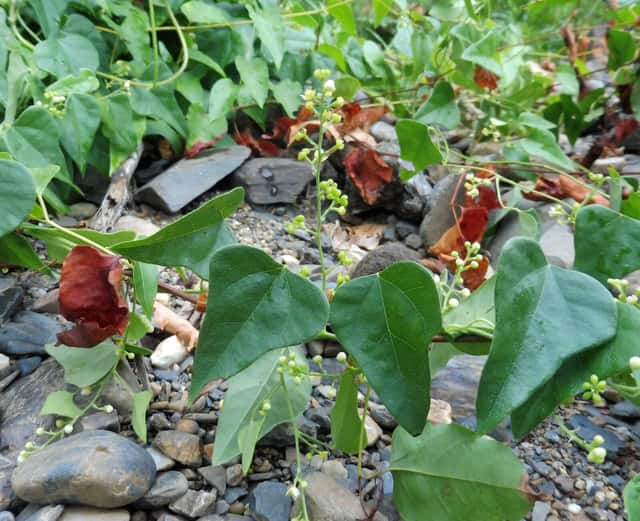
Menispermaceae
Carolina coralbead: Fast Growing
Cocculus carolinus
An easy native vine for sun or part shade that handles heat, drought, clay and compacted soil. Give it something to climb and prune each year to keep it in bounds, since it spreads fast and roots are hard to remove.
Every 7 days
Bright indirect
° - °C
% - %
Categories
What is Carolina coralbead?
Carolina coralbead (Cocculus carolinus) is a easy-care plant from the Menispermaceae family. Cocculus carolinus is a twining woody vine native to the southeastern and central United States, from North Florida to Texas and up the Mississippi valley. It climbs fences and shrubs or scrambles along the ground, reaching 3 to 4.5 m. The glossy dark green leaves are 8 to 15 cm long and shaped like...
Carolina coralbead grows up to 4.5m, spread of 180cm, watering every 7 days. It is not suitable for indoor environments and not safe for pets.
Unlike many tropical plants, Carolina coralbead tolerates watering mistakes. Best for beginners. Without precautions, ingestion can cause irritation in pets. Keep out of reach of cats and dogs.
How to Care for Carolina coralbead?
TLDR: Carolina coralbead needs Bright indirect, watering every 7 days, and temperatures between 15-30°C with 40-70% humidity.
How Often Should You Water Carolina coralbead?
Water about once a week while it gets established. After that it gets by on rain and handles dry spells, though it grows best in soil that stays slightly moist.
How Much Light Does Carolina coralbead Need?
Full sun to part shade, with 2 to 6 hours of direct sun. More sun means more berries.
What Is the Best Soil for Carolina coralbead?
Not fussy: clay, loam, sand or rocky soil all work, from pH 6 to 8. It tolerates compaction and does not need fertilizer.
What Pot Should You Use for Carolina coralbead?
Best planted in the ground on a fence, trellis or arbor. It is too vigorous for a pot over the long term.
What Is Carolina coralbead and Where Does It Come From?
Cocculus carolinus is a twining woody vine native to the southeastern and central United States, from North Florida to Texas and up the Mississippi valley. It climbs fences and shrubs or scrambles along the ground, reaching 3 to 4.5 m. The glossy dark green leaves are 8 to 15 cm long and shaped like a heart or a triangle. In summer it bears tiny greenish-white flowers that most people never notice. The show comes in September to November, when loose clusters of shiny red berries the size of a pea ripen. Each berry holds one seed coiled like a snail shell, which explains the name snailseed. Male and female flowers grow on separate plants, so a vine on its own may not fruit, and young plants often take a few years to start. Birds eat the berries, but they are bitter and toxic to people and pets. It is closely related to the moonseed, Menispermum canadense, and some botanists now place it in the genus Nephroia.
How to Propagate Carolina coralbead?
Seed
Wear gloves when handling the berries, since they are toxic. Plant several seedlings if you want fruit, because each plant is either male or female.
- 1 Collect ripe red berries in autumn
- 2 Remove the pulp and clean the snail-shaped seeds
- 3 Sow outdoors in autumn, or keep cold over winter and sow in spring
- 4 Cover lightly with soil and keep moist until seedlings appear
Materials needed:
How Big Does Carolina coralbead Grow?
TLDR: Carolina coralbead can reach up to 4.5m tall with Fast growth rate.
Max height
4.5m
Spread
1.8m
Growth rate
Fast
Foliage
Deciduous
Warning: Toxic Plant
This plant can be toxic if ingested. Keep out of reach of:
Plant Uses
Ornamental
Great for decoration
Is your plant showing symptoms?
Click on the symptom to discover possible causes:
Compare with similar plants
| Attribute | Difficulty | Light | Watering | Pet Safe |
|---|---|---|---|---|
| Field Maple | Easy | Bright indirect | 14d | ✓ |
| Iberian Houseleek | Easy | Direct sun | 14d | ✓ |
| Silver Birch | Easy | Direct sun | 14d | ✓ |
| Common Blanketflower | Easy | Direct sun | 10d | ✓ |





