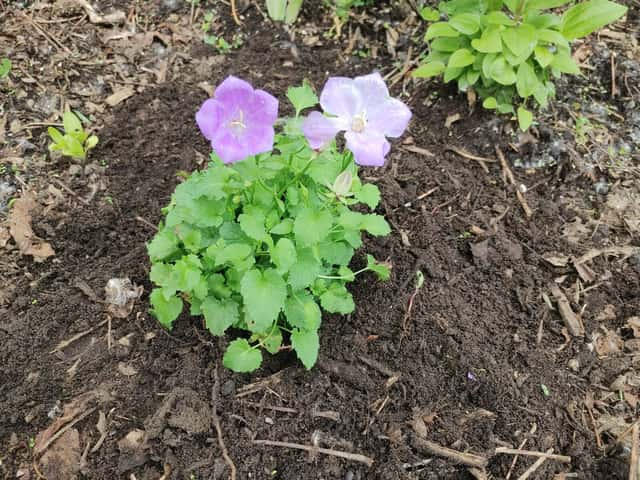
Campanulaceae
Carpathian Bellflower (Campanula carpatica)
Campanula carpatica
An easy plant for sun or part shade in a cool spot. Keep the soil lightly moist, never soggy, mulch to keep the roots cool and deadhead to extend flowering. Divide the clump every 2 to 4 years.
Every 4 days
Bright indirect
-35° - 30°C
40% - 70%
Categories
What is Carpathian bellflower?
Carpathian bellflower (Campanula carpatica) is a easy-care plant from the Campanulaceae family. Campanula carpatica is a low perennial in the Campanulaceae family, native to the Carpathian Mountains of eastern Europe, where it grows among mountain rocks. It forms a compact mound 10 to 30 cm tall and wide, with small heart-shaped, toothed leaves. From late spring through summer it covers itself...
Carpathian bellflower grows up to 30cm, spread of 30cm, watering every 4 days, -35°C – 30°C, 40–70% humidity. It is not suitable for indoor environments and safe for pets.
Unlike many tropical plants, Carpathian bellflower tolerates watering mistakes. Best for beginners. Unlike many popular species, Carpathian bellflower is safe to keep around pets.
How to Care for Carpathian bellflower?
TLDR: Carpathian bellflower needs Bright indirect, watering every 4 days, and temperatures between -35-30°C with 40-70% humidity.
How Often Should You Water Carpathian bellflower?
Water when the top couple of centimetres of soil dry out: it dislikes both drought and soggy soil. Check pots more often in hot weather. Cut back in winter to avoid wet roots.
How Much Light Does Carpathian bellflower Need?
Full sun in mild climates, or part shade with morning sun where summers are hot. Strong heat with warm nights shortens its life.
What Is the Best Soil for Carpathian bellflower?
Fertile, well-draining loamy, sandy or chalky soil. In pots, use a flowering-plant mix with some sand or perlite.
What Pot Should You Use for Carpathian bellflower?
Medium pot, wider than deep, with drainage holes. Terracotta helps prevent soggy soil. It also suits troughs and rock crevices.
What Is Carpathian bellflower and Where Does It Come From?
Campanula carpatica is a low perennial in the Campanulaceae family, native to the Carpathian Mountains of eastern Europe, where it grows among mountain rocks. It forms a compact mound 10 to 30 cm tall and wide, with small heart-shaped, toothed leaves. From late spring through summer it covers itself in upturned bell- or cup-shaped flowers in blue, purple or white on thin, wiry stems. It is a favourite for border edges, rock gardens and containers.
How to Propagate Carpathian bellflower?
Clump division
Dividing every 2 to 4 years also rejuvenates the plant so it flowers more.
- 1 In spring or early summer, lift the clump from the ground or pot
- 2 Split it into pieces with roots and shoots, by hand or with a clean knife
- 3 Replant each piece at the same depth, about 30 cm apart
- 4 Water well and keep moist until it starts growing again
Materials needed:
Seed
Named cultivars such as the Clips series may not come true from seed.
- 1 Sow outdoors after the last frost or start indoors before it
- 2 Scatter the very fine seed on the surface without covering
- 3 Keep moist in a bright spot
- 4 Transplant when seedlings have 3 to 4 leaves
Materials needed:
How Big Does Carpathian bellflower Grow?
TLDR: Carpathian bellflower can reach up to 30cm tall with Medium growth rate.
Max height
30cm
Spread
30cm
Growth rate
Medium
Foliage
Semi-evergreen
Plant Uses
Ornamental
Great for decoration
Ground Cover
Soil coverage
Is your plant showing symptoms?
Click on the symptom to discover possible causes:
What Diseases Commonly Affect Carpathian bellflower?
TLDR: Carpathian bellflower is susceptible to 4 known diseases. Monitor regularly for early detection.
Slugs and Snails
Slugs and snails are mollusks that feed on plant tissue, causing irregular holes in leaves and damage to young seedlings. They are most active at night and in moist conditions, leaving characteristic silvery slime trails. These pests can quickly devastate gardens, especially during wet seasons.
Powdery Mildew
Powdery mildew is a common fungal disease caused by various fungi species including Erysiphe, Podosphaera, Oïdium, and Leveillula. It affects over 10,000 plant species worldwide. The disease thrives in warm, dry climates with high humidity and appears as a distinctive white powdery coating on plant surfaces.
Rust
Rust is a common fungal disease caused by fungi in the order Pucciniales that affects a wide variety of plants. The disease gets its name from the characteristic orange, yellow, or reddish-brown pustules that appear on leaves, resembling metal rust. This obligate fungal parasite requires living plants to survive and can cause significant economic losses in agricultural crops.
Root Rot
Root rot is a serious fungal disease that affects the root system of plants, causing them to decay and die. It is primarily caused by overwatering, poor drainage, or soil-borne fungi such as Pythium, Phytophthora, Rhizoctonia, and Fusarium. The disease thrives in waterlogged conditions where roots are deprived of oxygen, making them susceptible to fungal infection.
Fun Facts
Campanula comes from the Latin campana, bell
It reached Kew Gardens in 1774, sent by Nikolaus von Jacquin
Its flowers face upward, unlike many nodding bellflowers
Frequently asked questions
How do I keep it flowering longer?
Can I grow it in a pot?
Why is it dying in the heat?
What pests attack it?
Compare with similar plants
| Attribute | Difficulty | Light | Watering | Pet Safe |
|---|---|---|---|---|
| Field Maple | Easy | Bright indirect | 14d | ✓ |
| Iberian Houseleek | Easy | Direct sun | 14d | ✓ |
| Silver Birch | Easy | Direct sun | 14d | ✓ |
| Common Blanketflower | Easy | Direct sun | 10d | ✓ |





