Aizoaceae
Cat's jaws (Faucaria felina)
Faucaria felina
Give it plenty of light with a few hours of direct sun, and use a very free-draining cactus mix. Water only when the mix is completely dry, and hardly at all in winter. Protect from cold below 5 °C and from constant rain. Overwatering is what kills it most often.
Every 14 days
Bright indirect
5° - 35°C
20% - 50%
Categories
What is Cat's jaws?
Cat's jaws (Faucaria felina) is a easy-care plant from the Aizoaceae family. Cat's jaws (Faucaria felina) is a small, stemless succulent in the ice plant family (Aizoaceae), native to the Eastern and Western Cape of South Africa. It forms compact clumps up to 15 cm tall of thick, boat-shaped leaves up to 7 cm long, dark green to greyish, with 3 to 5 curved white teeth along...
Cat's jaws grows up to 15cm, watering every 14 days, 5°C – 35°C, 20–50% humidity. It is suitable for indoor environments and safe for pets.
Unlike many tropical plants, Cat's jaws tolerates watering mistakes. Best for beginners. Unlike many popular species, Cat's jaws is safe to keep around pets. Without adequate drainage, root rot can develop within 28 days.
How to Care for Cat's jaws?
TLDR: Cat's jaws needs Bright indirect, watering every 14 days, and temperatures between 5-35°C with 20-50% humidity.
How Often Should You Water Cat's jaws?
During the growing season, water deeply once the mix is completely dry, usually every 2 weeks. In winter, give just enough to stop the leaves shrivelling. Never leave water in the saucer.
How Much Light Does Cat's jaws Need?
It likes morning sun or filtered sun; indoors, keep it at your brightest window. In low light the leaves stretch and it won't flower, since the flowers only open in sun.
What Is the Best Soil for Cat's jaws?
Use cactus and succulent mix with plenty of coarse sand, grit or perlite (half or more). The key is that water drains away fast.
What Pot Should You Use for Cat's jaws?
A shallow, wide terracotta pot with a drainage hole. Terracotta helps the mix dry out faster.
Care Schedule
Repot
Every 730 days
What Is Cat's jaws and Where Does It Come From?
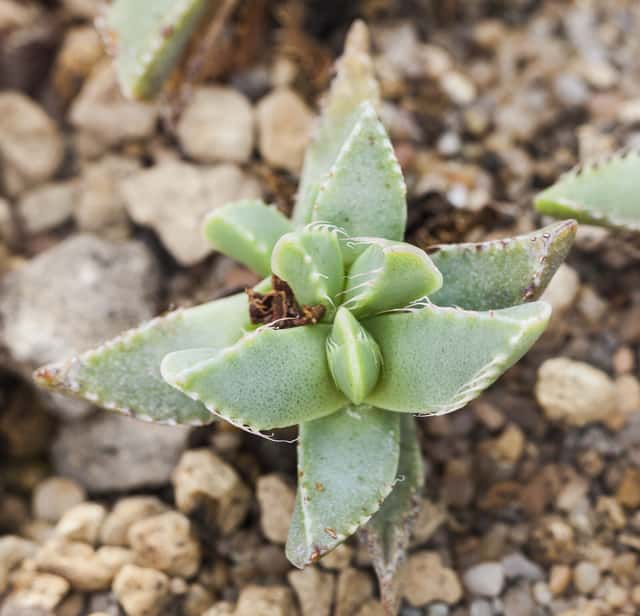
Cat's jaws (Faucaria felina) is a small, stemless succulent in the ice plant family (Aizoaceae), native to the Eastern and Western Cape of South Africa. It forms compact clumps up to 15 cm tall of thick, boat-shaped leaves up to 7 cm long, dark green to greyish, with 3 to 5 curved white teeth along the edges that look like a cat's claws. The daisy-like flowers are yellow to orange, up to 5 cm across, and open only in sunshine. Most plants sold simply as 'Faucaria' are a form of this species.
How to Propagate Cat's jaws?
Division
Letting the cut callus before planting prevents rot.
- 1 Take the plant out of its pot and separate a rosette with roots or a piece of the base
- 2 Let the cut surface dry for 1 to 2 days
- 3 Plant in dry succulent mix
- 4 Wait about a week before the first watering
Materials needed:
Seed
The seeds are tiny. Seedlings grow slowly and take a few years to flower.
- 1 Scatter the seeds on moist sandy mix without covering them
- 2 Cover the pot with clear plastic
- 3 Keep in a bright, warm spot out of strong sun
- 4 Remove the plastic gradually once seedlings appear
Materials needed:
How Big Does Cat's jaws Grow?
TLDR: Cat's jaws can reach up to 15cm tall with Slow growth rate.
Max height
15cm
Growth rate
Slow
Foliage
Evergreen
Plant Uses
Ornamental
Great for decoration
Is your plant showing symptoms?
Click on the symptom to discover possible causes:
What Diseases Commonly Affect Cat's jaws?
TLDR: Cat's jaws is susceptible to 2 known diseases. Monitor regularly for early detection.
Root Rot
Root rot is a serious fungal disease that affects the root system of plants, causing them to decay and die. It is primarily caused by overwatering, poor drainage, or soil-borne fungi such as Pythium, Phytophthora, Rhizoctonia, and Fusarium. The disease thrives in waterlogged conditions where roots are deprived of oxygen, making them susceptible to fungal infection.
Mealybugs
Mealybugs are small, soft-bodied insects covered with a white, waxy, cottony material. They are common pests of houseplants and outdoor plants in mild climates. These sap-sucking insects feed on plant tissue, causing damage, stunted growth, and can lead to plant death if left untreated. They produce sticky honeydew which attracts sooty mold.
Fun Facts
The name felina comes from the leaf teeth looking like a cat's claws.
The flowers open around midday and stay shut on cloudy days.
The teeth on the leaf edges help the plant catch moisture from the air and channel it to the roots.
Frequently asked questions
Why won't my cat's jaws flower?
Are the teeth on the leaves sharp?
Is cat's jaws toxic to cats and dogs?
Why have the leaves turned soft and translucent?
Compare with similar plants
| Attribute | Difficulty | Light | Watering | Pet Safe |
|---|---|---|---|---|
| Field Maple | Easy | Bright indirect | 14d | ✓ |
| Iberian Houseleek | Easy | Direct sun | 14d | ✓ |
| Silver Birch | Easy | Direct sun | 14d | ✓ |
| Common Blanketflower | Easy | Direct sun | 10d | ✓ |





