Urticaceae
Cecropia (genus)
Cecropia
An easy, fast-growing tree for tropical climates. Plant it in full sun in well-drained soil that stays moist, and keep lawn grass away from the roots while young. It does not tolerate frost: below 0 °C it drops its leaves and may die. It is short-lived and has soft, brittle wood, so give it room and keep it away from buildings. Check local rules first, as some species are invasive in warm regions outside the Americas.
Every 7 days
Direct sun
-1° - °C
% - %
Categories
What is Cecropia?
Cecropia (Cecropia) is a easy-care plant from the Urticaceae family. Cecropia is a genus of trees in the nettle family (Urticaceae) native to tropical America, from Mexico to southern Brazil, from sea level to 2,600 m. There are about 60 species, including the trumpet tree (Cecropia peltata), Ambay pumpwood (C. pachystachya) and red cecropia (C. glaziovii). They are...
Cecropia grows up to 15.0m, watering every 7 days. It is not suitable for indoor environments and safe for pets.
Unlike many tropical plants, Cecropia tolerates watering mistakes. Best for beginners. Unlike many popular species, Cecropia is safe to keep around pets.
How to Care for Cecropia?
TLDR: Cecropia needs Direct sun, watering every 7 days, and temperatures between -1-30°C with 40-70% humidity.
How Often Should You Water Cecropia?
Water young trees every week during the first year, keeping the soil moist but not soggy. Once established, rainfall is usually enough in tropical climates; give a deep soak during long dry spells.
How Much Light Does Cecropia Need?
Full sun. It is a light-hungry species: in shade it grows thin and weak.
What Is the Best Soil for Cecropia?
Well-drained soil, ideally fertile and evenly moist. As a pioneer it also establishes in poor, disturbed soils.
What Pot Should You Use for Cecropia?
Not suited to long-term container growing: it is a fast-growing tree. Seedlings can stay in large, well-drained pots until planted out.
What Is Cecropia and Where Does It Come From?
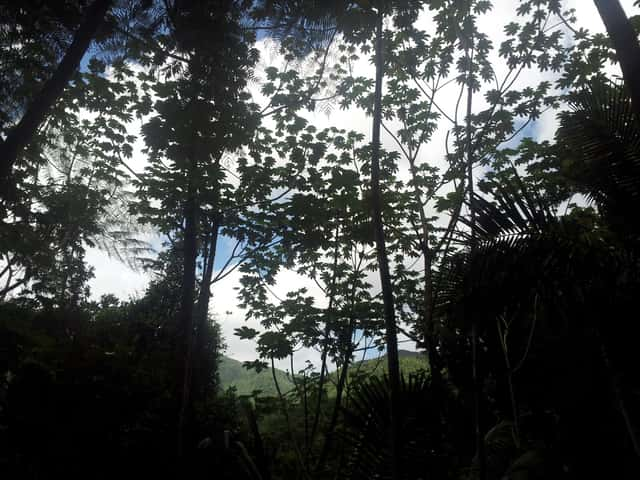
Cecropia is a genus of trees in the nettle family (Urticaceae) native to tropical America, from Mexico to southern Brazil, from sea level to 2,600 m. There are about 60 species, including the trumpet tree (Cecropia peltata), Ambay pumpwood (C. pachystachya) and red cecropia (C. glaziovii). They are pioneer trees: among the first to colonise forest gaps and cleared land, and they grow very fast. Most reach 5-15 m, with sparse branches and an umbrella-like crown of large, rounded leaves 30-40 cm across, split into 7-11 lobes and often whitish underneath. The trunk and branches are hollow and, in the wild, house Azteca ants that defend the tree. Plants are male or female; females bear finger-like fruits eaten by bats, birds and monkeys, and the leaves are a staple food for sloths. Some species have become invasive outside the Americas, for example in Hawaii and Southeast Asia.
How to Propagate Cecropia?
Seed
The seeds are tiny and numerous: sow them fresh and don't bury them. For stored or dormant seed, soaking in 60 °C water for 3-5 minutes improved germination in C. pachystachya.
- 1 Pick ripe fruiting spikes straight from the tree
- 2 Leave them in a plastic bag for a few days until the pulp softens, then rinse the seeds in running water over a sieve
- 3 Scatter the fresh seeds on an organic, clay-rich mix in a tray or bed in part shade, without covering them
- 4 Water lightly to settle them and keep moist until they germinate
Materials needed:
How Big Does Cecropia Grow?
TLDR: Cecropia can reach up to 15.0m tall with Fast growth rate.
Max height
15.0m
Growth rate
Fast
Foliage
Evergreen
Plant Uses
Ornamental
Great for decoration
Medicinal
Medicinal properties
Medicinal Uses
- Leaf tea is used in folk medicine as a diuretic and for cough, asthma and high blood pressure (benefits and safe dose not established)
Culinary Uses
- Young buds eaten cooked as a vegetable in some regions
Is your plant showing symptoms?
Click on the symptom to discover possible causes:
What Diseases Commonly Affect Cecropia?
TLDR: Cecropia is susceptible to 1 known diseases. Monitor regularly for early detection.
Fun Facts
Its leaves are a staple food for sloths
A mature tree can produce up to a million seeds
In the wild, Azteca ants live inside the hollow trunk and defend the tree
Frequently asked questions
How fast does Cecropia grow?
Can Cecropia survive cold?
Why are there ants in the trunk?
Is Cecropia invasive?
Compare with similar plants
| Attribute | Difficulty | Light | Watering | Pet Safe |
|---|---|---|---|---|
| Field Maple | Easy | Bright indirect | 14d | ✓ |
| Iberian Houseleek | Easy | Direct sun | 14d | ✓ |
| Silver Birch | Easy | Direct sun | 14d | ✓ |
| Common Blanketflower | Easy | Direct sun | 10d | ✓ |





