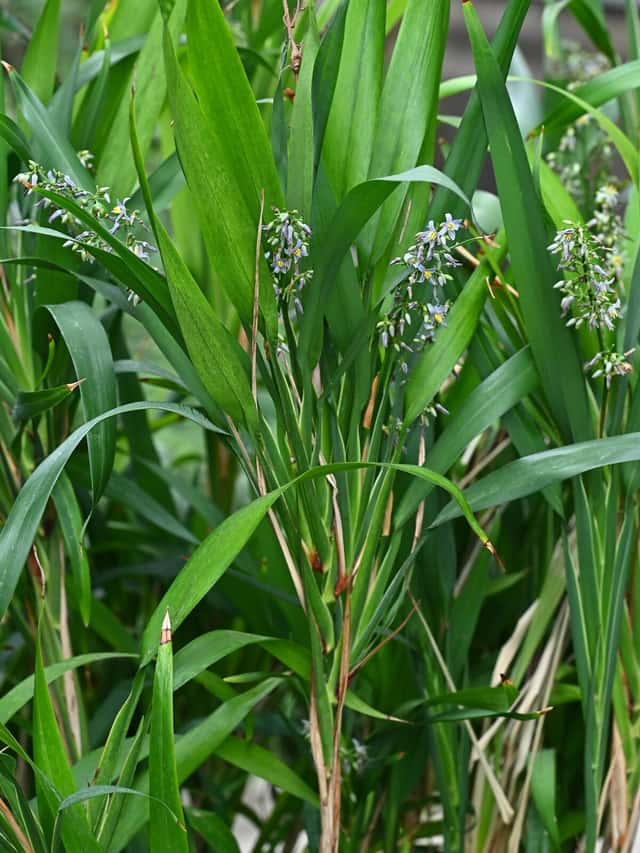
Asphodelaceae
Cerulean Flax Lily (Dianella ensifolia)
Dianella ensifolia
An easy plant for semi-shade to full sun in moist, well-drained, slightly acidic soil. Water moderately and never leave it waterlogged. Tidy old leaves and spent stems once or twice a year and divide crowded clumps. Pest problems are rare.
Every 7 days
Partial shade
-2° - 38°C
40% - 80%
Categories
What is Cerulean Flax Lily?
Cerulean Flax Lily (Dianella ensifolia) is a easy-care plant from the Asphodelaceae family. Dianella ensifolia, the cerulean flax lily, is a clump-forming evergreen perennial with a creeping rhizome. Its native range is huge, from Madagascar and India through southern China, Japan and Southeast Asia to eastern Australia and the Pacific Islands. The leathery, glossy, sword-shaped leaves gro...
Cerulean Flax Lily grows up to 1.8m, spread of 90cm, watering every 7 days, -2°C – 38°C, 40–80% humidity. It is suitable for indoor environments and not safe for pets.
Unlike many tropical plants, Cerulean Flax Lily tolerates watering mistakes. Best for beginners. Without precautions, ingestion can cause irritation in pets. Keep out of reach of cats and dogs. Without adequate drainage, root rot can develop within 14 days.
How to Care for Cerulean Flax Lily?
TLDR: Cerulean Flax Lily needs Partial shade, watering every 7 days, and temperatures between -2-38°C with 40-80% humidity.
How Often Should You Water Cerulean Flax Lily?
Water when the top 2-3 cm of soil is dry, roughly once a week in warm weather, and less in winter. Yellowing leaves usually mean too much water or poor drainage.
How Much Light Does Cerulean Flax Lily Need?
Grows in semi-shade to full sun. A few hours of direct sun give more flowers and berries; in deep shade it grows but fruits poorly. Indoors, keep it next to a bright window.
What Is the Best Soil for Cerulean Flax Lily?
Prefers fertile, loamy, well-drained soil that is slightly acidic (pH 5.0-6.5). Work compost into the planting hole and avoid spots where water pools.
What Pot Should You Use for Cerulean Flax Lily?
Medium to large pot with drainage holes, terracotta or plastic, with a drainage layer at the bottom. In the garden it works well in beds and borders.
Care Schedule
Fertilize
Every 60 days
Repot
Every 730 days
What Is Cerulean Flax Lily and Where Does It Come From?
Dianella ensifolia, the cerulean flax lily, is a clump-forming evergreen perennial with a creeping rhizome. Its native range is huge, from Madagascar and India through southern China, Japan and Southeast Asia to eastern Australia and the Pacific Islands. The leathery, glossy, sword-shaped leaves grow 30-80 cm long. Flowering stems reach 1.2-1.8 m and carry loose panicles of small white to pale blue flowers with yellow-orange anthers, followed by round, shiny deep blue to purple berries. The berries are considered toxic and should not be eaten.
How to Propagate Cerulean Flax Lily?
Clump division
The quickest and most reliable method. Trim the leaves by half to cut water loss while the roots recover.
- 1 Lift the clump in early spring
- 2 Cut it into sections that each have rhizome, roots and at least 3 leaves
- 3 Replant at the same depth in well-drained soil
- 4 Water well and keep the soil lightly moist until established
Materials needed:
Seed
Wear gloves when handling the berries, which are considered toxic. Germination can be slow and uneven.
- 1 Collect fully ripe berries and remove the pulp
- 2 Wash and dry the black seeds
- 3 Sow shallowly in a light, moist seed mix
- 4 Keep warm in bright indirect light until they germinate
Materials needed:
How Big Does Cerulean Flax Lily Grow?
TLDR: Cerulean Flax Lily can reach up to 1.8m tall with Medium growth rate.
Max height
1.8m
Spread
90cm
Growth rate
Medium
Foliage
Evergreen
Warning: Toxic Plant
This plant can be toxic if ingested. Keep out of reach of:
Plant Uses
Ornamental
Great for decoration
Medicinal
Medicinal properties
Medicinal Uses
- Stems, leaves, fruits and roots are used in traditional Southeast Asian medicine for various ailments
- Do not use without medical advice: the plant is considered toxic
Is your plant showing symptoms?
Click on the symptom to discover possible causes:
What Diseases Commonly Affect Cerulean Flax Lily?
TLDR: Cerulean Flax Lily is susceptible to 5 known diseases. Monitor regularly for early detection.
Root Rot
Root rot is a serious fungal disease that affects the root system of plants, causing them to decay and die. It is primarily caused by overwatering, poor drainage, or soil-borne fungi such as Pythium, Phytophthora, Rhizoctonia, and Fusarium. The disease thrives in waterlogged conditions where roots are deprived of oxygen, making them susceptible to fungal infection.
Slugs and Snails
Slugs and snails are mollusks that feed on plant tissue, causing irregular holes in leaves and damage to young seedlings. They are most active at night and in moist conditions, leaving characteristic silvery slime trails. These pests can quickly devastate gardens, especially during wet seasons.
Mealybugs
Mealybugs are small, soft-bodied insects covered with a white, waxy, cottony material. They are common pests of houseplants and outdoor plants in mild climates. These sap-sucking insects feed on plant tissue, causing damage, stunted growth, and can lead to plant death if left untreated. They produce sticky honeydew which attracts sooty mold.
Aphids
Aphids are small, soft-bodied, pear-shaped insects (1/16 to 1/8 inch long) that feed by sucking nutrient-rich sap from plants. They reproduce rapidly and can quickly weaken plants, causing distorted growth and transmitting plant viruses. Aphids come in various colors including green, black, red, yellow, brown, and gray. They secrete honeydew, a sticky substance that attracts ants and encourages sooty mold growth.
Meaning & Symbolism
The genus honours Diana, Roman goddess of the hunt and the woods. Its sword-shaped leaves and jewel-like blue berries make it a symbol of protection and quiet resilience in shaded gardens.
Fun Facts
The genus is named after Diana, the Roman goddess of the hunt
Ensifolia means sword-shaped leaf
The flowers open in the afternoon and are pollinated by insects
Birds eat the berries and spread the seeds
Frequently asked questions
Is Dianella ensifolia toxic?
How often should I water it?
Can it grow indoors?
How do I propagate it?
Compare with similar plants
| Attribute | Difficulty | Light | Watering | Pet Safe |
|---|---|---|---|---|
| Field Maple | Easy | Bright indirect | 14d | ✓ |
| Iberian Houseleek | Easy | Direct sun | 14d | ✓ |
| Silver Birch | Easy | Direct sun | 14d | ✓ |
| Common Blanketflower | Easy | Direct sun | 10d | ✓ |





