Brassicaceae
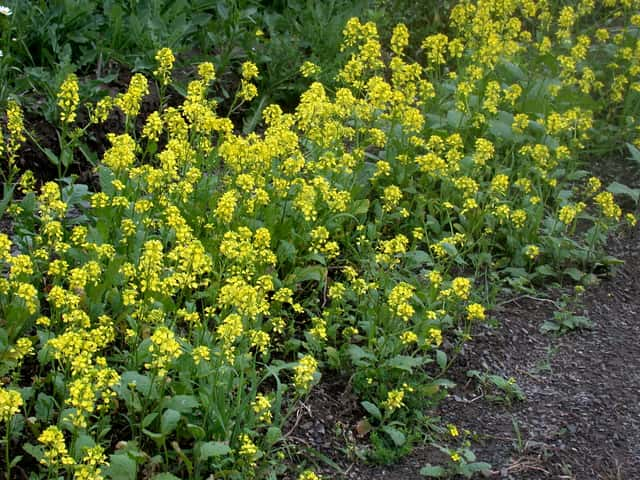
Charlock (Sinapis arvensis)
Sinapis arvensis
Full sun and almost no care: it grows on its own in ordinary soil and self-seeds freely. Pick young leaves before flowering and pull plants before they set seed if you don't want it to spread.
Every 7 days
Direct sun
° - °C
% - %
Categories
What is Charlock?
Charlock (Sinapis arvensis) is a easy-care plant from the Brassicaceae family. Charlock (Sinapis arvensis) is an annual herb in the cabbage family (Brassicaceae), native to the Mediterranean basin, Europe, North Africa and parts of Asia, and now naturalised in the Americas, Australia and South Africa. It usually grows 20 cm to 1 m tall and bears clusters of four-petalled yello...
Charlock grows up to 1.0m, watering every 7 days. It is not suitable for indoor environments and safe for pets.
Unlike many tropical plants, Charlock tolerates watering mistakes. Best for beginners. Unlike many popular species, Charlock is safe to keep around pets.
How to Care for Charlock?
TLDR: Charlock needs Direct sun, watering every 7 days, and temperatures between 15-30°C with 40-70% humidity.
How Often Should You Water Charlock?
Water only to germinate the seed and in long dry spells; rain is usually enough.
How Much Light Does Charlock Need?
Needs full sun.
What Is the Best Soil for Charlock?
Prefers sunny chalky soil but grows in almost any cultivated ground.
What Pot Should You Use for Charlock?
Rarely grown in pots; if you do, use one at least 20 cm deep.
What Is Charlock and Where Does It Come From?
Charlock (Sinapis arvensis) is an annual herb in the cabbage family (Brassicaceae), native to the Mediterranean basin, Europe, North Africa and parts of Asia, and now naturalised in the Americas, Australia and South Africa. It usually grows 20 cm to 1 m tall and bears clusters of four-petalled yellow flowers from spring to late summer. It grows mainly in arable fields, roadsides and waste ground, preferring sunny, chalky soils, and is a common weed of crops. Young leaves are edible when cooked and the ground seeds make a mustard-like condiment.
How to Propagate Charlock?
Seed
It self-seeds and the seeds persist in the soil for years, so harvest before the pods dry.
- 1 Scatter the seeds on loose, sunny soil
- 2 Cover with a thin layer of soil
- 3 Keep moist until they germinate
- 4 Thin seedlings to about 15 cm apart
Materials needed:
How Big Does Charlock Grow?
TLDR: Charlock can reach up to 1.0m tall with Fast growth rate.
Max height
1.0m
Growth rate
Fast
Foliage
Deciduous
Plant Uses
Edible
Can be consumed
Culinary Uses
- Young leaves, cooked
- Ground seeds as a mustard-like condiment
Is your plant showing symptoms?
Click on the symptom to discover possible causes:
What Diseases Commonly Affect Charlock?
TLDR: Charlock is susceptible to 5 known diseases. Monitor regularly for early detection.
Downy Mildew
Downy mildew is a fungal-like disease caused by oomycetes (water molds) that thrives in cool, wet conditions. It affects a wide range of plants, causing yellowing leaves with fuzzy white-gray growth underneath, leading to defoliation and reduced yields if left untreated.
Flea beetle damage
Flea beetles are small, jumping insects that feed on the leaves of many vegetable crops. They chew numerous small, circular holes, creating a characteristic 'shothole' appearance. While established plants can often tolerate the damage, young seedlings are highly susceptible and can be stunted or killed if the infestation is severe.
Caterpillars
Caterpillars are the larval stage of moths and butterflies that feed voraciously on plant foliage, stems, flowers, and fruits. Common species include cabbage loopers, tomato hornworms, armyworms, and cutworms. These pests can cause extensive damage by consuming large amounts of plant tissue in a short time. They vary in size from small (1/4 inch) to large (5 inches), with colors ranging from green to brown, often featuring stripes or spots. Caterpillars are highly mobile and can quickly spread throughout gardens, making them one of the most destructive common pests.
Leaf Curl Virus
Leaf curl virus is a serious viral disease caused by begomoviruses, transmitted by whiteflies (Bemisia tabaci). It affects various plants including tomatoes, peppers, and ornamentals, causing significant yield losses and plant decline. Once infected, plants cannot be cured and management focuses on prevention and vector control.
Fun Facts
It was eaten as a famine food during Ireland's Great Famine
Caterpillars of the small white and green-veined white butterflies feed on it
It contains sinalbin, the compound behind mustard's heat
Frequently asked questions
Is charlock edible?
Is charlock toxic to animals?
How do I control it in the garden?
How is it different from cultivated mustard?
Compare with similar plants
| Attribute | Difficulty | Light | Watering | Pet Safe |
|---|---|---|---|---|
| Field Maple | Easy | Bright indirect | 14d | ✓ |
| Iberian Houseleek | Easy | Direct sun | 14d | ✓ |
| Silver Birch | Easy | Direct sun | 14d | ✓ |
| Common Blanketflower | Easy | Direct sun | 10d | ✓ |





