Commelinaceae
Climbing Dayflower (Commelina diffusa)
Commelina diffusa
Very easy and largely self-sufficient: moist soil, part shade or filtered sun and warmth. Use it as a ground cover only in a contained bed or pot, because it spreads fast by stems and seed. Pinch back the tips to control size, and when pulling it remove every piece, since any stem fragment will root again.
Every 4 days
Partial shade
° - °C
% - %
Categories
What is Climbing Dayflower?
Climbing Dayflower (Commelina diffusa) is a easy-care plant from the Commelinaceae family. Commelina diffusa is a creeping herb in the spiderwort family (Commelinaceae), probably native to tropical Asia, Australia and Polynesia and now found throughout the warm regions of the world. Its soft, fleshy, much-branched stems grow up to 1 m long and root at every node that touches the soil, for...
Climbing Dayflower grows up to spread of 100cm, watering every 4 days. It is not suitable for indoor environments and safe for pets.
Unlike many tropical plants, Climbing Dayflower tolerates watering mistakes. Best for beginners. Unlike many popular species, Climbing Dayflower is safe to keep around pets.
How to Care for Climbing Dayflower?
TLDR: Climbing Dayflower needs Partial shade, watering every 4 days, and temperatures between 15-30°C with 40-70% humidity.
How Often Should You Water Climbing Dayflower?
Keep the soil consistently moist: water every 3 to 5 days in hot weather, or when the surface starts to dry. It tolerates brief waterlogging but wilts quickly in prolonged drought.
How Much Light Does Climbing Dayflower Need?
Part shade or morning sun with afternoon shade. It also grows in full sun if the soil stays moist, and tolerates deeper shade with fewer flowers.
What Is the Best Soil for Climbing Dayflower?
Ordinary, fertile, moisture-retentive soil with organic matter. It is not fussy and grows in clay, disturbed ground and even wet, boggy areas.
What Pot Should You Use for Climbing Dayflower?
A wide, shallow pot or hanging basket with drainage holes, where the stems can trail without escaping into the garden.
What Is Climbing Dayflower and Where Does It Come From?
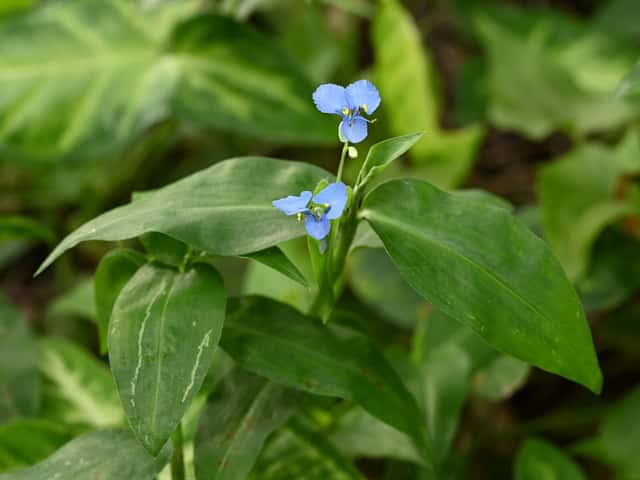
Commelina diffusa is a creeping herb in the spiderwort family (Commelinaceae), probably native to tropical Asia, Australia and Polynesia and now found throughout the warm regions of the world. Its soft, fleshy, much-branched stems grow up to 1 m long and root at every node that touches the soil, forming dense mats. The alternate, lance-shaped leaves are 2 to 11 cm long and wrap the stem with a sheath. The bright blue (rarely white) flowers have two large petals and one small one, with yellow stamens, and open only in the morning before closing in the afternoon. It likes damp, shady spots, stream banks and disturbed ground, and is a common weed of crops, gardens and lawns in warm climates.
How to Propagate Climbing Dayflower?
Stem cuttings
It roots so readily that a stem only needs to touch the soil. Do not put trimmings in the garden compost.
- 1 Cut a stem piece with 2 or 3 nodes
- 2 Strip the leaves from the lowest node
- 3 Bury that node in moist potting mix or stand it in a glass of water
- 4 Keep moist in part shade until new growth appears
Materials needed:
Seed
The plant self-seeds easily, so collecting seed is rarely needed.
- 1 Scatter the dark seeds over moist potting mix
- 2 Cover with a thin layer of soil
- 3 Keep moist and warm
Materials needed:
How Big Does Climbing Dayflower Grow?
TLDR: Climbing Dayflower can reach up to ?cm tall with Fast growth rate.
Spread
1.0m
Growth rate
Fast
Plant Uses
Ornamental
Great for decoration
Medicinal
Medicinal properties
Edible
Can be consumed
Ground Cover
Soil coverage
Medicinal Uses
- Used in traditional Chinese medicine to reduce fever
- Applied to deep cuts in traditional Hawaiian medicine
Culinary Uses
- Young shoot tips are eaten cooked as a vegetable in Papua New Guinea
Is your plant showing symptoms?
Click on the symptom to discover possible causes:
What Diseases Commonly Affect Climbing Dayflower?
TLDR: Climbing Dayflower is susceptible to 5 known diseases. Monitor regularly for early detection.
Aphids
Aphids are small, soft-bodied, pear-shaped insects (1/16 to 1/8 inch long) that feed by sucking nutrient-rich sap from plants. They reproduce rapidly and can quickly weaken plants, causing distorted growth and transmitting plant viruses. Aphids come in various colors including green, black, red, yellow, brown, and gray. They secrete honeydew, a sticky substance that attracts ants and encourages sooty mold growth.
Mosaic Virus
Mosaic virus is a group of plant viruses that cause mottled, patchy patterns on leaves and can affect a wide variety of plants. The virus creates characteristic yellow, white, and green mosaic patterns, often accompanied by stunted growth and deformed plant parts. This highly contagious disease spreads rapidly through insect vectors and contaminated tools.
Mosaic Virus
Potyviruses (family Potyviridae, genus Potyvirus) are plant viruses transmitted primarily by aphids during feeding and mechanically through sap. They cause mosaic patterns (light and dark patches) on leaves, leaf curling and distortion, vein clearing, leaf blistering, stunting, and in vegetables and fruits, streaks and discoloration. In potatoes (Potato virus Y), necrotic spots on leaves and ringspots on tubers may occur; in cucurbits (e.g., Zucchini yellow mosaic virus), distinct mosaic and deformations of leaves and fruit; in peppers, streaks and spots on fruit; in brassicas (Turnip mosaic virus), mosaic and stunted growth; and in plums, Sharka (plum pox) causing spots and fruit distortion. Infection can also be introduced via seeds, seedlings, tubers, scions, and host weeds. Unfortunately, infected plants cannot be cured.
Caterpillars
Caterpillars are the larval stage of moths and butterflies that feed voraciously on plant foliage, stems, flowers, and fruits. Common species include cabbage loopers, tomato hornworms, armyworms, and cutworms. These pests can cause extensive damage by consuming large amounts of plant tissue in a short time. They vary in size from small (1/4 inch) to large (5 inches), with colors ranging from green to brown, often featuring stripes or spots. Caterpillars are highly mobile and can quickly spread throughout gardens, making them one of the most destructive common pests.
Fun Facts
Each flower opens in the morning and closes the same day, hence the name dayflower
A blue dye can be extracted from the flowers
It tolerates temporary flooding and even grows in rice paddies
Frequently asked questions
How do I tell Commelina diffusa from other dayflowers?
Is climbing dayflower invasive?
How do I get rid of dayflower in my garden?
How often should I water it?
Compare with similar plants
| Attribute | Difficulty | Light | Watering | Pet Safe |
|---|---|---|---|---|
| Field Maple | Easy | Bright indirect | 14d | ✓ |
| Iberian Houseleek | Easy | Direct sun | 14d | ✓ |
| Silver Birch | Easy | Direct sun | 14d | ✓ |
| Common Blanketflower | Easy | Direct sun | 10d | ✓ |
Choose & Compare
Sources & References
- Pacific Pests, Pathogens, Weeds & Pesticides — Spreading dayflower (Commelina diffusa)
- Environmental Weeds of Australia (Lucid) — Commelina diffusa
- UF/IFAS EP668 — Biology and management of whitemouth and spreading dayflower
- EPPO Global Database — Commelina diffusa pests
- Wikipedia — Commelina mosaic virus (potyvirus, aphid-transmitted)
- Embrapa — Trapoerabas (Commelina spp.) como plantas daninhas





