Acanthaceae
Clockvine (genus Thunbergia)
Thunbergia
An easy, fast-growing climber. Give it full sun or bright light with a little shade in the hottest hours, rich well-drained soil and something to climb (trellis, fence, arch). Water when the surface dries, without waterlogging. Feed every 4-6 weeks in spring and summer. It won't tolerate temperatures below 10 °C: in cold areas grow it as an annual or in a sheltered pot.
Every 7 days
Bright indirect
10° - °C
% - %
Categories
What is Clockvine?
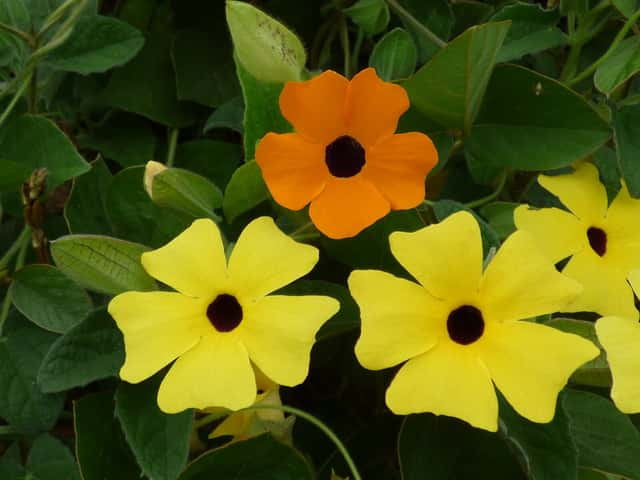
Clockvine (Thunbergia) is a easy-care plant from the Acanthaceae family. Thunbergia is a genus in the acanthus family (Acanthaceae) with about 150 species of vines and shrubs from tropical Africa, Madagascar and southern Asia. The most widely grown are black-eyed Susan vine (Thunbergia alata), with orange, yellow or white flowers around a dark eye; sky vine or Bengal clo...
Clockvine grows up to 8.0m, watering every 7 days. It is suitable for indoor environments and safe for pets.
Unlike many tropical plants, Clockvine tolerates watering mistakes. Best for beginners. Unlike many popular species, Clockvine is safe to keep around pets. Without adequate drainage, root rot can develop within 14 days.
How to Care for Clockvine?
TLDR: Clockvine needs Bright indirect, watering every 7 days, and temperatures between 10-30°C with 40-70% humidity.
How Often Should You Water Clockvine?
Water when the top few centimetres of soil are dry, about once a week in warm weather. Don't let it dry out to the point of wilting, and don't keep it soggy: roots rot in constantly wet soil.
How Much Light Does Clockvine Need?
Full sun or light part shade. With less than a few hours of direct sun it flowers poorly. In very hot climates, afternoon shade helps.
What Is the Best Soil for Clockvine?
Fertile, well-drained soil with plenty of organic matter. In pots, use a light flowering-plant mix with good drainage.
What Pot Should You Use for Clockvine?
A large, deep pot with drainage holes, ideally with a built-in trellis or stake.
Care Schedule
Fertilize
Every 35 days
What Is Clockvine and Where Does It Come From?
Thunbergia is a genus in the acanthus family (Acanthaceae) with about 150 species of vines and shrubs from tropical Africa, Madagascar and southern Asia. The most widely grown are black-eyed Susan vine (Thunbergia alata), with orange, yellow or white flowers around a dark eye; sky vine or Bengal clockvine (T. grandiflora), with large blue-lilac flowers; orange clockvine (T. gregorii); and Mysore trumpet vine (T. mysorensis), with hanging chains of red and yellow flowers. They are twining climbers that wrap around supports and grow quickly, from 2 to 8 m depending on the species, with trumpet-shaped flowers from summer into autumn. In the tropics they live for years; where there is frost they are grown as annuals or in a sheltered pot. Some species escape from gardens and become invasive in warm regions.
How to Propagate Clockvine?
Seed
Works very well for T. alata, which is usually sold as seed. Only sow directly outdoors once the soil has warmed up.
- 1 Soak the seeds in warm water for 12-24 hours
- 2 Sow 1 cm deep in moist seed compost
- 3 Keep warm, above 18 °C
- 4 Plant out once there is no risk of cold and give the seedlings a support within the first few weeks
Materials needed:
Stem cutting
Use softwood or semi-ripe cuttings. Rooting hormone helps with woody species such as T. grandiflora.
- 1 Cut a healthy young shoot 10-15 cm long
- 2 Remove the lower leaves
- 3 Insert into light, moist compost
- 4 Keep warm and bright, out of direct sun, until rooted
Materials needed:
How Big Does Clockvine Grow?
TLDR: Clockvine can reach up to 8.0m tall with Fast growth rate.
Max height
8.0m
Growth rate
Fast
Foliage
Evergreen
Plant Uses
Ornamental
Great for decoration
Is your plant showing symptoms?
Click on the symptom to discover possible causes:
What Diseases Commonly Affect Clockvine?
TLDR: Clockvine is susceptible to 8 known diseases. Monitor regularly for early detection.
Whiteflies
Whiteflies are small, soft-bodied, winged insects closely related to aphids and mealybugs. They are moth-like in appearance, about 1/16 inch long, triangular in shape, and gray-white in color. These sap-sucking pests feed on plant tissue, causing yellowing, stunted growth, and wilting. They also excrete honeydew, which attracts ants and promotes sooty mold growth. Whiteflies can transmit serious plant viruses.
Spider Mites
Spider mites are tiny arachnids (less than 1/20 inch long) related to spiders and ticks that feed on plant sap. They thrive in hot, dry conditions and can cause significant damage to ornamental and vegetable plants. During severe infestations, crop losses can reach 14% or higher as these pests disrupt vital plant processes including photosynthesis, carbon dioxide absorption, and transpiration.
Aphids
Aphids are small, soft-bodied, pear-shaped insects (1/16 to 1/8 inch long) that feed by sucking nutrient-rich sap from plants. They reproduce rapidly and can quickly weaken plants, causing distorted growth and transmitting plant viruses. Aphids come in various colors including green, black, red, yellow, brown, and gray. They secrete honeydew, a sticky substance that attracts ants and encourages sooty mold growth.
Scale Insects
Scale insects are small sap-sucking pests that appear as brown, shell-like bumps on plant stems and leaves. There are over 25 species, divided into armored (hard) and unarmored (soft) scales. They feed by piercing plant tissue and extracting sap, which weakens the plant and can lead to yellowing, stunted growth, and even death if left untreated. They also excrete honeydew, which attracts ants and promotes sooty mold growth.
Fun Facts
The name honours Swedish naturalist Carl Peter Thunberg, a student of Linnaeus
The dark centre of black-eyed Susan vine flowers looks like an eye
Some species, such as sky vine, are listed as invasive weeds in Australia
Frequently asked questions
Does clockvine need sun?
How often should I water it?
Can Thunbergia survive cold?
Is Thunbergia toxic to pets?
Compare with similar plants
| Attribute | Difficulty | Light | Watering | Pet Safe |
|---|---|---|---|---|
| Field Maple | Easy | Bright indirect | 14d | ✓ |
| Iberian Houseleek | Easy | Direct sun | 14d | ✓ |
| Silver Birch | Easy | Direct sun | 14d | ✓ |
| Common Blanketflower | Easy | Direct sun | 10d | ✓ |





