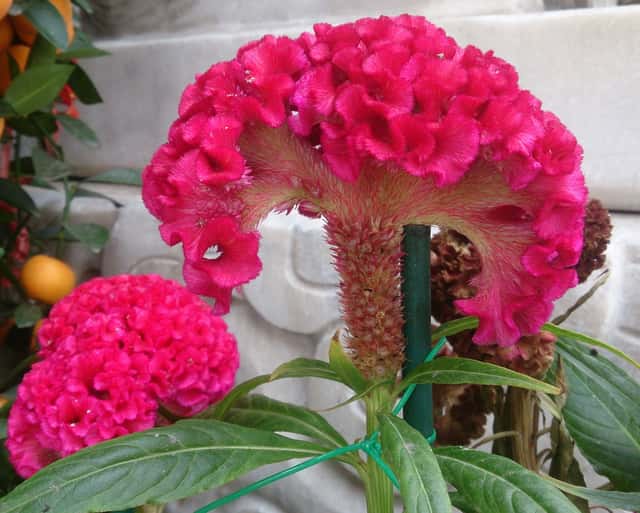
Amaranthaceae
Celosia: Edible Plant
Celosia argentea var. cristata
Cockscomb requires full sun, nutrient-rich, organic-rich, well-draining soil. It thrives best in warm temperatures between 15-32°C and needs moderate, regular watering without waterlogging. As a heat-loving annual, it can behave as a short-lived perennial in hardiness zones 9-11.
Every 3 days
Direct sun
15° - 32°C
40% - 70%
Categories
What is Celosia?
Celosia (Celosia argentea var. cristata) is a easy-care plant from the Amaranthaceae family. Celosia argentea var. cristata (cockscomb) is an annual or short-lived perennial ornamental plant belonging to the Amaranthaceae family, believed to originate from India, tropical Asia, and Africa. Its distinctive, velvety, wavy inflorescence, resembling a rooster's comb or a brain, can bloom in sha...
Celosia grows up to 60cm, spread of 30cm, watering every 3 days, 15°C – 32°C, 40–70% humidity. It is suitable for indoor environments and safe for pets.
Unlike many tropical plants, Celosia tolerates watering mistakes. Best for beginners. Unlike many popular species, Celosia is safe to keep around pets. Without adequate drainage, root rot can develop within 7 days.
How to Care for Celosia?
TLDR: Celosia needs Direct sun, watering every 3 days, and temperatures between 15-32°C with 40-70% humidity.
How Often Should You Water Celosia?
Always water at soil level near the base of the plant, avoiding wetting the flowers and leaves, as this promotes fungal diseases (e.g., stem rot, leaf spot). Water thoroughly, but only when the top layer of soil has dried out — rather less frequently and deeply than often and superficially.
How Much Light Does Celosia Need?
It needs at least 6-8 hours of direct sunlight daily for abundant, vibrant blooms; in shady locations, flowering will be weak and stems will become leggy.
What Is the Best Soil for Celosia?
Requires loose, humus-rich, well-draining, slightly acidic to neutral soil (pH 6.0-7.5).
What Pot Should You Use for Celosia?
A clay or terracotta pot with good drainage holes to prevent root and stem rot.
Care Schedule
Fertilize
Every 14 days
Misting
Every 7 days
Rotate
Every 7 days
What Is Celosia and Where Does It Come From?
Celosia argentea var. cristata (cockscomb) is an annual or short-lived perennial ornamental plant belonging to the Amaranthaceae family, believed to originate from India, tropical Asia, and Africa. Its distinctive, velvety, wavy inflorescence, resembling a rooster's comb or a brain, can bloom in shades of red, yellow, orange, pink, and burgundy. In traditional gardens of India, Burma, and China, it was cultivated as a sacred plant near temples, which contributed to its survival. The plant grows 30-60 cm tall, develops quickly, and its flowers retain their shape and color for a long time, even when dried.
How to Propagate Celosia?
Seed Sowing
- Keep the soil consistently moist during germination.
- Warm soil (min. 16°C) promotes faster and more even emergence.
- Avoid disturbing the roots when transplanting, as cockscomb is sensitive to this.
- 1 Sowing
Sow seeds indoors approximately 6-8 weeks before the last expected frost date, on the surface of a fine-grained potting medium.
- 2 Provide Light
Seeds need light to germinate, so cover them with only a very thin layer of soil.
- 3 Transplanting
After the danger of frost has passed and when the soil temperature is at least 16°C, transplant seedlings to their final sunny location, spaced 15-30 cm apart.
Materials needed:
How Big Does Celosia Grow?
TLDR: Celosia can reach up to 60cm tall with Fast growth rate.
Max height
60cm
Spread
30cm
Growth rate
Fast
Foliage
Deciduous
Plant Uses
Ornamental
Great for decoration
Edible
Can be consumed
Medicinal
Medicinal properties
Medicinal Uses
- Traditionally used for extracts with hepatoprotective (liver-protective) effects
- Its seeds have diuretic properties
- Source of extracts with anti-inflammatory and immunostimulant effects
- Ingredient in traditional remedies used for hemostasis and wound healing
Culinary Uses
- Young leaves and shoots can be cooked and consumed like spinach
- An important leafy vegetable in Nigeria, Benin, Congo, and Indonesia
- Its seeds can be used as a pseudocereal
- In Korea, it is used as a decorative element for sweets and rice cakes
Is your plant showing symptoms?
Click on the symptom to discover possible causes:
What Diseases Commonly Affect Celosia?
TLDR: Celosia is susceptible to 10 known diseases. Monitor regularly for early detection.
Root Rot
Root rot is a serious fungal disease that affects the root system of plants, causing them to decay and die. It is primarily caused by overwatering, poor drainage, or soil-borne fungi such as Pythium, Phytophthora, Rhizoctonia, and Fusarium. The disease thrives in waterlogged conditions where roots are deprived of oxygen, making them susceptible to fungal infection.
Leaf Spot
Leaf spot is a common fungal disease caused by various pathogens including Alternaria, Ascochyta, Colletotrichum, Septoria, and Venturia. It primarily affects leaves, causing discolored spots that can lead to premature leaf drop if left untreated.
Powdery Mildew
Powdery mildew is a common fungal disease caused by various fungi species including Erysiphe, Podosphaera, Oïdium, and Leveillula. It affects over 10,000 plant species worldwide. The disease thrives in warm, dry climates with high humidity and appears as a distinctive white powdery coating on plant surfaces.
Gray Mold (Botrytis Blight)
Gray mold, caused by the fungus Botrytis cinerea, is one of the most common fungal diseases in plants. It affects over 200 plant species, including ornamentals, vegetables, fruits, and houseplants. The disease thrives in cool, humid conditions with poor air circulation, causing grayish spots and soft rot on infected tissues.
Meaning & Symbolism
In the language of flowers, cockscomb symbolizes foolishness, eccentricity, and warmth. Due to its long-lasting, almost unfading flowers, it is also considered a symbol of immortality and transient beauty. In Indian, Burmese, and Chinese traditions, it was planted near temples as a sacred plant, thus also carrying the meaning of protection and spiritual purity.
Compare with similar plants
| Attribute | Difficulty | Light | Watering | Pet Safe |
|---|---|---|---|---|
| Field Maple | Easy | Bright indirect | 14d | ✓ |
| Silver Birch | Easy | Direct sun | 14d | ✓ |
| Common Blanketflower | Easy | Direct sun | 10d | ✓ |
| Cushion Bush | Easy | Direct sun | 14d | ✓ |





