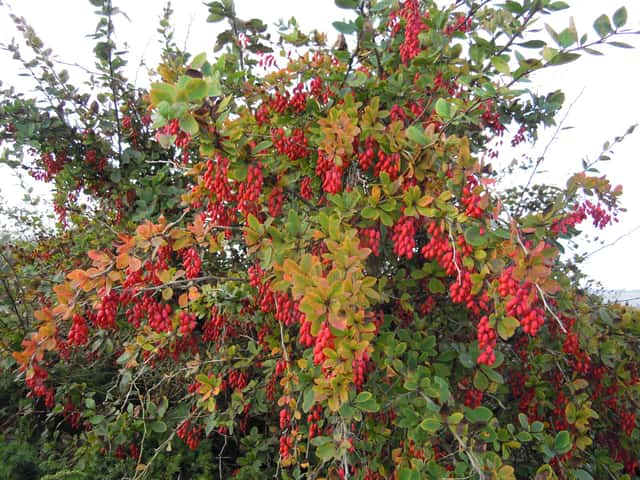
Berberidaceae
Common Barberry (Berberis vulgaris)
Berberis vulgaris
A very tough garden shrub that handles hard frost, poor soil and some drought. Plant it in sun or part shade, water during the first seasons until established, then only in long dry spells. Prune in late winter to keep it in bounds, wearing gloves for the spines. Check first that it is allowed where you live, because of wheat rust.
Every 7 days
Direct sun
° - °C
% - %
Categories
What is Common barberry?
Common barberry (Berberis vulgaris) is a easy-care plant from the Berberidaceae family. Berberis vulgaris is a shrub in the family Berberidaceae, native to central and southern Europe, northwest Africa and western Asia. It loses its leaves in winter and can reach 4 meters. The stems carry three-pronged spines, and above each spine sits a tuft of 2 to 5 oval, finely toothed leaves 2 to...
Common barberry grows up to 4.0m, spread of 250cm, watering every 7 days. It is not suitable for indoor environments and safe for pets.
Unlike many tropical plants, Common barberry tolerates watering mistakes. Best for beginners. Unlike many popular species, Common barberry is safe to keep around pets.
How to Care for Common barberry?
TLDR: Common barberry needs Direct sun, watering every 7 days, and temperatures between 15-30°C with 40-70% humidity.
How Often Should You Water Common barberry?
After planting, water deeply once a week through the first year. Once established it lives on rainfall and only needs water in long droughts. Do not let the soil stay soggy.
How Much Light Does Common barberry Need?
Full sun is best for flowers and fruit. It tolerates part shade and light woodland shade as long as the soil does not dry out.
What Is the Best Soil for Common barberry?
Grows in clay, loam or sand, including poor soil. It prefers soil that stays slightly moist and drains well.
What Pot Should You Use for Common barberry?
Usually grown in the ground or as a hedge. In a container, choose a large, deep pot with drainage holes, since the shrub reaches 2-4 meters.
What Is Common barberry and Where Does It Come From?
Berberis vulgaris is a shrub in the family Berberidaceae, native to central and southern Europe, northwest Africa and western Asia. It loses its leaves in winter and can reach 4 meters. The stems carry three-pronged spines, and above each spine sits a tuft of 2 to 5 oval, finely toothed leaves 2 to 5 cm long. In late spring it bears drooping clusters of small yellow flowers with a strong scent. Oblong red berries 7 to 10 mm long follow in late summer and autumn; they are very sour and rich in vitamin C. In Iran the dried berries (zereshk) flavor rice; in Europe they go into jam. The bark, roots and leaves contain berberine, which is harmful if eaten. The plant hosts wheat stem rust, so growing it is banned in Canada and several US states.
How to Propagate Common barberry?
Seed
The seed needs a cold period to germinate. Wear gloves when picking because of the spines.
- 1 Pick ripe berries in autumn and clean the seeds from the pulp
- 2 Sow right away outdoors or in a pot left out in the cold
- 3 Winter cold breaks dormancy and seedlings come up in spring
- 4 Move seedlings to their final spot after a year
Materials needed:
Stem cutting
Semi-ripe cuttings taken in midsummer root best. Use clean pruners and wear gloves.
- 1 Cut 10-15 cm semi-ripe tips from this year's shoots
- 2 Strip the lower leaves and dip the base in rooting hormone
- 3 Insert into a light, moist mix in a covered pot or propagator
- 4 Keep shaded and moist until rooted
Materials needed:
How Big Does Common barberry Grow?
TLDR: Common barberry can reach up to 4.0m tall with Medium growth rate.
Max height
4.0m
Spread
2.5m
Growth rate
Medium
Foliage
Deciduous
Warning: Toxic Plant
This plant can be toxic if ingested. Keep out of reach of:
Plant Uses
Ornamental
Great for decoration
Edible
Can be consumed
Medicinal
Medicinal properties
Medicinal Uses
- Traditional decoction of bark and root for stomach complaints and coughs (berberine can be harmful at high doses; do not use without medical advice)
Culinary Uses
- Berries in jam (high in pectin)
- Dried berries (zereshk) in rice and Iranian dishes
Is your plant showing symptoms?
Click on the symptom to discover possible causes:
What Diseases Commonly Affect Common barberry?
TLDR: Common barberry is susceptible to 1 known diseases. Monitor regularly for early detection.
Fun Facts
Berberine in the roots turns the wood and inner bark bright yellow.
Many countries ran campaigns to dig up common barberry to protect wheat fields.
The stamens snap inward when an insect touches them, dusting it with pollen.
Frequently asked questions
Are common barberry berries edible?
Why is it banned in some places?
When should I prune it?
Is it cold hardy?
Compare with similar plants
| Attribute | Difficulty | Light | Watering | Pet Safe |
|---|---|---|---|---|
| Field Maple | Easy | Bright indirect | 14d | ✓ |
| Iberian Houseleek | Easy | Direct sun | 14d | ✓ |
| Silver Birch | Easy | Direct sun | 14d | ✓ |
| Common Blanketflower | Easy | Direct sun | 10d | ✓ |
Choose & Compare
Sources & References
- Wikipedia - Berberis vulgaris
- NC State Extension Gardener Plant Toolbox - Common Barberry
- RHS - Berberis vulgaris
- World Plants - Berberis vulgaris (Common Barberry)
- WSU Extension - Control of Common Barberry to Reduce Stem Rust in Wheat and Barley
- Iran J Basic Med Sci (2017) - Toxicology effects of Berberis vulgaris and berberine: a review





