Marchantiaceae
Common Liverwort: Ground Cover Plant
Marchantia polymorpha
Common Liverwort thrives in constantly moist, shaded to semi-shaded environments with high humidity (70-100%). Avoid direct sunlight and drying out, but also avoid stagnant water, as it can cause parts of the colony to rot. A nutrient-rich, moisture-retentive substrate supports rapid, creeping growth.
Every 1 days
Low light
10° - 24°C
70% - 100%
Categories
What is Common Liverwort?
Common Liverwort (Marchantia polymorpha) is a medium-care plant from the Marchantiaceae family. Common Liverwort (Marchantia polymorpha) is a widespread bryophyte characterized by a flat, ribbon-like thallus that forms dense, green mats on moist, nutrient-rich soil. It is often the first plant to establish itself after fire or soil disturbance and is also used as an indicator of high soil mois...
Common Liverwort grows up to 10cm, watering every 1 days, 10°C – 24°C, 70–100% humidity. It is suitable for indoor environments and safe for pets.
Unlike many popular species, Common Liverwort is safe to keep around pets. Without adequate drainage, root rot can develop within 7 days.
How to Care for Common Liverwort?
TLDR: Common Liverwort needs Low light, watering every 1 days, and temperatures between 10-24°C with 70-100% humidity.
How Often Should You Water Common Liverwort?
Keep the substrate evenly moist at all times - never let it dry out completely, even for short periods. Water lightly and frequently (preferably daily in dry environments) rather than infrequently and heavily, and avoid letting water pool around the thallus.
How Much Light Does Common Liverwort Need?
Place in shade to semi-shade - dappled, indirect light is ideal. Direct sunlight quickly dries out the thin thallus and can cause it to bleach or die back. The plant can even grow under artificial light without natural daylight.
What Is the Best Soil for Common Liverwort?
Use a moisture-retentive, nutrient-rich substrate, such as a mixture of peat moss, perlite, sand, and compost, with a pH of 5.5-7.5. The substrate must be able to hold moisture without becoming waterlogged.
What Pot Should You Use for Common Liverwort?
Best suited for shallow bowls, terrariums, or closed glass containers that can maintain high humidity. Avoid pots without good moisture retention, and manually remove excess water in closed terrarium setups without drainage holes.
Care Schedule
Misting
Every 1 days
What Is Common Liverwort and Where Does It Come From?
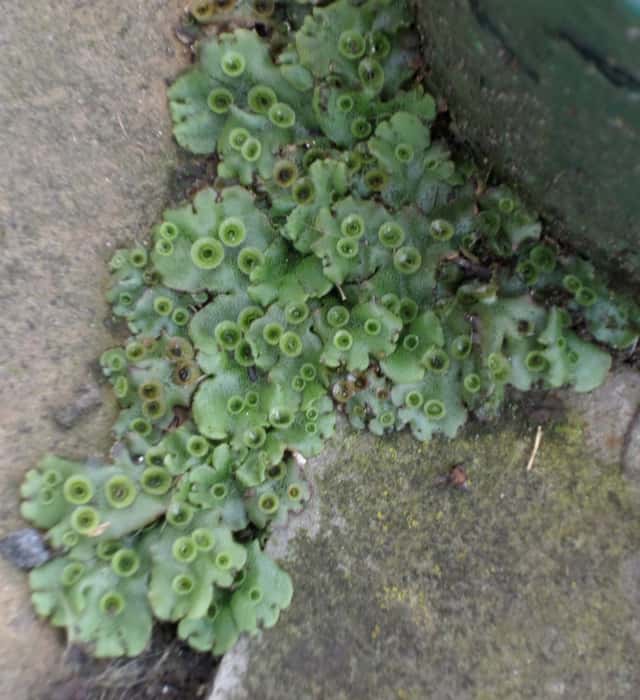
Common Liverwort (Marchantia polymorpha) is a widespread bryophyte characterized by a flat, ribbon-like thallus that forms dense, green mats on moist, nutrient-rich soil. It is often the first plant to establish itself after fire or soil disturbance and is also used as an indicator of high soil moisture and poor drainage in nurseries and greenhouses. The species reproduces both sexually, via spores from umbrella-shaped reproductive organs (gametophores), and asexually, via gemmae formed in cup-like structures on the upper surface of the thallus.
How to Propagate Common Liverwort?
How Big Does Common Liverwort Grow?
TLDR: Common Liverwort can reach up to 10cm tall with Fast growth rate.
Max height
10cm
Growth rate
Fast
Foliage
Evergreen
Plant Uses
Ground Cover
Soil coverage
Medicinal
Medicinal properties
Medicinal Uses
- Historically used in folk medicine for liver ailments according to the Doctrine of Signatures - no scientifically documented effect
Is your plant showing symptoms?
Click on the symptom to discover possible causes:
What Diseases Commonly Affect Common Liverwort?
TLDR: Common Liverwort is susceptible to 4 known diseases. Monitor regularly for early detection.
Fungus Gnats
Fungus gnats are small, gray-to-black mosquito-like insects (1/8 to 1/10 inches long) commonly found in indoor plants. Adult gnats are mostly a nuisance, but their larvae feed on plant roots and organic matter in soil, potentially causing serious damage to young or vulnerable plants. The larvae are translucent white with distinctive black heads and can leave slime trails on the soil surface in heavy infestations.
Slugs and Snails
Slugs and snails are mollusks that feed on plant tissue, causing irregular holes in leaves and damage to young seedlings. They are most active at night and in moist conditions, leaving characteristic silvery slime trails. These pests can quickly devastate gardens, especially during wet seasons.
Fusarium Wilt
Fusarium wilt is a serious fungal disease caused by the soil-borne fungus Fusarium oxysporum. The fungus invades roots and blocks the water-conducting vessels (xylem) of the plant, causing progressive wilting and eventual death. Host-specific forms of the pathogen exist that attack different plant species.
Phytophthora Root Rot
The Phytophthora genus consists of soil-borne oomycetes (water molds) that act as plant pathogens, primarily affecting trees and woody plants. It typically spreads through the root system, leading to systemic decline and eventual plant collapse.
Meaning & Symbolism
The name "liverwort" originates from the medieval Doctrine of Signatures, where the liver-like, lobed shape of the thallus led physicians to believe the plant could treat liver diseases. Today, the species symbolizes botanical resilience and renewal, as it is often the first plant to recolonize burned or disturbed soil areas.
Compare with similar plants
| Attribute | Difficulty | Light | Watering | Pet Safe |
|---|---|---|---|---|
| Dark Fieldcap | Medium | Low light | 2d | ⚠️ |
| Azalea | Medium | Partial shade | 3d | ⚠️ |
| Muriel's Bamboo | Medium | Partial shade | 3d | ✓ |
| Bougainvillea | Medium | Direct sun | 7d | ⚠️ |
Choose & Compare
Sources & References
- Marchantia polymorpha - NC State Extension Gardener Plant Toolbox
- Common Liverwort (Marchantia Polymorpha) Plant Care & How to Grow, Water
- Marchantia Polymorpha Care Guide
- Common Liverwort (Marchantia polymorpha) Care Guide
- Marchantia polymorpha model reveals conserved infection mechanisms in the vascular wilt fungal pathogen Fusarium oxysporum
- Marchantia polymorpha as a model plant in the evolutionary study of plant-microorganism interactions
- GEMMA CUP-ASSOCIATED MYB1, essential in vegetative reproduction in Marchantia polymorpha




