Saxifragaceae
Coral Bells (Heuchera sanguinea)
Heuchera sanguinea
Easy in temperate gardens and hardy through cold winters (USDA zones 3 to 8). Plant it with morning sun and shade during the hot afternoon, in free-draining soil rich in organic matter. Its main enemy is heavy, soggy soil, which rots the roots. Cut off spent flower stems to get more blooms and divide the clump every 2 or 3 years in spring.
Every 7 days
Partial shade
-40° - °C
% - %
Categories
What is Coral bells?
Coral bells (Heuchera sanguinea) is a easy-care plant from the Saxifragaceae family. Heuchera sanguinea is a clump-forming perennial in the saxifrage family (Saxifragaceae), native to Arizona, New Mexico and northern Mexico, where it grows among moist, shaded rocks. The leaves are rounded to heart-shaped, 7 to 15 cm long, and sit low to the ground. From late spring into early summer...
Coral bells grows up to 50cm, spread of 45cm, watering every 7 days. It is not suitable for indoor environments and safe for pets.
Unlike many tropical plants, Coral bells tolerates watering mistakes. Best for beginners. Unlike many popular species, Coral bells is safe to keep around pets.
How to Care for Coral bells?
TLDR: Coral bells needs Partial shade, watering every 7 days, and temperatures between -40-30°C with 40-70% humidity.
How Often Should You Water Coral bells?
Water when the soil surface is dry, about once a week in hot weather. Once established it handles dry spells. Never let the soil stay soggy.
How Much Light Does Coral bells Need?
Morning sun with afternoon shade is ideal. Strong afternoon sun scorches and wilts the leaves; too much shade means fewer flowers.
What Is the Best Soil for Coral bells?
Loose soil with compost, well drained and slightly acidic. It dislikes heavy clay; in that case, plant in a raised bed or a pot.
What Pot Should You Use for Coral bells?
Grows well in a pot with a drainage hole, at least 20-25 cm wide, in free-draining mix. Drainage is easier to control in a pot than in clay ground.
Care Schedule
Repot
Every 900 days
What Is Coral bells and Where Does It Come From?
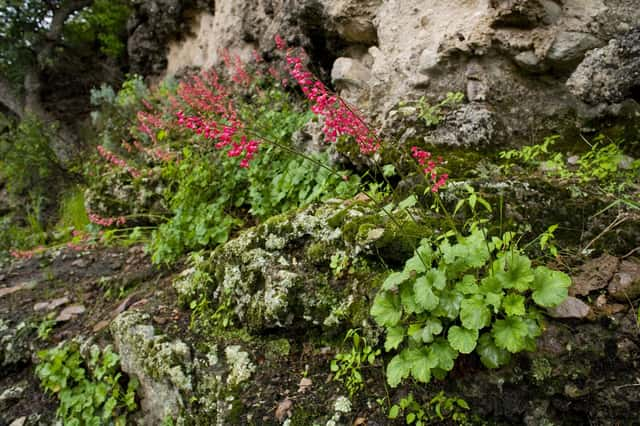
Heuchera sanguinea is a clump-forming perennial in the saxifrage family (Saxifragaceae), native to Arizona, New Mexico and northern Mexico, where it grows among moist, shaded rocks. The leaves are rounded to heart-shaped, 7 to 15 cm long, and sit low to the ground. From late spring into early summer, thin stems rise well above the leaves carrying small red or pink bells, sometimes white, that draw hummingbirds and bees. The name sanguinea means "blood red", after the flowers. It is one of the species behind the colorful-leaved heucheras sold today.
How to Propagate Coral bells?
Clump division
A two-year-old plant can give up to six divisions. If the leaves wilt, remove a few so the division can recover.
- 1 In early spring, lift the clump with a spade
- 2 Split it with a sharp knife or spade so each piece has roots and leaves
- 3 Replant each piece with the crown at soil level
- 4 Water well and keep the soil lightly moist until it settles in
Materials needed:
Seed
Seedlings from cultivars may not look like the parent plant.
- 1 Scatter the very small seeds on top of moist mix
- 2 Do not cover them: they need light to germinate
- 3 Keep moist in a bright, cool spot
- 4 Transplant once the seedlings have a few leaves
Materials needed:
How Big Does Coral bells Grow?
TLDR: Coral bells can reach up to 50cm tall with Medium growth rate.
Max height
50cm
Spread
45cm
Growth rate
Medium
Foliage
Semi-evergreen
Plant Uses
Ornamental
Great for decoration
Ground Cover
Soil coverage
Is your plant showing symptoms?
Click on the symptom to discover possible causes:
What Diseases Commonly Affect Coral bells?
TLDR: Coral bells is susceptible to 6 known diseases. Monitor regularly for early detection.
Root Rot
Root rot is a serious fungal disease that affects the root system of plants, causing them to decay and die. It is primarily caused by overwatering, poor drainage, or soil-borne fungi such as Pythium, Phytophthora, Rhizoctonia, and Fusarium. The disease thrives in waterlogged conditions where roots are deprived of oxygen, making them susceptible to fungal infection.
Powdery Mildew
Powdery mildew is a common fungal disease caused by various fungi species including Erysiphe, Podosphaera, Oïdium, and Leveillula. It affects over 10,000 plant species worldwide. The disease thrives in warm, dry climates with high humidity and appears as a distinctive white powdery coating on plant surfaces.
Phytophthora Root Rot
Disease caused by fungus-like organisms (oomycetes) that live in soil and can survive for years. It affects roots, stem, and crown of plants, being especially severe in waterlogged or poorly drained soils. It is the second most common cause of root rot in trees and shrubs.
Rust
Rust is a common fungal disease caused by fungi in the order Pucciniales that affects a wide variety of plants. The disease gets its name from the characteristic orange, yellow, or reddish-brown pustules that appear on leaves, resembling metal rust. This obligate fungal parasite requires living plants to survive and can cause significant economic losses in agricultural crops.
Fun Facts
The name sanguinea is Latin for "blood red", after the flowers.
Tannins in the leaves make deer and rabbits leave it alone.
Native peoples of North America used the root as an astringent.
Frequently asked questions
Why did my coral bells rot?
The leaves have a white powder on them. What is it?
The plant lifts off the ground as if it had no roots. Why?
Is it toxic to cats and dogs?
Compare with similar plants
| Attribute | Difficulty | Light | Watering | Pet Safe |
|---|---|---|---|---|
| Field Maple | Easy | Bright indirect | 14d | ✓ |
| Iberian Houseleek | Easy | Direct sun | 14d | ✓ |
| Silver Birch | Easy | Direct sun | 14d | ✓ |
| Common Blanketflower | Easy | Direct sun | 10d | ✓ |





