Caprifoliaceae
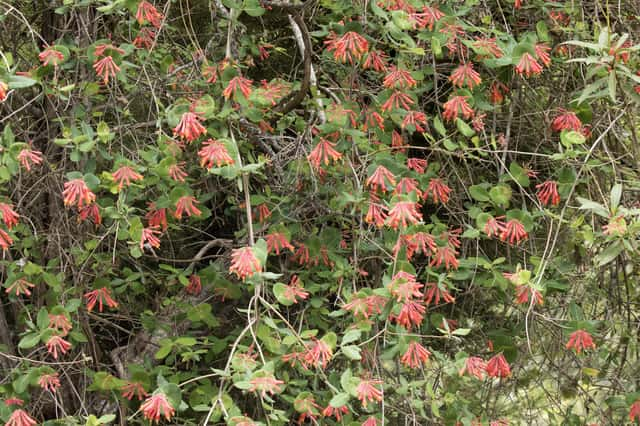
Coral honeysuckle (Lonicera sempervirens)
Lonicera sempervirens
An easy, fast-growing climber for fences, trellises and pergolas. It flowers best in full sun, wants well-drained soil with average moisture and a light trim right after flowering. It is very cold hardy.
Every 7 days
Bright indirect
-34° - °C
% - %
Categories
What is Coral honeysuckle?
Coral honeysuckle (Lonicera sempervirens) is a easy-care plant from the Caprifoliaceae family. Lonicera sempervirens is a woody climber in the honeysuckle family, native to the eastern and southeastern United States. It twines up supports to 3 to 6 m. Its blue-green leaves are opposite, and the top pairs fuse around the stem into a single disc. From spring into summer it bears clusters of tub...
Coral honeysuckle grows up to 6.0m, spread of 180cm, watering every 7 days. It is not suitable for indoor environments and safe for pets.
Unlike many tropical plants, Coral honeysuckle tolerates watering mistakes. Best for beginners. Unlike many popular species, Coral honeysuckle is safe to keep around pets.
How to Care for Coral honeysuckle?
TLDR: Coral honeysuckle needs Bright indirect, watering every 7 days, and temperatures between -34-30°C with 40-70% humidity.
How Often Should You Water Coral honeysuckle?
Water about once a week, or when the top few centimetres of soil are dry. Once established it copes with short dry spells but flowers better with steady moisture. Do not let it get waterlogged.
How Much Light Does Coral honeysuckle Need?
Full sun, six or more hours a day, for the best flowering. It tolerates part shade but blooms less and is more prone to powdery mildew.
What Is the Best Soil for Coral honeysuckle?
Loam, clay or humus-rich soil that drains well, acidic to neutral. It tolerates slightly salty soil.
What Pot Should You Use for Coral honeysuckle?
A large pot, 40 cm or more, with a trellis and good drainage holes.
What Is Coral honeysuckle and Where Does It Come From?
Lonicera sempervirens is a woody climber in the honeysuckle family, native to the eastern and southeastern United States. It twines up supports to 3 to 6 m. Its blue-green leaves are opposite, and the top pairs fuse around the stem into a single disc. From spring into summer it bears clusters of tubular flowers 4 to 5 cm long, coral-red outside and yellow-orange inside, unscented and a magnet for hummingbirds. Small red berries follow, eaten by birds but not for people. It keeps its leaves in mild winters and drops them in cold ones. Unlike Japanese honeysuckle, it is not invasive.
How to Propagate Coral honeysuckle?
Layering
This is the easiest method; stems that touch the ground often root on their own.
- 1 Pick a flexible stem and bend it down to the ground
- 2 Lightly scrape the bark where it will be buried
- 3 Bury that section about 5 cm deep and pin it down
- 4 Keep moist and, once rooted, cut it from the parent
Materials needed:
Semi-hardwood cuttings
A plastic bag over the pot helps hold humidity.
- 1 In early summer, cut shoot tips 10 to 15 cm long with two or three nodes
- 2 Remove the lower leaves and dip the base in rooting hormone
- 3 Insert into a light, moist mix
- 4 Keep in light shade and high humidity until rooted
Materials needed:
Seed
Seeds need a cold period to germinate well.
- 1 Collect ripe berries and clean the seeds
- 2 Sow outdoors in autumn, or keep in moist sand in the fridge for about 2 months before sowing
- 3 Keep the mix moist until germination
Materials needed:
How Big Does Coral honeysuckle Grow?
TLDR: Coral honeysuckle can reach up to 6.0m tall with Fast growth rate.
Max height
6.0m
Spread
1.8m
Growth rate
Fast
Foliage
Semi-evergreen
Plant Uses
Ornamental
Great for decoration
Is your plant showing symptoms?
Click on the symptom to discover possible causes:
What Diseases Commonly Affect Coral honeysuckle?
TLDR: Coral honeysuckle is susceptible to 3 known diseases. Monitor regularly for early detection.
Powdery Mildew
Powdery mildew is a common fungal disease caused by various fungi species including Erysiphe, Podosphaera, Oïdium, and Leveillula. It affects over 10,000 plant species worldwide. The disease thrives in warm, dry climates with high humidity and appears as a distinctive white powdery coating on plant surfaces.
Aphids
Aphids are small, soft-bodied, pear-shaped insects (1/16 to 1/8 inch long) that feed by sucking nutrient-rich sap from plants. They reproduce rapidly and can quickly weaken plants, causing distorted growth and transmitting plant viruses. Aphids come in various colors including green, black, red, yellow, brown, and gray. They secrete honeydew, a sticky substance that attracts ants and encourages sooty mold growth.
Leaf Spot
Leaf spot is a common fungal disease caused by various pathogens including Alternaria, Ascochyta, Colletotrichum, Septoria, and Venturia. It primarily affects leaves, causing discolored spots that can lead to premature leaf drop if left untreated.
Fun Facts
The leaf pairs just below the flowers fuse into what looks like a single disc pierced by the stem
It is a key spring nectar source for the ruby-throated hummingbird
The name sempervirens means "evergreen", as it keeps its leaves in mild winters
Frequently asked questions
Is coral honeysuckle fragrant?
When should I prune Lonicera sempervirens?
Is it invasive like Japanese honeysuckle?
Why do the leaves get a white powder?
Compare with similar plants
| Attribute | Difficulty | Light | Watering | Pet Safe |
|---|---|---|---|---|
| Field Maple | Easy | Bright indirect | 14d | ✓ |
| Iberian Houseleek | Easy | Direct sun | 14d | ✓ |
| Silver Birch | Easy | Direct sun | 14d | ✓ |
| Common Blanketflower | Easy | Direct sun | 10d | ✓ |





