Lamiaceae
Creeping thyme (Thymus praecox)
Thymus praecox
Plant in full sun in sandy or gravelly, well-drained soil. Water sparingly once established. No fertilizer needed. Trim lightly after flowering to keep the mat tight. Wet soil, especially in winter, is what kills it.
Every 14 days
Direct sun
-15° - 32°C
% - %
Categories
What is Creeping thyme?
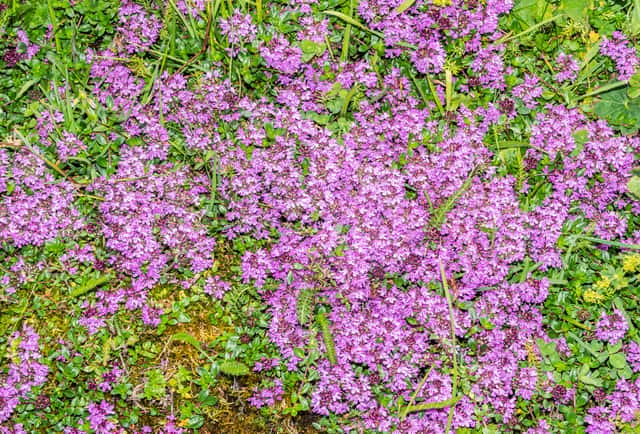
Creeping thyme (Thymus praecox) is a easy-care plant from the Lamiaceae family. Creeping thyme (Thymus praecox) is a low, mat-forming, woody-based perennial in the mint family (Lamiaceae), native to Europe, Turkey and Greenland. Its stems spread along the ground and root as they go, forming a dense carpet 5 to 15 cm tall of tiny, hairy, blue-green leaves with a spicy scent. Fro...
Creeping thyme grows up to 15cm, spread of 30cm, watering every 14 days, -15°C – 32°C. It is not suitable for indoor environments and safe for pets.
Unlike many tropical plants, Creeping thyme tolerates watering mistakes. Best for beginners. Unlike many popular species, Creeping thyme is safe to keep around pets.
How to Care for Creeping thyme?
TLDR: Creeping thyme needs Direct sun, watering every 14 days, and temperatures between -15-32°C with 40-70% humidity.
How Often Should You Water Creeping thyme?
Water regularly for the first few weeks after planting. After that, water only when the soil is dry, about every 2 weeks in summer and hardly at all in winter. In pots, check with a finger before watering.
How Much Light Does Creeping thyme Need?
Needs at least 6 hours of direct sun a day. In shade it thins out, flowers poorly and rots more easily.
What Is the Best Soil for Creeping thyme?
Sandy, rocky or shallow soil with excellent drainage, pH 6 to 8; it handles poor and chalky soils. A layer of gravel around the plant keeps the foliage off damp soil.
What Pot Should You Use for Creeping thyme?
A shallow, wide terracotta pot with drainage holes and a gritty mix with plenty of sand or gravel. Also good in troughs and dry stone walls.
What Is Creeping thyme and Where Does It Come From?
Creeping thyme (Thymus praecox) is a low, mat-forming, woody-based perennial in the mint family (Lamiaceae), native to Europe, Turkey and Greenland. Its stems spread along the ground and root as they go, forming a dense carpet 5 to 15 cm tall of tiny, hairy, blue-green leaves with a spicy scent. From late spring into summer it is covered in tiny pinkish-purple flowers that draw bees and butterflies. It tolerates light foot traffic and is a classic between stepping stones. It is a different species from Thymus serpyllum, though the two are often sold under each other's name.
How to Propagate Creeping thyme?
Division
Late autumn also works. Small pieces establish better if grown on in pots for a few weeks.
- 1 Dig up a section of the mat with roots
- 2 Pull it apart into smaller pieces, each with stems and roots
- 3 Replant at the same depth in well-drained soil
- 4 Water well and keep lightly moist until established
Materials needed:
Semi-hardwood cuttings
Don't keep cuttings wet: they rot easily. Stems lying on the ground often already have roots and can be cut off and potted directly.
- 1 Cut 5-8 cm tips from semi-woody shoots
- 2 Strip the leaves from the lower half
- 3 Insert in a mix of sand and potting compost
- 4 Keep in bright light out of strong sun, with the mix just moist
Materials needed:
How Big Does Creeping thyme Grow?
TLDR: Creeping thyme can reach up to 15cm tall with Medium growth rate.
Max height
15cm
Spread
30cm
Growth rate
Medium
Foliage
Evergreen
Plant Uses
Ornamental
Great for decoration
Ground Cover
Soil coverage
Aromatic
Pleasant fragrance
Edible
Can be consumed
Medicinal Uses
- The leaves and essential oil have antiseptic and deodorant properties (traditional use)
Culinary Uses
- The leaves can be used as a seasoning, though the flavour is milder than common thyme
Is your plant showing symptoms?
Click on the symptom to discover possible causes:
What Diseases Commonly Affect Creeping thyme?
TLDR: Creeping thyme is susceptible to 2 known diseases. Monitor regularly for early detection.
Root Rot
Root rot is a serious fungal disease that affects the root system of plants, causing them to decay and die. It is primarily caused by overwatering, poor drainage, or soil-borne fungi such as Pythium, Phytophthora, Rhizoctonia, and Fusarium. The disease thrives in waterlogged conditions where roots are deprived of oxygen, making them susceptible to fungal infection.
Slugs and Snails
Slugs and snails are mollusks that feed on plant tissue, causing irregular holes in leaves and damage to young seedlings. They are most active at night and in moist conditions, leaving characteristic silvery slime trails. These pests can quickly devastate gardens, especially during wet seasons.
Meaning & Symbolism
The name thyme is traced to the Greek thumos, linked to courage, and the plant was long an emblem of bravery. The epithet praecox means 'very early', a nod to its early flowering.
Fun Facts
Praecox is Latin for 'very early', after its early flowering.
Its flowers are rich in nectar and heavily visited by honey bees.
Thyme species hybridize so freely that even botanists find them hard to tell apart.
Frequently asked questions
Can you walk on creeping thyme?
Is creeping thyme toxic to cats and dogs?
Why is my creeping thyme turning brown in the middle?
Are Thymus praecox and Thymus serpyllum the same plant?
Compare with similar plants
| Attribute | Difficulty | Light | Watering | Pet Safe |
|---|---|---|---|---|
| Field Maple | Easy | Bright indirect | 14d | ✓ |
| Iberian Houseleek | Easy | Direct sun | 14d | ✓ |
| Silver Birch | Easy | Direct sun | 14d | ✓ |
| Common Blanketflower | Easy | Direct sun | 10d | ✓ |





