Bromeliaceae
Crimson Bromeliad (Fascicularia bicolor)
Fascicularia bicolor
Sun or bright part shade, very free-draining soil, and little water once established. Takes light frost if the soil isn't wet.
Every 14 days
Bright indirect
-5° - °C
% - %
Categories
What is Crimson Bromeliad?
Crimson Bromeliad (Fascicularia bicolor) is a easy-care plant from the Bromeliaceae family. Fascicularia bicolor is a bromeliad found only in Chile, from the Valparaíso region south to Los Lagos. It grows on damp coastal rocks or perched on tree trunks in the cool southern rainforest. It forms tight rosettes of long, stiff leaves with spiny edges, up to 50 cm long, and over the years build...
Crimson Bromeliad grows up to 50cm, spread of 100cm, watering every 14 days. It is not suitable for indoor environments and safe for pets.
Unlike many tropical plants, Crimson Bromeliad tolerates watering mistakes. Best for beginners. Unlike many popular species, Crimson Bromeliad is safe to keep around pets.
How to Care for Crimson Bromeliad?
TLDR: Crimson Bromeliad needs Bright indirect, watering every 14 days, and temperatures between -5-30°C with 40-70% humidity.
How Often Should You Water Crimson Bromeliad?
Water when the soil is dry, roughly every 14 days in summer. In the ground, once established, it rarely needs watering except in long droughts. In winter, only if there is no rain; cold plus wet roots will rot it.
How Much Light Does Crimson Bromeliad Need?
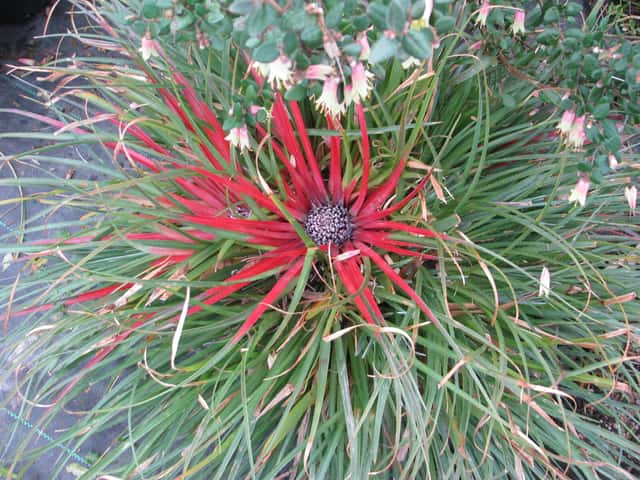
Full sun or bright part shade. More sun gives a stronger red centre and a more compact plant.
What Is the Best Soil for Crimson Bromeliad?
Poor to moderately fertile, sandy soil with very good drainage. Don't overfeed: rich soil gives lots of leaves and few flowers. It also does well among rocks or fixed to a log.
What Pot Should You Use for Crimson Bromeliad?
A wide, shallow terracotta pot with good drainage, since the clump spreads sideways. Where frosts are hard, keep it in a pot so you can move it under cover for winter.
What Is Crimson Bromeliad and Where Does It Come From?
Fascicularia bicolor is a bromeliad found only in Chile, from the Valparaíso region south to Los Lagos. It grows on damp coastal rocks or perched on tree trunks in the cool southern rainforest. It forms tight rosettes of long, stiff leaves with spiny edges, up to 50 cm long, and over the years builds into a wide clump of many rosettes. The show comes at flowering time: the inner leaves turn bright crimson and a cluster of pale blue flowers, ringed by ivory bracts, appears in the middle. Each rosette flowers once and then slowly dies back while the offsets around it take over. It is the only species in its genus and one of the few bromeliads that can take a light frost.
How to Propagate Crimson Bromeliad?
Offsets
The leaf edges are spiny: wear gloves and long sleeves. Bigger offsets root faster.
- 1 Wearing thick gloves, pick an offset with several leaves and some roots
- 2 Cut it away from the parent with a clean knife
- 3 Plant it in lightly moist, sandy mix
- 4 Keep it in part shade and water sparingly until it starts growing
Materials needed:
Seed
Very slow: it takes years to get a good-sized rosette. Dividing offsets is far more practical.
- 1 Sow fresh seed on the surface of fine, moist compost without covering it
- 2 Cover the tray to keep humidity in
- 3 Keep somewhere warm and bright, out of direct sun
Materials needed:
How Big Does Crimson Bromeliad Grow?
TLDR: Crimson Bromeliad can reach up to 50cm tall with Slow growth rate.
Max height
50cm
Spread
1.0m
Growth rate
Slow
Foliage
Evergreen
Plant Uses
Ornamental
Great for decoration
Is your plant showing symptoms?
Click on the symptom to discover possible causes:
What Diseases Commonly Affect Crimson Bromeliad?
TLDR: Crimson Bromeliad is susceptible to 3 known diseases. Monitor regularly for early detection.
Root Rot
Root rot is a serious fungal disease that affects the root system of plants, causing them to decay and die. It is primarily caused by overwatering, poor drainage, or soil-borne fungi such as Pythium, Phytophthora, Rhizoctonia, and Fusarium. The disease thrives in waterlogged conditions where roots are deprived of oxygen, making them susceptible to fungal infection.
Aphids
Aphids are small, soft-bodied, pear-shaped insects (1/16 to 1/8 inch long) that feed by sucking nutrient-rich sap from plants. They reproduce rapidly and can quickly weaken plants, causing distorted growth and transmitting plant viruses. Aphids come in various colors including green, black, red, yellow, brown, and gray. They secrete honeydew, a sticky substance that attracts ants and encourages sooty mold growth.
Scale Insects
Scale insects are small sap-sucking pests that appear as brown, shell-like bumps on plant stems and leaves. There are over 25 species, divided into armored (hard) and unarmored (soft) scales. They feed by piercing plant tissue and extracting sap, which weakens the plant and can lead to yellowing, stunted growth, and even death if left untreated. They also excrete honeydew, which attracts ants and promotes sooty mold growth.
Fun Facts
It is the only species in its genus and grows wild only in Chile
In the wild it often grows on tree trunks, especially in the forks of branches
Each rosette flowers just once in its life
Frequently asked questions
Why has the centre of my fascicularia turned red?
Does the rosette die after flowering?
Is it frost hardy?
Is Fascicularia toxic to cats and dogs?
Compare with similar plants
| Attribute | Difficulty | Light | Watering | Pet Safe |
|---|---|---|---|---|
| Field Maple | Easy | Bright indirect | 14d | ✓ |
| Iberian Houseleek | Easy | Direct sun | 14d | ✓ |
| Silver Birch | Easy | Direct sun | 14d | ✓ |
| Common Blanketflower | Easy | Direct sun | 10d | ✓ |





