Apiaceae
Culantro (Eryngium foetidum)
Eryngium foetidum
A herb for partial shade and constantly moist soil. It likes warmth and cannot take frost. In shade the leaves grow larger and more tender and the plant is slower to bolt. Cut off flower stalks as soon as they appear to keep it producing leaves.
Every 3 days
Partial shade
10° - °C
% - %
Categories
What is Culantro?
Culantro (Eryngium foetidum) is a medium-care plant from the Apiaceae family. Culantro (Eryngium foetidum) is an aromatic herb in the carrot family (Apiaceae), native to Mexico, the Caribbean and Central and South America and grown throughout the tropics. It forms a low rosette of long, lance-shaped leaves with serrated, slightly spiny edges. It smells like cilantro, only str...
Culantro grows up to 60cm, watering every 3 days. It is suitable for indoor environments and safe for pets.
Unlike many popular species, Culantro is safe to keep around pets. Without adequate drainage, root rot can develop within 7 days.
How to Care for Culantro?
TLDR: Culantro needs Partial shade, watering every 3 days, and temperatures between 10-30°C with 40-70% humidity.
How Often Should You Water Culantro?
Keep the soil evenly moist but not soggy: water every 2 to 3 days in hot weather, when the surface starts to dry. Drought makes it bolt sooner and the leaves get tough.
How Much Light Does Culantro Need?
Partial shade. It tolerates full sun, but with afternoon shade the leaves are larger, greener and more aromatic.
What Is the Best Soil for Culantro?
Rich, loose, well-drained soil with a pH of 6 to 8. Dig in compost before planting. It is a heavy feeder, so top up with compost or organic fertilizer during the season.
What Pot Should You Use for Culantro?
A medium pot at least 20 cm deep with drainage holes. Plastic pots help hold moisture.
What Is Culantro and Where Does It Come From?
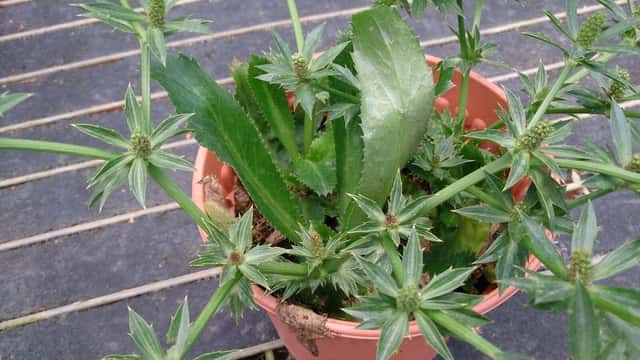
Culantro (Eryngium foetidum) is an aromatic herb in the carrot family (Apiaceae), native to Mexico, the Caribbean and Central and South America and grown throughout the tropics. It forms a low rosette of long, lance-shaped leaves with serrated, slightly spiny edges. It smells like cilantro, only stronger. In heat and long days it sends up a stalk of small, spiny, pale green flower heads. It is a staple in Caribbean and Latin American cooking, such as Puerto Rican sofrito, and in Southeast Asian dishes, where it is known as ngo gai.
How to Propagate Culantro?
Seed
Germination is slow and uneven. Plants self-seed if you let a few stalks flower.
- 1 Scatter the tiny seeds on the surface of pre-moistened mix without covering
- 2 Keep warm, above 10 °C at night, and constantly moist
- 3 Once seedlings have a few leaves, move them to pots or beds
- 4 Space plants 15 cm apart
Materials needed:
How Big Does Culantro Grow?
TLDR: Culantro can reach up to 60cm tall with Medium growth rate.
Max height
60cm
Plant Uses
Edible
Can be consumed
Aromatic
Pleasant fragrance
Medicinal
Medicinal properties
Medicinal Uses
- In traditional medicine across the Americas, leaf tea is used for fever, diarrhea and pain; these uses are not clinically proven.
Culinary Uses
- Fresh leaves season sofrito, salsas, soups, stews, rice and ceviche.
- Can replace cilantro with a stronger flavor; it holds up better to cooking and dries well.
Is your plant showing symptoms?
Click on the symptom to discover possible causes:
What Diseases Commonly Affect Culantro?
TLDR: Culantro is susceptible to 6 known diseases. Monitor regularly for early detection.
Root-Knot Nematodes
Root-knot nematodes (Meloidogyne species) are microscopic roundworms that parasitize plant roots, causing characteristic galls or knots. These soil-borne pests are among the most economically damaging plant pathogens worldwide, affecting a wide range of ornamental and edible plants. The nematodes inject enzymes into root cells, causing abnormal swelling and disrupting water and nutrient uptake.
Aphids
Aphids are small, soft-bodied, pear-shaped insects (1/16 to 1/8 inch long) that feed by sucking nutrient-rich sap from plants. They reproduce rapidly and can quickly weaken plants, causing distorted growth and transmitting plant viruses. Aphids come in various colors including green, black, red, yellow, brown, and gray. They secrete honeydew, a sticky substance that attracts ants and encourages sooty mold growth.
Root Rot
Root rot is a serious fungal disease that affects the root system of plants, causing them to decay and die. It is primarily caused by overwatering, poor drainage, or soil-borne fungi such as Pythium, Phytophthora, Rhizoctonia, and Fusarium. The disease thrives in waterlogged conditions where roots are deprived of oxygen, making them susceptible to fungal infection.
Overwatering
Overwatering occurs when plants receive too much water, depriving roots of oxygen and causing root rot. This environmental stress is one of the most common causes of houseplant death, as waterlogged soil prevents roots from breathing and functioning properly.
Fun Facts
Shade delays flowering and gives bigger leaves.
In Trinidad and Tobago it is called shadow beni.
The dried leaves keep their color and aroma.
Frequently asked questions
Is culantro the same as cilantro?
Why is my culantro flowering?
When can I harvest?
Can I grow culantro in a pot?
Compare with similar plants
| Attribute | Difficulty | Light | Watering | Pet Safe |
|---|---|---|---|---|
| Dark Fieldcap | Medium | Low light | 2d | ⚠️ |
| Azalea | Medium | Partial shade | 3d | ⚠️ |
| Muriel's Bamboo | Medium | Partial shade | 3d | ✓ |
| Bougainvillea | Medium | Direct sun | 7d | ⚠️ |




