Apiaceae
Cutleaf Waterparsnip (Berula erecta)
Berula erecta
A plant for pond margins and shallow water: it needs permanently wet soil or a few centimetres of water, in sun or part shade. It spreads by stolons. It is poisonous: not for eating.
Every 1 days
Bright indirect
° - °C
% - %
Categories
What is Cutleaf Waterparsnip?
Cutleaf Waterparsnip (Berula erecta) is a easy-care plant from the Apiaceae family. Cutleaf waterparsnip (Berula erecta) is an aquatic perennial in the carrot family (Apiaceae), native to Europe, western and central Asia, North America and eastern Africa. It grows on the margins and in shallow water of lakes, ponds, ditches, streams and fens, rooted in fertile mud or clay. Its holl...
Cutleaf Waterparsnip grows up to 1.0m, watering every 1 days. It is not suitable for indoor environments and safe for pets.
Unlike many tropical plants, Cutleaf Waterparsnip tolerates watering mistakes. Best for beginners. Unlike many popular species, Cutleaf Waterparsnip is safe to keep around pets.
How to Care for Cutleaf Waterparsnip?
TLDR: Cutleaf Waterparsnip needs Bright indirect, watering every 1 days, and temperatures between 15-30°C with 40-70% humidity.
How Often Should You Water Cutleaf Waterparsnip?
Keep the soil permanently waterlogged or the crown in shallow water; it cannot dry out.
How Much Light Does Cutleaf Waterparsnip Need?
Full sun to moderate shade.
What Is the Best Soil for Cutleaf Waterparsnip?
Fertile mud or clay, neutral to chalky, always wet.
What Pot Should You Use for Cutleaf Waterparsnip?
An aquatic basket set on the shallow shelf of a pond or tub.
What Is Cutleaf Waterparsnip and Where Does It Come From?
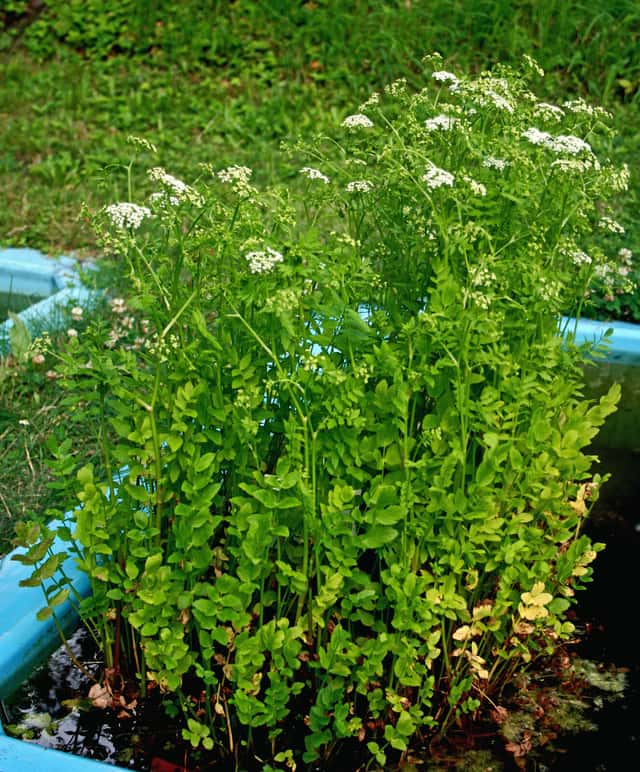
Cutleaf waterparsnip (Berula erecta) is an aquatic perennial in the carrot family (Apiaceae), native to Europe, western and central Asia, North America and eastern Africa. It grows on the margins and in shallow water of lakes, ponds, ditches, streams and fens, rooted in fertile mud or clay. Its hollow stems usually reach about 1 m, and it spreads by a short rhizome and stolons that root and form colonies. The pinnate leaves have 4 to 9 pairs of toothed leaflets and a ring-shaped mark on the leaf stalk below the lowest pair. In summer it bears compound umbels of tiny white flowers; fully submerged plants seldom bloom. The rhizome, roots and fruit are poisonous, and the plant is easily confused with other water umbellifers, some of them deadly.
How to Propagate Cutleaf Waterparsnip?
Stolon division
Wear gloves: the rhizome and roots are poisonous. Loose pieces float off and root on their own, so it can spread too much in small ponds.
- 1 In spring, detach a plantlet that already has roots at a stolon node
- 2 Plant it in marginal mud or an aquatic basket
- 3 Keep it in shallow water
Materials needed:
Seed
The fruit floats and is spread by water; little is known about germination.
- 1 Collect ripe fruit in late summer
- 2 Sow on a muddy mix kept constantly wet
Materials needed:
How Big Does Cutleaf Waterparsnip Grow?
TLDR: Cutleaf Waterparsnip can reach up to 1.0m tall with Medium growth rate.
Max height
1.0m
Warning: Toxic Plant
This plant can be toxic if ingested. Keep out of reach of:
Plant Uses
Medicinal
Medicinal properties
Medicinal Uses
- Traditionally used externally for rheumatism and skin rashes (Indigenous peoples of North America and Mexico); the plant is poisonous
Is your plant showing symptoms?
Click on the symptom to discover possible causes:
Fun Facts
Fully submerged plants rarely flower and multiply by stolons instead.
The fruit has air-filled cells and floats, so water carries it to new sites.
Crushed leaves smell of carrot or parsnip.
Frequently asked questions
Is Berula erecta poisonous?
How do I tell it from similar plants?
Where does it grow?
Can I grow it in a garden pond?
Compare with similar plants
| Attribute | Difficulty | Light | Watering | Pet Safe |
|---|---|---|---|---|
| Field Maple | Easy | Bright indirect | 14d | ✓ |
| Iberian Houseleek | Easy | Direct sun | 14d | ✓ |
| Silver Birch | Easy | Direct sun | 14d | ✓ |
| Common Blanketflower | Easy | Direct sun | 10d | ✓ |





