Convolvulaceae
Cypress Vine (Ipomoea quamoclit)
Ipomoea quamoclit
Easy and fast: direct sun, free-draining soil, regular water and something to climb. Sow every year where winters are cold.
Every 4 days
Direct sun
° - °C
% - %
Categories
What is Cypress Vine?
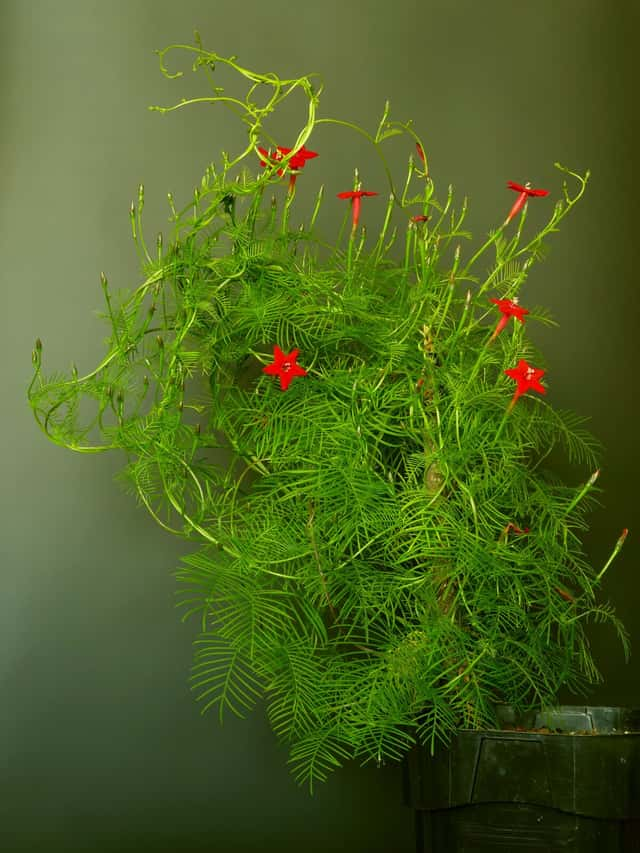
Cypress Vine (Ipomoea quamoclit) is a easy-care plant from the Convolvulaceae family. Cypress vine is a slender twining climber in the morning glory family, native to tropical America from Mexico to northern South America. It winds around any support and reaches 3 to 6 m in a single season. The leaves are cut into many thread-like segments, like a feather or a leaf skeleton, giving t...
Cypress Vine grows up to 6.0m, spread of 180cm, watering every 4 days. It is not suitable for indoor environments and not safe for pets.
Unlike many tropical plants, Cypress Vine tolerates watering mistakes. Best for beginners. Without precautions, ingestion can cause irritation in pets. Keep out of reach of cats and dogs.
How to Care for Cypress Vine?
TLDR: Cypress Vine needs Direct sun, watering every 4 days, and temperatures between 15-30°C with 40-70% humidity.
How Often Should You Water Cypress Vine?
Keep the soil lightly moist, watering every 3 or 4 days in hot weather. It handles a short dry spell but flowers more with steady water.
How Much Light Does Cypress Vine Need?
Full sun, at least 6 hours of direct light. In shade it makes leaves and few flowers.
What Is the Best Soil for Cypress Vine?
Ordinary garden soil with good drainage. Rich, heavily fed soil gives foliage instead of flowers.
What Pot Should You Use for Cypress Vine?
Pot of 30 cm or more with a drainage hole and a trellis or netting attached. Looks good on fences, railings and arbors.
What Is Cypress Vine and Where Does It Come From?
Cypress vine is a slender twining climber in the morning glory family, native to tropical America from Mexico to northern South America. It winds around any support and reaches 3 to 6 m in a single season. The leaves are cut into many thread-like segments, like a feather or a leaf skeleton, giving the plant a lacy look. From early summer until frost it carries small trumpet flowers that open into a five-pointed star, usually scarlet, sometimes pink or white, and much visited by hummingbirds. Outside the tropics it is grown as an annual and self-sows freely. The seeds are toxic.
How to Propagate Cypress Vine?
Seed
It dislikes root disturbance: if you sow in pots, transplant with the whole root ball. Store seeds away from children and pets.
- 1 Nick or sand the seed coat lightly and soak in warm water for 12 to 24 hours
- 2 Sow 1 cm deep, in place or in small pots, once frost has passed
- 3 Keep the soil moist and warm until seedlings appear
- 4 Put the trellis or support in place early
Materials needed:
How Big Does Cypress Vine Grow?
TLDR: Cypress Vine can reach up to 6.0m tall with Fast growth rate.
Max height
6.0m
Spread
1.8m
Growth rate
Fast
Warning: Toxic Plant
This plant can be toxic if ingested. Keep out of reach of:
Plant Uses
Ornamental
Great for decoration
Is your plant showing symptoms?
Click on the symptom to discover possible causes:
What Diseases Commonly Affect Cypress Vine?
TLDR: Cypress Vine is susceptible to 5 known diseases. Monitor regularly for early detection.
Aphids
Aphids are small, soft-bodied, pear-shaped insects (1/16 to 1/8 inch long) that feed by sucking nutrient-rich sap from plants. They reproduce rapidly and can quickly weaken plants, causing distorted growth and transmitting plant viruses. Aphids come in various colors including green, black, red, yellow, brown, and gray. They secrete honeydew, a sticky substance that attracts ants and encourages sooty mold growth.
Spider Mites
Spider mites are tiny arachnids (less than 1/20 inch long) related to spiders and ticks that feed on plant sap. They thrive in hot, dry conditions and can cause significant damage to ornamental and vegetable plants. During severe infestations, crop losses can reach 14% or higher as these pests disrupt vital plant processes including photosynthesis, carbon dioxide absorption, and transpiration.
Leaf Spot
Leaf spot is a common fungal disease caused by various pathogens including Alternaria, Ascochyta, Colletotrichum, Septoria, and Venturia. It primarily affects leaves, causing discolored spots that can lead to premature leaf drop if left untreated.
White Rust
Fun Facts
Its red tubular flowers are shaped for hummingbird bills
The name quamoclit probably comes from Nahuatl, the Aztec language
In India it is called Ganesh Vel and used in offerings
Frequently asked questions
Is cypress vine toxic to dogs and cats?
Why are my seeds not germinating?
Does it come back next year?
Compare with similar plants
| Attribute | Difficulty | Light | Watering | Pet Safe |
|---|---|---|---|---|
| Field Maple | Easy | Bright indirect | 14d | ✓ |
| Iberian Houseleek | Easy | Direct sun | 14d | ✓ |
| Silver Birch | Easy | Direct sun | 14d | ✓ |
| Common Blanketflower | Easy | Direct sun | 10d | ✓ |





