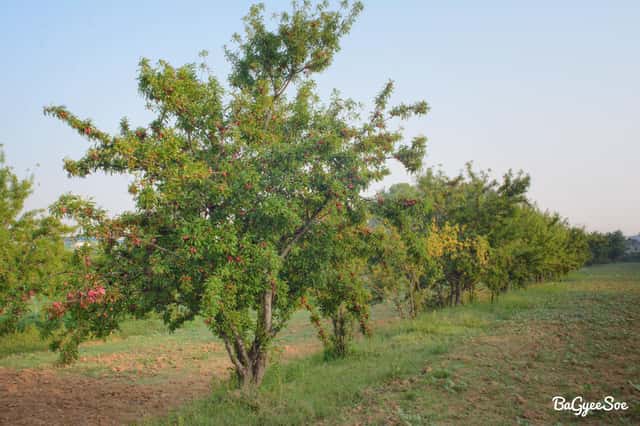
Rosaceae
Damson (Prunus insititia)
Prunus insititia
Grow in full sun with fertile, well-drained soil and moderate, regular watering during the fruiting season. A hardy, low-maintenance tree once established, tolerant of cold winters.
Every 7 days
Direct sun
-20° - 30°C
% - %
Categories
What is Damson?
Damson (Prunus insititia) is a easy-care plant from the Rosaceae family. The damson (Prunus insititia) is a small deciduous tree or shrub in the rose family (Rosaceae), native to Europe and southwest Asia. It bears white blossoms in early spring and small, tart, dark purple fruits traditionally used in jams, preserves and damson gin.
Damson grows up to 4.0m, spread of 400cm, watering every 7 days, -20°C – 30°C. It is not suitable for indoor environments and not safe for pets.
Unlike many tropical plants, Damson tolerates watering mistakes. Best for beginners. Without precautions, ingestion can cause irritation in pets. Keep out of reach of cats and dogs.
How to Care for Damson?
TLDR: Damson needs Direct sun, watering every 7 days, and temperatures between -20-30°C with 40-70% humidity.
How Often Should You Water Damson?
Water moderately, letting the soil surface dry between waterings; increase watering during flowering and fruit development, and reduce it during winter dormancy.
How Much Light Does Damson Need?
Plant in full sun, with at least 6-8 hours of direct light daily, for the best flowering and fruit set.
What Is the Best Soil for Damson?
Choose cool, moisture-retentive, well-drained soil enriched with organic matter; waterlogged soil encourages root rot.
Care Schedule
Fertilize
Every 365 days
What Is Damson and Where Does It Come From?
The damson (Prunus insititia) is a small deciduous tree or shrub in the rose family (Rosaceae), native to Europe and southwest Asia. It bears white blossoms in early spring and small, tart, dark purple fruits traditionally used in jams, preserves and damson gin.
How to Propagate Damson?
Grafting
This is the most common commercial method, as damson is frequently used as a rootstock for other Prunus species.
- 1 Select a vigorous, healthy Prunus rootstock
- 2 Make a matching bevel cut on both the rootstock and the scion of the desired variety
- 3 Join the pieces together and secure with grafting tape
- 4 Protect the union until the tissues have fully healed
Materials needed:
Seed
Seedlings from hybrid trees may not reliably reproduce the parent plant characteristics.
- 1 Collect pits from ripe fruit
- 2 Cold-stratify in moist substrate for 3-4 months
- 3 Sow in a sunny spot after stratification
- 4 Keep soil moist until germination
Materials needed:
How Big Does Damson Grow?
TLDR: Damson can reach up to 4.0m tall with Medium growth rate.
Max height
4.0m
Spread
4.0m
Growth rate
Medium
Foliage
Deciduous
Warning: Toxic Plant
This plant can be toxic if ingested. Keep out of reach of:
Plant Uses
Edible
Can be consumed
Ornamental
Great for decoration
Culinary Uses
- Jams and preserves
- Damson gin and liqueurs
- Cooked fruit desserts
Is your plant showing symptoms?
Click on the symptom to discover possible causes:
What Diseases Commonly Affect Damson?
TLDR: Damson is susceptible to 8 known diseases. Monitor regularly for early detection.
Brown Rot
Monilinia is a genus of ascomycete fungi that causes blossom blight and brown rot in fruit trees. It spreads most rapidly in cool, wet weather, particularly during the bloom period. Symptoms include flowers that turn brown and remain attached to the shoots, small tan spots on fruit that expand into gray-beige spore rings (sporodochia), twig dieback, and 'mummified' fruit that shrivels and often persists on the tree. It primarily affects stone fruits (peach, nectarine, apricot, plum, cherry) but can also infect pome fruits such as apple and pear.
Scale Insects
Scale insects are small sap-sucking pests that appear as brown, shell-like bumps on plant stems and leaves. There are over 25 species, divided into armored (hard) and unarmored (soft) scales. They feed by piercing plant tissue and extracting sap, which weakens the plant and can lead to yellowing, stunted growth, and even death if left untreated. They also excrete honeydew, which attracts ants and promotes sooty mold growth.
Shot Hole Disease
Stigmina carpophila (syn. Wilsonomyces carpophilus) is a fungus that primarily affects stone fruits: peach, apricot, plum, cherry, and almond. It is activated by rain, humidity, and mild temperatures, especially between late autumn, winter, and spring. Typical symptoms include small round spots on the leaves that dry out and fall off, leaving holes like buckshot; dark, rough spots appear on the fruit which may crack; cracks and gum exudation (gummosis) are noted on branches and young shoots. It is also known as 'shot hole disease' of stone fruits.
Aphids
Aphids are small, soft-bodied, pear-shaped insects (1/16 to 1/8 inch long) that feed by sucking nutrient-rich sap from plants. They reproduce rapidly and can quickly weaken plants, causing distorted growth and transmitting plant viruses. Aphids come in various colors including green, black, red, yellow, brown, and gray. They secrete honeydew, a sticky substance that attracts ants and encourages sooty mold growth.
Fun Facts
The name damson derives from damascene, a reference to Damascus, Syria, from where the species is thought to have spread across Europe.
It is widely used as a rootstock for grafting other Prunus fruit trees, such as plums and peaches.
The fruit ripens in late summer to early autumn and becomes sweeter after the first light frosts.
Frequently asked questions
Does damson need full sun?
Are damson fruits edible?
What are the main diseases affecting damson trees?
When does the damson tree flower?
Compare with similar plants
| Attribute | Difficulty | Light | Watering | Pet Safe |
|---|---|---|---|---|
| Field Maple | Easy | Bright indirect | 14d | ✓ |
| Silver Birch | Easy | Direct sun | 14d | ✓ |
| Common Blanketflower | Easy | Direct sun | 10d | ✓ |
| Cushion Bush | Easy | Direct sun | 14d | ✓ |
Choose & Compare
Sources & References
- Prunus insititia (F) | damson Fruit Edible - RHS
- Prunus insititia Damson - PFAF Plant Database
- Prunus insititia - Wikipedia
- Prunus insititia - Wikipedia (PT)
- Prunus domestica subsp. insititia - Wikipedia (ES)
- How to Care for Prunus insititia: A Complete Guide
- Disease Control for Home Plum Orchards - CAES





