Araceae
Domino Peace Lily (Spathiphyllum 'Domino')
Spathiphyllum 'Domino'
Easy houseplant: medium to bright indirect light, evenly moist but never soggy soil, and monthly feeding in spring and summer. It needs more light than a plain green peace lily to keep its white variegation.
Every 7 days
Partial shade
15° - 25°C
40% - 60%
Categories
What is Domino Peace Lily?
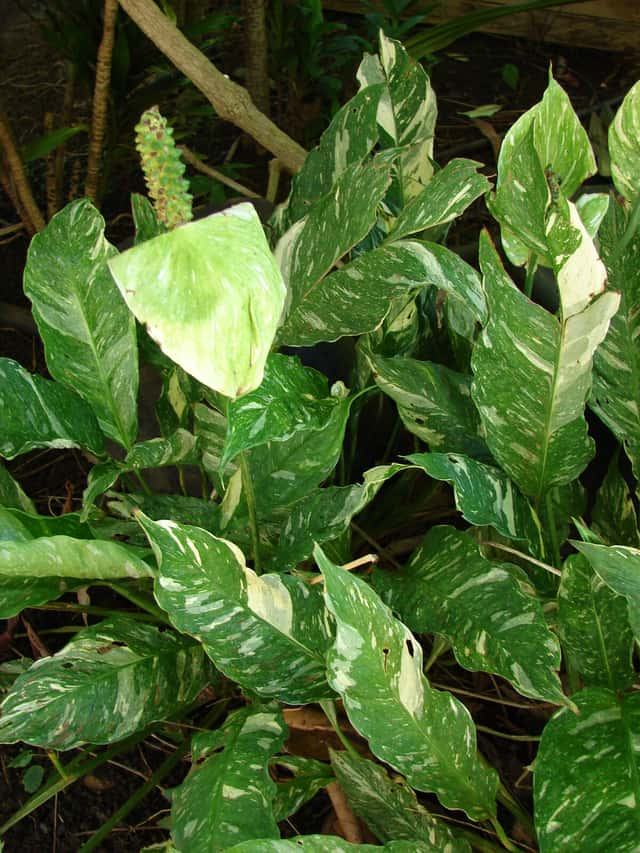
Domino Peace Lily (Spathiphyllum 'Domino') is a easy-care plant from the Araceae family. A variegated peace lily cultivar with glossy dark green leaves streaked and speckled with white. It arose as a spontaneous sport of the cultivar 'Daniel' in Belgium and forms an upright clump about 30-60 cm tall. White spathes appear above the foliage and turn green as they age.
Domino Peace Lily grows up to 60cm, spread of 60cm, watering every 7 days, 15°C – 25°C, 40–60% humidity. It is suitable for indoor environments and not safe for pets.
Unlike many tropical plants, Domino Peace Lily tolerates watering mistakes. Best for beginners. Without precautions, ingestion can cause irritation in pets. Keep out of reach of cats and dogs. Without adequate drainage, root rot can develop within 14 days.
How to Care for Domino Peace Lily?
TLDR: Domino Peace Lily needs Partial shade, watering every 7 days, and temperatures between 15-25°C with 40-60% humidity.
How Often Should You Water Domino Peace Lily?
Water when the top 2-3 cm of soil is dry, usually about once a week in the warm months and every 10-14 days in winter. Drooping means thirst; yellow leaves usually mean too much water. Filtered or rain water helps prevent brown tips caused by chlorine, fluoride and salts.
How Much Light Does Domino Peace Lily Need?
Bright indirect light near an east or north window. In low light new leaves come out greener and flowering drops off; direct sun scorches the white areas.
What Is the Best Soil for Domino Peace Lily?
Rich, moisture-retentive but well-draining mix: potting soil with fine bark, coco coir and perlite, in a pot with drainage holes.
What Pot Should You Use for Domino Peace Lily?
Plastic or ceramic pot with drainage holes, only slightly larger than the root ball; plastic holds moisture longer.
Care Schedule
Fertilize
Every 30 days
Repot
Every 365 days
What Is Domino Peace Lily and Where Does It Come From?
A variegated peace lily cultivar with glossy dark green leaves streaked and speckled with white. It arose as a spontaneous sport of the cultivar 'Daniel' in Belgium and forms an upright clump about 30-60 cm tall. White spathes appear above the foliage and turn green as they age.
How to Propagate Domino Peace Lily?
Division
Only divide large, healthy plants. Variegation can be unstable, so keep divisions that show a good mix of white and green.
- 1 Remove the plant from its pot and loosen the soil around the roots
- 2 Split the clump into sections, each with several leaves and its own roots
- 3 Pot each section in fresh, slightly moist mix
- 4 Keep in indirect light and water lightly until it settles
Materials needed:
How Big Does Domino Peace Lily Grow?
TLDR: Domino Peace Lily can reach up to 60cm tall with Medium growth rate.
Max height
60cm
Spread
60cm
Growth rate
Medium
Foliage
Evergreen
Warning: Toxic Plant
This plant can be toxic if ingested. Keep out of reach of:
Plant Uses
Ornamental
Great for decoration
Air Purifying
Improves air quality
Is your plant showing symptoms?
Click on the symptom to discover possible causes:
What Diseases Commonly Affect Domino Peace Lily?
TLDR: Domino Peace Lily is susceptible to 13 known diseases. Monitor regularly for early detection.
Root Rot
Root rot is a serious fungal disease that affects the root system of plants, causing them to decay and die. It is primarily caused by overwatering, poor drainage, or soil-borne fungi such as Pythium, Phytophthora, Rhizoctonia, and Fusarium. The disease thrives in waterlogged conditions where roots are deprived of oxygen, making them susceptible to fungal infection.
Pythium Root Rot
Pythium root rot is a serious fungal disease caused by various Pythium species including P. aphanidermatum, P. ultimum, and P. irregulare. These water molds are present in practically all cultivated soils and attack plant roots under wet conditions, causing rapid wet rot that can extend into the stem. The disease is favored by poor drainage, overwatering, and specific temperatures depending on the species.
Overwatering
Overwatering occurs when plants receive too much water, depriving roots of oxygen and causing root rot. This environmental stress is one of the most common causes of houseplant death, as waterlogged soil prevents roots from breathing and functioning properly.
Leaf Tip Necrosis
Leaf tip necrosis, also known as tip burn, is a non-infectious environmental condition where the tips and edges of leaves turn brown, dry, and crispy. This occurs due to various stress factors affecting the plant's ability to maintain healthy tissue at the leaf extremities.
Meaning & Symbolism
Peace, purity and calm
Fun Facts
It was found in Belgium as a spontaneous mutation of the cultivar 'Daniel' and received a US plant patent in 1997.
The white pattern differs from leaf to leaf, so no two leaves look the same.
Its variegation does not come true from seed, so it is propagated by division or tissue culture.
Frequently asked questions
Why is my Domino peace lily losing its white variegation?
How often should I water a Domino peace lily?
Is the Domino peace lily toxic to cats and dogs?
Why are the leaf tips turning brown?
Compare with similar plants
| Attribute | Difficulty | Light | Watering | Pet Safe |
|---|---|---|---|---|
| Field Maple | Easy | Bright indirect | 14d | ✓ |
| Iberian Houseleek | Easy | Direct sun | 14d | ✓ |
| Silver Birch | Easy | Direct sun | 14d | ✓ |
| Common Blanketflower | Easy | Direct sun | 10d | ✓ |





