Acanthaceae
Dragon's tongue (Hemigraphis repanda)
Hemigraphis repanda
An easy plant that likes indirect light, moist soil and humid air. Water when the top 2-3 cm of mix are dry and don't let it wilt. Feed in spring and summer. It works in terrariums, but it does not survive long fully submerged in an aquarium.
Every 5 days
Partial shade
18° - 27°C
50% - 80%
Categories
What is Dragon's tongue?
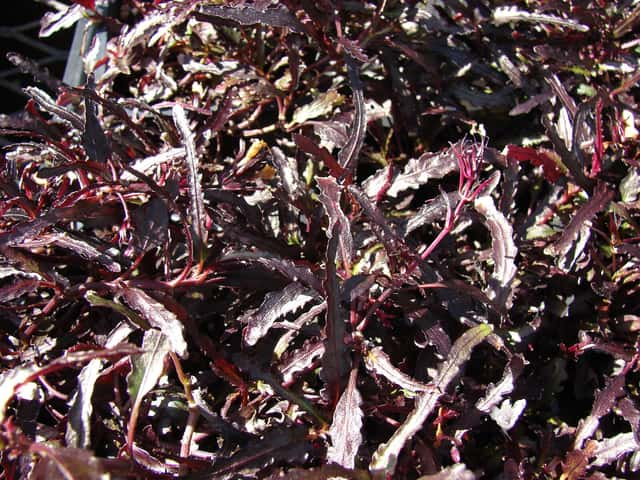
Dragon's tongue (Hemigraphis repanda) is a easy-care plant from the Acanthaceae family. Dragon's tongue (Hemigraphis repanda, now classified as Strobilanthes sinuata) is a small perennial in the Acanthaceae family, native to Southeast Asia, mainly the Malay Peninsula. It forms low, trailing clumps about 15-30 cm tall, with narrow, toothed leaves that are green to purplish on top and de...
Dragon's tongue grows up to 30cm, spread of 30cm, watering every 5 days, 18°C – 27°C, 50–80% humidity. It is suitable for indoor environments and safe for pets.
Unlike many tropical plants, Dragon's tongue tolerates watering mistakes. Best for beginners. Unlike many popular species, Dragon's tongue is safe to keep around pets. Without adequate drainage, root rot can develop within 10 days.
How to Care for Dragon's tongue?
TLDR: Dragon's tongue needs Partial shade, watering every 5 days, and temperatures between 18-27°C with 50-80% humidity.
How Often Should You Water Dragon's tongue?
Water when the top 2-3 cm of mix are dry, usually every 4-7 days. It is not drought tolerant, but soggy soil and standing water in the saucer lead to root rot.
How Much Light Does Dragon's tongue Need?
Medium to bright indirect light. It tolerates part shade; in low light stems get leggy and leaves turn greener. Avoid strong midday sun, which scorches the thin leaves.
What Is the Best Soil for Dragon's tongue?
A rich, organic mix that holds moisture but drains well, pH 6 to 7. Use a pot with drainage holes.
What Pot Should You Use for Dragon's tongue?
A shallow or medium pot with drainage holes; it also suits terrariums and the land part of paludariums.
Care Schedule
Fertilize
Every 30 days
What Is Dragon's tongue and Where Does It Come From?
Dragon's tongue (Hemigraphis repanda, now classified as Strobilanthes sinuata) is a small perennial in the Acanthaceae family, native to Southeast Asia, mainly the Malay Peninsula. It forms low, trailing clumps about 15-30 cm tall, with narrow, toothed leaves that are green to purplish on top and deep burgundy underneath. In spring and summer it bears small white flowers that stand out against the dark foliage. It is grown in pots, as a ground cover in shady beds and in terrariums and paludariums. Do not confuse it with purple waffle plant (Hemigraphis alternata), which has broad, puckered leaves.
How to Propagate Dragon's tongue?
Stem cuttings
Humidity speeds rooting; a clear plastic bag over the pot helps.
- 1 Cut a healthy 5-10 cm stem
- 2 Strip the lower leaves
- 3 Plant in moist mix or root in water
- 4 Keep in bright, indirect light with humid air
Materials needed:
Division
One large clump can give several new plants at once.
- 1 Remove the plant from its pot
- 2 Split the clump into pieces, each with roots and leaves
- 3 Repot in fresh mix
- 4 Water and keep in bright shade for a few days
Materials needed:
How Big Does Dragon's tongue Grow?
TLDR: Dragon's tongue can reach up to 30cm tall with Medium growth rate.
Max height
30cm
Spread
30cm
Growth rate
Medium
Foliage
Evergreen
Plant Uses
Ornamental
Great for decoration
Ground Cover
Soil coverage
Is your plant showing symptoms?
Click on the symptom to discover possible causes:
What Diseases Commonly Affect Dragon's tongue?
TLDR: Dragon's tongue is susceptible to 3 known diseases. Monitor regularly for early detection.
Root Rot
Root rot is a serious fungal disease that affects the root system of plants, causing them to decay and die. It is primarily caused by overwatering, poor drainage, or soil-borne fungi such as Pythium, Phytophthora, Rhizoctonia, and Fusarium. The disease thrives in waterlogged conditions where roots are deprived of oxygen, making them susceptible to fungal infection.
Spider Mites
Spider mites are tiny arachnids (less than 1/20 inch long) related to spiders and ticks that feed on plant sap. They thrive in hot, dry conditions and can cause significant damage to ornamental and vegetable plants. During severe infestations, crop losses can reach 14% or higher as these pests disrupt vital plant processes including photosynthesis, carbon dioxide absorption, and transpiration.
Scale Insects
Scale insects are small sap-sucking pests that appear as brown, shell-like bumps on plant stems and leaves. There are over 25 species, divided into armored (hard) and unarmored (soft) scales. They feed by piercing plant tissue and extracting sap, which weakens the plant and can lead to yellowing, stunted growth, and even death if left untreated. They also excrete honeydew, which attracts ants and promotes sooty mold growth.
Fun Facts
Its accepted scientific name is now Strobilanthes sinuata, but Hemigraphis repanda is still the usual trade name
It is often sold as an aquarium plant, yet it does not live long fully submerged
The deep burgundy undersides of the leaves give the clump its purple cast
Frequently asked questions
Can dragon's tongue live in an aquarium?
How much light does it need?
How often should I water it?
Is it the same as purple waffle plant?
Compare with similar plants
| Attribute | Difficulty | Light | Watering | Pet Safe |
|---|---|---|---|---|
| Field Maple | Easy | Bright indirect | 14d | ✓ |
| Iberian Houseleek | Easy | Direct sun | 14d | ✓ |
| Silver Birch | Easy | Direct sun | 14d | ✓ |
| Common Blanketflower | Easy | Direct sun | 10d | ✓ |
Choose & Compare
Sources & References
- Costa Farms — Dragon's Tongue (Hemigraphis repanda)
- Gardening Know How — Dragon's Tongue Care
- Bantam — Dragon's Tongue (Hemigraphis repanda) vivarium care
- NParks Flora & Fauna Web — Strobilanthes sinuata
- Harvest to Table — How to Grow Hemigraphis
- University of Hawaii CTAHR — Ground covers (OF-7)
- POWO — Strobilanthes sinuata (syn. Hemigraphis repanda)





