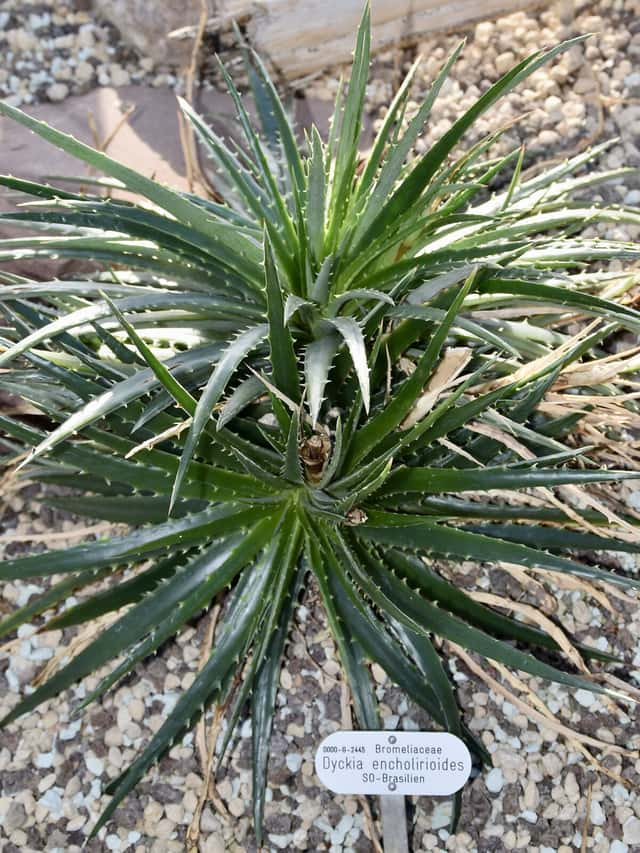
Bromeliaceae
Dyckia encholirioides
Dyckia encholirioides
Easy. Full sun, sandy fast-draining soil, regular water in warm weather and little in cold weather. Copes with drought, wind and salt spray.
Every 7 days
Bright indirect
0° - °C
% - %
Categories
What is Dyckia encholirioides?
Dyckia encholirioides (Dyckia encholirioides) is a easy-care plant from the Bromeliaceae family. Dyckia encholirioides is a terrestrial bromeliad endemic to Brazil, growing on rocks and sand along the coast from São Paulo to Rio Grande do Sul, always close to the sea in full sun and salt spray. It forms dense rosettes of narrow, stiff, triangular leaves with 3-5 mm spines on the edges, green ab...
Dyckia encholirioides grows up to 2.0m, watering every 7 days. It is not suitable for indoor environments and safe for pets.
Unlike many tropical plants, Dyckia encholirioides tolerates watering mistakes. Best for beginners. Unlike many popular species, Dyckia encholirioides is safe to keep around pets.
How to Care for Dyckia encholirioides?
TLDR: Dyckia encholirioides needs Bright indirect, watering every 7 days, and temperatures between 0-30°C with 40-70% humidity.
How Often Should You Water Dyckia encholirioides?
Water once the soil has dried well. It survives dry spells but grows better with regular summer watering. Water little in cold weather.
How Much Light Does Dyckia encholirioides Need?
Full sun all day. In shade the leaves go soft and it rarely flowers.
What Is the Best Soil for Dyckia encholirioides?
Use sandy soil or a cactus mix with coarse sand. Standing water around the roots is harmful.
What Pot Should You Use for Dyckia encholirioides?
A wide pot a little larger than the plant, with good drainage; the roots take up a lot of room.
What Is Dyckia encholirioides and Where Does It Come From?
Dyckia encholirioides is a terrestrial bromeliad endemic to Brazil, growing on rocks and sand along the coast from São Paulo to Rio Grande do Sul, always close to the sea in full sun and salt spray. It forms dense rosettes of narrow, stiff, triangular leaves with 3-5 mm spines on the edges, green above and silvery below, and slowly builds large clumps. From late winter to spring it sends up a tall branched stalk, up to 2 m, with many small yellow, orange or red flowers visited by bees. Unlike many bromeliads, it does not die after flowering.
How to Propagate Dyckia encholirioides?
Offsets (pups)
Larger pups establish faster.
- 1 Wear thick gloves because of the spines
- 2 Detach a side pup that already has its own roots
- 3 Plant in sandy, well-drained mix
- 4 Water lightly until it settles
Materials needed:
Seed
Dyckia seed loses viability quickly, so sow soon after harvest. The species needs cross-pollination to set seed.
- 1 Sow fresh seed on moist sandy mix
- 2 Keep in a bright, warm place
- 3 Pot on once seedlings are sturdy
Materials needed:
How Big Does Dyckia encholirioides Grow?
TLDR: Dyckia encholirioides can reach up to 2.0m tall with Medium growth rate.
Max height
2.0m
Foliage
Evergreen
Plant Uses
Ornamental
Great for decoration
Ground Cover
Soil coverage
Is your plant showing symptoms?
Click on the symptom to discover possible causes:
Fun Facts
In the wild it grows so close to the sea that some plants sit within reach of the waves.
Old dry leaves wrap the trunk and shield it from sun and salt.
Its flowers are visited by carpenter bees and, now and then, hummingbirds.
Frequently asked questions
Does Dyckia encholirioides die after flowering?
Can it grow indoors?
Is it cold hardy?
Are the spines sharp?
Compare with similar plants
| Attribute | Difficulty | Light | Watering | Pet Safe |
|---|---|---|---|---|
| Field Maple | Easy | Bright indirect | 14d | ✓ |
| Iberian Houseleek | Easy | Direct sun | 14d | ✓ |
| Silver Birch | Easy | Direct sun | 14d | ✓ |
| Common Blanketflower | Easy | Direct sun | 10d | ✓ |
Choose & Compare
Sources & References
- HortFlora (Royal Botanic Gardens Victoria) - Dyckia, incl. D. encholirioides (Christensen & Butcher 2005)
- UF/IFAS Gardening Solutions - Dyckia
- Canarius - Dyckia encholirioides
- Dyckia Brazil (Constantino Gastaldi) - Dyckia encholirioides var. spinosissima
- Krieck, UFSC - Biologia reprodutiva de Dyckia encholirioides (dissertação)
- Wikipedia - Dyckia encholirioides





