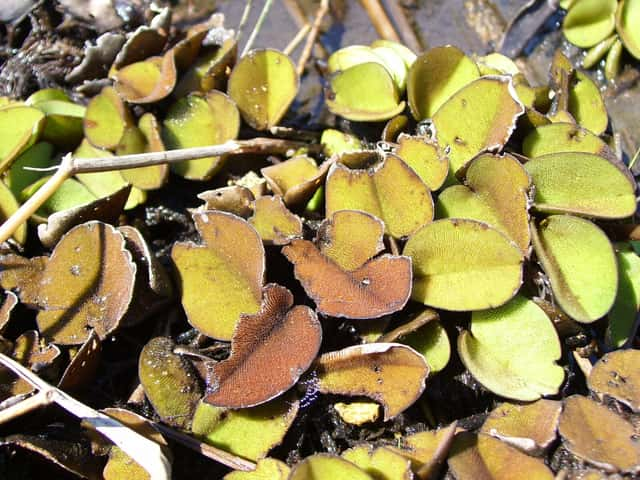
Salviniaceae
Eared Watermoss (Salvinia auriculata)
Salvinia auriculata
A fast-growing floater: bright light, still or slow water and 20-28 °C. The only regular job is removing the surplus.
Every 1 days
Bright indirect
18° - 30°C
% - %
Categories
What is Eared Watermoss?
Eared Watermoss (Salvinia auriculata) is a easy-care plant from the Salviniaceae family. Salvinia auriculata is a small floating fern that drifts freely on still ponds, marshes and slow rivers from Mexico and the Caribbean to Argentina. Each node carries two oval leaves 1-2.5 cm long, covered in water-repellent hairs, plus a third leaf modified into a root-like, hairy strand that hangs...
Eared Watermoss grows up to 3cm, watering every 1 days, 18°C – 30°C. It is suitable for indoor environments and safe for pets.
Unlike many tropical plants, Eared Watermoss tolerates watering mistakes. Best for beginners. Unlike many popular species, Eared Watermoss is safe to keep around pets. Without adequate drainage, root rot can develop within 7 days.
How to Care for Eared Watermoss?
TLDR: Eared Watermoss needs Bright indirect, watering every 1 days, and temperatures between 18-30°C with 40-70% humidity.
How Often Should You Water Eared Watermoss?
No watering: it lives on the water surface. Keep it in still or slow-moving, dechlorinated water and avoid constant splashing on the leaves, which rot if they stay submerged.
How Much Light Does Eared Watermoss Need?
Bright light, from filtered sun to full sun outdoors. In aquariums use a strong light and leave a gap between the water and the lid so leaves do not scorch or stay wet.
What Is the Best Soil for Eared Watermoss?
No soil needed. It takes nutrients straight from the water; in very clean water, a little liquid aquarium fertilizer keeps the leaves green.
What Pot Should You Use for Eared Watermoss?
Pond, tub, aquarium or any watertight container. A wide container suits it better than a deep one, since it covers the surface.
What Is Eared Watermoss and Where Does It Come From?
Salvinia auriculata is a small floating fern that drifts freely on still ponds, marshes and slow rivers from Mexico and the Caribbean to Argentina. Each node carries two oval leaves 1-2.5 cm long, covered in water-repellent hairs, plus a third leaf modified into a root-like, hairy strand that hangs in the water. It has no flowers: it spreads by breaking into pieces and by spores held in small sacs among the roots. It is grown in ponds and aquariums, where it shelters young fish and soaks up nutrients, but it spreads quickly and has become invasive in parts of Africa.
How to Propagate Eared Watermoss?
Separating pieces
It multiplies on its own and one piece can cover a large area in weeks. Never dump surplus plants in rivers or lakes.
- 1 Pull off a piece with at least 3 pairs of leaves
- 2 Float it on another pond or aquarium
- 3 Keep it in a bright spot with water at 20-28 °C
Materials needed:
How Big Does Eared Watermoss Grow?
TLDR: Eared Watermoss can reach up to 3cm tall with Fast growth rate.
Max height
3cm
Growth rate
Fast
Foliage
Evergreen
Plant Uses
Ornamental
Great for decoration
Is your plant showing symptoms?
Click on the symptom to discover possible causes:
What Diseases Commonly Affect Eared Watermoss?
TLDR: Eared Watermoss is susceptible to 4 known diseases. Monitor regularly for early detection.
Curculionidae
Curculionidae (weevils) are small beetles that feed on plants. Adults chew leaf margins, leaving crescent-shaped notches, primarily at night. The larvae live in the substrate and consume roots, causing decline, yellowing, and wilting even when the substrate is moist, and in severe cases, plant death. They frequently affect ornamentals and garden plants such as strawberries, citrus, roses, hydrangeas, azaleas, blueberries, begonias, and many potted plants.
Caterpillars
Caterpillars are the larval stage of moths and butterflies that feed voraciously on plant foliage, stems, flowers, and fruits. Common species include cabbage loopers, tomato hornworms, armyworms, and cutworms. These pests can cause extensive damage by consuming large amounts of plant tissue in a short time. They vary in size from small (1/4 inch) to large (5 inches), with colors ranging from green to brown, often featuring stripes or spots. Caterpillars are highly mobile and can quickly spread throughout gardens, making them one of the most destructive common pests.
Low Light Stress
Low light stress, also known as etiolation, occurs when plants do not receive adequate light for proper growth and development. This leads to abnormal growth patterns characterized by elongated stems, pale leaves, and weakened overall structure as the plant attempts to reach toward available light sources.
Nutrient Deficiency
Nutrient deficiency occurs when a plant cannot access one or more essential mineral elements in sufficient quantities for healthy growth. Plants require 17 essential nutrients: macronutrients (N, P, K, Ca, Mg, S) and micronutrients (Fe, Zn, Mn, Cu, B, Mo, Cl). Each plays a unique role in metabolism, structure, and reproduction. Deficiencies arise from depleted soils, incorrect pH blocking uptake, poor watering practices leaching nutrients, root damage, or imbalanced fertilization. Understanding whether a nutrient is mobile or immobile determines where symptoms first appear: mobile nutrients (N, P, K, Mg) show symptoms on older leaves first, while immobile nutrients (Ca, Fe, Zn, Cu, B) show symptoms on new growth first.
Fun Facts
The leaf hairs trap a layer of air so well that they inspired research into water-repellent ship coatings
Its "roots" are actually modified leaves
By 1949 it had infested the Zambezi River in Africa
Studies show it can remove heavy metals from polluted water
Frequently asked questions
Does eared watermoss need soil?
Why are the leaves turning yellow or small?
Is it invasive?
Is it good for aquariums?
Compare with similar plants
| Attribute | Difficulty | Light | Watering | Pet Safe |
|---|---|---|---|---|
| Field Maple | Easy | Bright indirect | 14d | ✓ |
| Iberian Houseleek | Easy | Direct sun | 14d | ✓ |
| Silver Birch | Easy | Direct sun | 14d | ✓ |
| Common Blanketflower | Easy | Direct sun | 10d | ✓ |





