Cactaceae
Fishhook Barrel Cactus (Ferocactus wislizeni)
Ferocactus wislizeni
An easy, very tough cactus: full sun, well-drained soil and little water. In pots, water in the warm season letting the mix dry out between waterings and keep it dry in winter. Tolerates dry cold to about -9 °C.
Every 14 days
Direct sun
-9° - °C
% - %
Categories
What is Fishhook barrel cactus?
Fishhook barrel cactus (Ferocactus wislizeni) is a easy-care plant from the Cactaceae family. Ferocactus wislizeni, the fishhook barrel cactus, comes from the Sonoran and Chihuahuan deserts of southern Arizona, New Mexico, west Texas and northern Mexico, where it grows on rocky ridges and open bajadas. It starts as a ball and becomes a barrel 1 to 2 m tall (rarely 3 m) and up to 80 cm across...
Fishhook barrel cactus grows up to 3.0m, spread of 80cm, watering every 14 days. It is suitable for indoor environments and safe for pets.
Unlike many tropical plants, Fishhook barrel cactus tolerates watering mistakes. Best for beginners. Unlike many popular species, Fishhook barrel cactus is safe to keep around pets. Without adequate drainage, root rot can develop within 28 days.
How to Care for Fishhook barrel cactus?
TLDR: Fishhook barrel cactus needs Direct sun, watering every 14 days, and temperatures between -9-30°C with 40-70% humidity.
How Often Should You Water Fishhook barrel cactus?
In pots, water deeply about every 2 weeks in spring and summer, only once the mix is completely dry. Almost none in winter. In the ground in dry climates it can live on rainfall.
How Much Light Does Fishhook barrel cactus Need?
Full sun or light shade. Acclimatize gradually to strong sun to avoid sunburn and keep the same side facing the sun.
What Is the Best Soil for Fishhook barrel cactus?
Any soil as long as it drains well: a cactus mix with plenty of coarse sand, grit or pumice.
What Pot Should You Use for Fishhook barrel cactus?
A wide, fairly shallow terracotta pot with a drainage hole; the roots are shallow and spreading.
Care Schedule
Fertilize
Every 180 days
What Is Fishhook barrel cactus and Where Does It Come From?
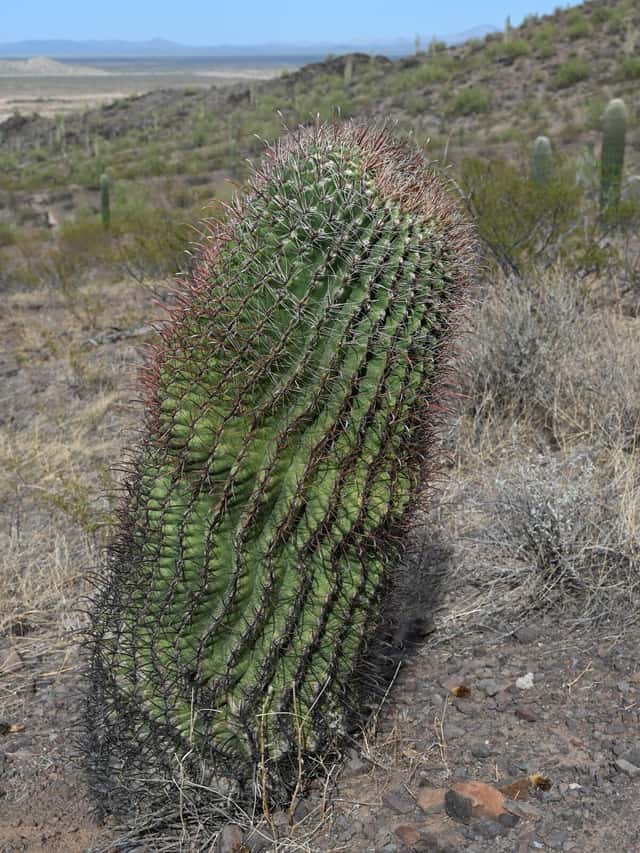
Ferocactus wislizeni, the fishhook barrel cactus, comes from the Sonoran and Chihuahuan deserts of southern Arizona, New Mexico, west Texas and northern Mexico, where it grows on rocky ridges and open bajadas. It starts as a ball and becomes a barrel 1 to 2 m tall (rarely 3 m) and up to 80 cm across, with 20 to 28 ribs and stout spines, the lowest central one curved like a fishhook. In summer it opens a ring of yellow, orange or red flowers at the top, followed by yellow, pineapple-shaped edible fruits. Mature plants usually lean south, which earned it the name compass barrel.
How to Propagate Fishhook barrel cactus?
Seed
Fresh seed germinates best. Seedlings are slow and take years to become barrels.
- 1 Scatter the seed over fine, moist cactus mix
- 2 Cover with a light layer of sand or leave on the surface
- 3 Keep warm and bright, out of direct sun, with the mix slightly moist
- 4 Pot seedlings individually once they are pea-sized
Materials needed:
How Big Does Fishhook barrel cactus Grow?
TLDR: Fishhook barrel cactus can reach up to 3.0m tall with Slow growth rate.
Max height
3.0m
Spread
80cm
Growth rate
Slow
Foliage
Evergreen
Plant Uses
Ornamental
Great for decoration
Edible
Can be consumed
Culinary Uses
- The rind of the ripe fruit is edible with a lemony taste and is made into candy and jelly in the Sonoran Desert.
Is your plant showing symptoms?
Click on the symptom to discover possible causes:
What Diseases Commonly Affect Fishhook barrel cactus?
TLDR: Fishhook barrel cactus is susceptible to 4 known diseases. Monitor regularly for early detection.
Root Rot
Root rot is a serious fungal disease that affects the root system of plants, causing them to decay and die. It is primarily caused by overwatering, poor drainage, or soil-borne fungi such as Pythium, Phytophthora, Rhizoctonia, and Fusarium. The disease thrives in waterlogged conditions where roots are deprived of oxygen, making them susceptible to fungal infection.
Mealybugs
Mealybugs are small, soft-bodied insects covered with a white, waxy, cottony material. They are common pests of houseplants and outdoor plants in mild climates. These sap-sucking insects feed on plant tissue, causing damage, stunted growth, and can lead to plant death if left untreated. They produce sticky honeydew which attracts sooty mold.
Scale Insects
Scale insects are small sap-sucking pests that appear as brown, shell-like bumps on plant stems and leaves. There are over 25 species, divided into armored (hard) and unarmored (soft) scales. They feed by piercing plant tissue and extracting sap, which weakens the plant and can lead to yellowing, stunted growth, and even death if left untreated. They also excrete honeydew, which attracts ants and promotes sooty mold growth.
Sunburn (Sun Scorch)
Sunburn or sun scorch is an environmental condition that occurs when plants are exposed to intense, direct sunlight beyond their tolerance level. This causes the breakdown of chlorophyll in the leaves, resulting in bleached, dried, and damaged foliage. The damage can happen rapidly, sometimes within just a few hours of exposure.
Fun Facts
Mature plants lean south, giving it the nickname compass barrel cactus.
Its fruits can stay on top of the plant for more than a year.
It can live from 50 to over 100 years.
Frequently asked questions
How often should I water a fishhook barrel cactus?
Is it cold hardy?
Is the fruit edible?
Why is my barrel cactus leaning?
Compare with similar plants
| Attribute | Difficulty | Light | Watering | Pet Safe |
|---|---|---|---|---|
| Field Maple | Easy | Bright indirect | 14d | ✓ |
| Iberian Houseleek | Easy | Direct sun | 14d | ✓ |
| Silver Birch | Easy | Direct sun | 14d | ✓ |
| Common Blanketflower | Easy | Direct sun | 10d | ✓ |





