Sapindaceae
Flamegold Rain Tree (Koelreuteria elegans)
Koelreuteria elegans
An easy tree for warm climates: full sun, any soil that drains, and watering only while young. Once established it tolerates drought, heat and air pollution. The wood is weak, so train the crown with pruning in the first years. It does not survive hard frost.
Every 7 days
Direct sun
-3° - 38°C
% - %
Categories
What is Flamegold Rain Tree?
Flamegold Rain Tree (Koelreuteria elegans) is a easy-care plant from the Sapindaceae family. Koelreuteria elegans is a tree in the soapberry family (Sapindaceae) with two subspecies: one from Fiji and one from Taiwan (subsp. formosana), which is the form planted along streets and in gardens. It reaches 7 to 17 m with a broad, open crown and twice-divided leaves made of many toothed leaflets...
Flamegold Rain Tree grows up to 17.0m, spread of 1500cm, watering every 7 days, -3°C – 38°C. It is not suitable for indoor environments and safe for pets.
Unlike many tropical plants, Flamegold Rain Tree tolerates watering mistakes. Best for beginners. Unlike many popular species, Flamegold Rain Tree is safe to keep around pets.
How to Care for Flamegold Rain Tree?
TLDR: Flamegold Rain Tree needs Direct sun, watering every 7 days, and temperatures between -3-38°C with 40-70% humidity.
How Often Should You Water Flamegold Rain Tree?
Water once a week in the first year, more in hot spells. Established trees live on rainfall and tolerate drought. Avoid waterlogged soil, which leads to root rot.
How Much Light Does Flamegold Rain Tree Need?
Full sun all day. In part shade it grows thin and leggy and flowers poorly.
What Is the Best Soil for Flamegold Rain Tree?
Grows in clay, sand, acidic or alkaline soil, as long as water does not sit around the roots.
What Pot Should You Use for Flamegold Rain Tree?
Not a container tree. Keep young plants in a deep pot or grow bag of 30 litres or more for up to two years, then plant in the ground.
What Is Flamegold Rain Tree and Where Does It Come From?
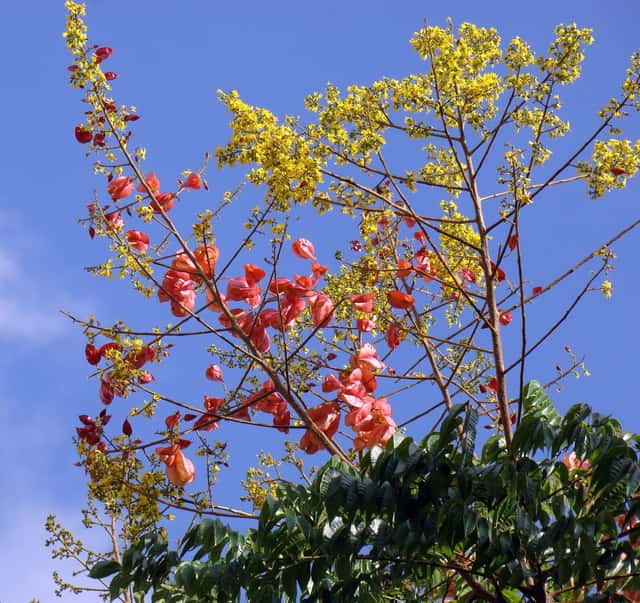
Koelreuteria elegans is a tree in the soapberry family (Sapindaceae) with two subspecies: one from Fiji and one from Taiwan (subsp. formosana), which is the form planted along streets and in gardens. It reaches 7 to 17 m with a broad, open crown and twice-divided leaves made of many toothed leaflets. In late summer and autumn it is covered in large clusters of small yellow flowers with red centres, followed by inflated, papery pink-red capsules like little lanterns that turn brown as they dry. It is related to the golden rain tree (Koelreuteria paniculata), which has its own entry and is more cold-hardy.
How to Propagate Flamegold Rain Tree?
Seed
Seeds sprout quickly in warm weather. Where the tree is invasive, do not plant near bushland and pick up fallen capsules.
- 1 Collect dry brown capsules and remove the black seeds
- 2 Soak the seeds in warm water for 24 hours
- 3 Sow 1 cm deep in light, moist potting mix
- 4 Keep warm and bright until they sprout
- 5 Plant out when the seedling is about 30 cm tall
Materials needed:
How Big Does Flamegold Rain Tree Grow?
TLDR: Flamegold Rain Tree can reach up to 17.0m tall with Fast growth rate.
Max height
17.0m
Spread
15.0m
Growth rate
Fast
Foliage
Semi-evergreen
Plant Uses
Ornamental
Great for decoration
Is your plant showing symptoms?
Click on the symptom to discover possible causes:
What Diseases Commonly Affect Flamegold Rain Tree?
TLDR: Flamegold Rain Tree is susceptible to 4 known diseases. Monitor regularly for early detection.
Scale Insects
Scale insects are small sap-sucking pests that appear as brown, shell-like bumps on plant stems and leaves. There are over 25 species, divided into armored (hard) and unarmored (soft) scales. They feed by piercing plant tissue and extracting sap, which weakens the plant and can lead to yellowing, stunted growth, and even death if left untreated. They also excrete honeydew, which attracts ants and promotes sooty mold growth.
Root Rot
Root rot is a serious fungal disease that affects the root system of plants, causing them to decay and die. It is primarily caused by overwatering, poor drainage, or soil-borne fungi such as Pythium, Phytophthora, Rhizoctonia, and Fusarium. The disease thrives in waterlogged conditions where roots are deprived of oxygen, making them susceptible to fungal infection.
Canker
Canker is a disease caused by various fungi and bacteria that create necrotic, sunken areas on bark of branches, stems, and trunks. Pathogens enter through wounds and natural openings, especially when plants are stressed. Canker can gradually weaken or kill branches by disrupting water and nutrient flow.
Verticillium Wilt
Verticillium wilt is a soil-borne fungal disease caused primarily by the fungi Verticillium dahliae and V. albo-atrum. These pathogens infect plant roots and grow within the vascular tissues, blocking water and nutrient transport, resulting in wilting and eventual plant death. The disease affects over 350 plant species including vegetables, fruits, ornamental flowers, and trees. The fungi can survive in soil for more than 10 years as resistant structures called microsclerotia.
Fun Facts
In Taiwan it changes colour through the year: green leaves, yellow flowers, red pods, then brown as they dry
Its inflated pods look like Chinese paper lanterns
Fallen flowers carpet the ground in yellow, which is where the rain tree name comes from
Frequently asked questions
How is Koelreuteria elegans different from Koelreuteria paniculata?
Is it a good tree near pavements?
Can it become a weed?
What pests and diseases affect it?
Compare with similar plants
| Attribute | Difficulty | Light | Watering | Pet Safe |
|---|---|---|---|---|
| Field Maple | Easy | Bright indirect | 14d | ✓ |
| Iberian Houseleek | Easy | Direct sun | 14d | ✓ |
| Silver Birch | Easy | Direct sun | 14d | ✓ |
| Common Blanketflower | Easy | Direct sun | 10d | ✓ |





