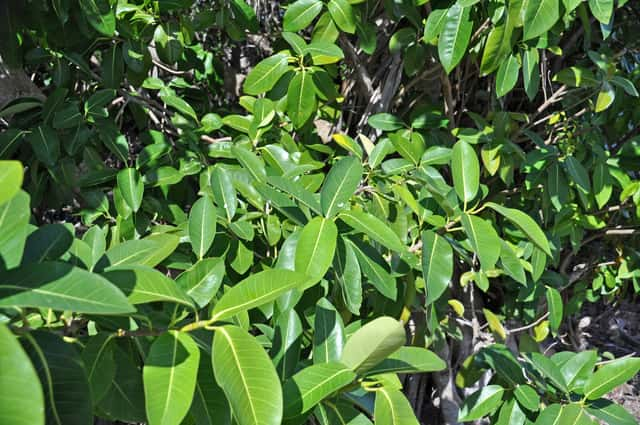
Moraceae
Florida Strangler Fig (Ficus aurea)
Ficus aurea
A fast-growing tree for frost-free climates that handles drought and poor soil. It needs a lot of room: aerial and surface roots lift paving and work into buildings. In a pot it stays small and works as a houseplant or bonsai.
Every 7 days
Bright indirect
° - °C
% - %
Categories
What is Florida strangler fig?
Florida strangler fig (Ficus aurea) is a easy-care plant from the Moraceae family. Ficus aurea is a fig in the family Moraceae, native to central and south Florida, the Caribbean, southern Mexico and Central America down to Panama. It is a strangler fig: birds drop the seed high in another tree, where it germinates, and its roots grow down to the ground, thicken and fuse around th...
Florida strangler fig grows up to 30.0m, spread of 2100cm, watering every 7 days. It is suitable for indoor environments and not safe for pets.
Unlike many tropical plants, Florida strangler fig tolerates watering mistakes. Best for beginners. Without precautions, ingestion can cause irritation in pets. Keep out of reach of cats and dogs. Without adequate drainage, root rot can develop within 14 days.
How to Care for Florida strangler fig?
TLDR: Florida strangler fig needs Bright indirect, watering every 7 days, and temperatures between 15-30°C with 40-70% humidity.
How Often Should You Water Florida strangler fig?
In the ground, water weekly until established; after that it is very drought tolerant. In a pot, water when the top 3-5 cm of soil is dry and empty the saucer.
How Much Light Does Florida strangler fig Need?
Prefers full sun and tolerates part shade. Indoors, keep it by the brightest window in the house.
What Is the Best Soil for Florida strangler fig?
Takes clay, sand or loam, acidic or alkaline (pH 4.5 to 8), as long as it drains. In a pot, use a free-draining mix.
What Pot Should You Use for Florida strangler fig?
For indoors or bonsai, a pot with a drainage hole only a little larger than the root ball. In the garden, plant well away from houses, walls and pipes.
What Is Florida strangler fig and Where Does It Come From?
Ficus aurea is a fig in the family Moraceae, native to central and south Florida, the Caribbean, southern Mexico and Central America down to Panama. It is a strangler fig: birds drop the seed high in another tree, where it germinates, and its roots grow down to the ground, thicken and fuse around the host's trunk until the host dies. It can grow past 18 meters with an even wider crown, and reaches 30 m in the wild. The leaves are dark green, smooth and thick. The figs come in pairs, small (up to 1.2 cm), and turn yellow when ripe; birds, bats and small mammals eat them. Like all figs, it bleeds milky sap when cut.
How to Propagate Florida strangler fig?
Stem cutting
Wear gloves: the sap irritates skin. Warmth and humidity speed up rooting.
- 1 Cut a 15-20 cm shoot with a few leaves
- 2 Rinse the milky sap from the cut and let it dry for a few hours
- 3 Remove the lower leaves and insert into moist, free-draining mix
- 4 Keep warm and bright, out of strong sun, until rooted
Materials needed:
Seed
Viable seed only forms where the species' own pollinating wasp lives.
- 1 Remove seeds from fully ripe figs
- 2 Scatter on moist mix without covering
- 3 Keep warm and humid until they germinate
Materials needed:
How Big Does Florida strangler fig Grow?
TLDR: Florida strangler fig can reach up to 30.0m tall with Fast growth rate.
Max height
30.0m
Spread
21.0m
Growth rate
Fast
Foliage
Evergreen
Warning: Toxic Plant
This plant can be toxic if ingested. Keep out of reach of:
Plant Uses
Ornamental
Great for decoration
Edible
Can be consumed
Medicinal
Medicinal properties
Medicinal Uses
- Traditional use in the Bahamas and Florida (no proven medical use; the sap irritates skin)
Culinary Uses
- Ripe figs eaten fresh, as early Floridians did
Is your plant showing symptoms?
Click on the symptom to discover possible causes:
What Diseases Commonly Affect Florida strangler fig?
TLDR: Florida strangler fig is susceptible to 3 known diseases. Monitor regularly for early detection.
Aphids
Aphids are small, soft-bodied, pear-shaped insects (1/16 to 1/8 inch long) that feed by sucking nutrient-rich sap from plants. They reproduce rapidly and can quickly weaken plants, causing distorted growth and transmitting plant viruses. Aphids come in various colors including green, black, red, yellow, brown, and gray. They secrete honeydew, a sticky substance that attracts ants and encourages sooty mold growth.
Scale Insects
Scale insects are small sap-sucking pests that appear as brown, shell-like bumps on plant stems and leaves. There are over 25 species, divided into armored (hard) and unarmored (soft) scales. They feed by piercing plant tissue and extracting sap, which weakens the plant and can lead to yellowing, stunted growth, and even death if left untreated. They also excrete honeydew, which attracts ants and promotes sooty mold growth.
Sooty Mold
Sooty mold is a fungal disease that develops on surfaces coated with honeydew, a sticky sweet substance secreted by sap-sucking insects like aphids, scale insects, and whiteflies. While it does not directly infect plant tissue, it reduces photosynthetic capacity by blocking sunlight and diminishes the plant's aesthetic appearance.
Fun Facts
Each fig species relies on its own wasp for pollination: for Ficus aurea it is Pegoscapus mexicanus.
In Mesoamerica the bark was used to make amate paper.
Its leaves feed the caterpillars of two daggerwing butterflies.
Frequently asked questions
Why is it called a strangler fig?
Is it toxic to cats and dogs?
Can I plant it near my house?
Are the figs edible?
Compare with similar plants
| Attribute | Difficulty | Light | Watering | Pet Safe |
|---|---|---|---|---|
| Field Maple | Easy | Bright indirect | 14d | ✓ |
| Iberian Houseleek | Easy | Direct sun | 14d | ✓ |
| Silver Birch | Easy | Direct sun | 14d | ✓ |
| Common Blanketflower | Easy | Direct sun | 10d | ✓ |





