Hydrocharitaceae
Frogbit (Hydrocharis)
Hydrocharis
An easy, fast-growing floating plant for still or slow-moving water. Just set the rosettes on the surface in full sun or light shade; no soil or pot is needed. Keep the water level topped up, thin out extra plantlets in summer so they do not cover the whole surface, and clear dead leaves in late autumn. Hardy outdoors as long as the pond is deep enough not to freeze to the bottom.
Every 7 days
Bright indirect
° - °C
% - %
Categories
What is Frogbit?
Frogbit (Hydrocharis) is a easy-care plant from the Hydrocharitaceae family. Hydrocharis is a small genus of five free-floating aquatic plants in the frogbit family (Hydrocharitaceae), found across Europe, Asia, parts of Africa, New Guinea and the Americas. The one usually grown in garden ponds is European frogbit, Hydrocharis morsus-ranae: rosettes of round to kidney-shaped...
Frogbit grows up to 10cm, spread of 100cm, watering every 7 days. It is suitable for indoor environments and safe for pets.
Unlike many tropical plants, Frogbit tolerates watering mistakes. Best for beginners. Unlike many popular species, Frogbit is safe to keep around pets. Without adequate drainage, root rot can develop within 14 days.
How to Care for Frogbit?
TLDR: Frogbit needs Bright indirect, watering every 7 days, and temperatures between 15-30°C with 40-70% humidity.
How Often Should You Water Frogbit?
Frogbit never needs watering in the usual sense: it lives floating on water. About once a week check the water level of the pond, tub or aquarium and top it up, ideally with rain water, so the rosettes keep floating and the roots stay submerged. Avoid strong currents, fountains or filter outflows that push water over the leaves. Remove yellowing leaves and, in late autumn, dead plant material so it does not rot in the water.
How Much Light Does Frogbit Need?
Grow it in full sun to partial shade. In strong light the rosettes stay compact and flower well; in dim light the leaves stretch, turn pale and flowering stops. Indoors, it only does well under a bright window or an aquarium light.
What Is the Best Soil for Frogbit?
No soil is needed: frogbit floats freely and takes its nutrients straight from the water through its roots. It prefers calm, clean, slightly alkaline water (pH about 6.5-7.8) that is reasonably rich in nutrients, such as an established pond. Avoid fertilizing the pond, which feeds algae more than the plant.
What Pot Should You Use for Frogbit?
No pot needed: float it on a pond, half-barrel water garden or large bowl at least 30-45 cm deep if it stays outdoors over winter; a coldwater aquarium with a lid gap and good light also works.
What Is Frogbit and Where Does It Come From?
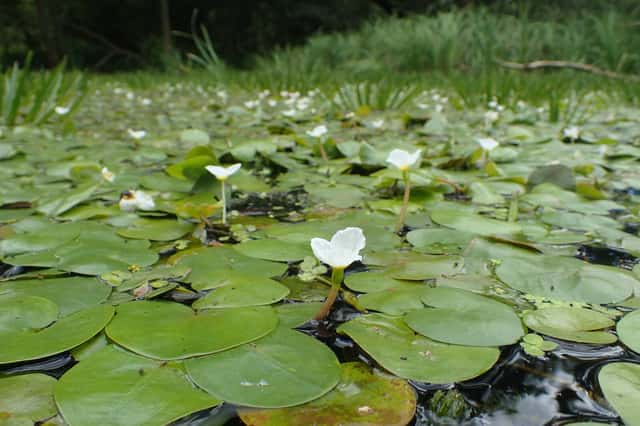
Hydrocharis is a small genus of five free-floating aquatic plants in the frogbit family (Hydrocharitaceae), found across Europe, Asia, parts of Africa, New Guinea and the Americas. The one usually grown in garden ponds is European frogbit, Hydrocharis morsus-ranae: rosettes of round to kidney-shaped glossy leaves about 3 cm across, often reddish underneath, floating on the surface with long dangling roots. Plants spread quickly by runners into mats 0.5-1 m wide but stay only about 10 cm tall. In summer they bear three-petalled white flowers, 2-3 cm across, with a yellow spot at the base of each petal; male and female flowers grow on separate plants. In autumn the plant dies back and survives the winter as small dormant buds (turions) that sink to the bottom and float up again in spring. In warmer parts of Asia its relative Hydrocharis dubia plays the same role in ponds and paddies.
How to Propagate Frogbit?
Separating runner plantlets
The plant multiplies on its own very quickly; separating plantlets is mostly a way to share or move it. Never release it into natural waters.
- 1 Find a young rosette with its own roots growing at the end of a runner.
- 2 Snip or gently pull the runner to separate it from the mother plant.
- 3 Place the new rosette on the surface of still water in a bright spot.
Materials needed:
Overwintering buds (turions)
The pond must be deep enough (at least 30-45 cm) not to freeze to the bottom, otherwise the buds die.
- 1 In autumn, collect the small dormant buds that form at the ends of runners before they sink, or let them sink naturally in a deep pond.
- 2 Keep collected buds in a jar of pond water in a cool, frost-free place over winter.
- 3 In spring, return them to the pond surface; they float up and grow into new rosettes.
Materials needed:
How Big Does Frogbit Grow?
TLDR: Frogbit can reach up to 10cm tall with Fast growth rate.
Max height
10cm
Spread
1.0m
Growth rate
Fast
Foliage
Deciduous
Plant Uses
Ornamental
Great for decoration
Is your plant showing symptoms?
Click on the symptom to discover possible causes:
What Diseases Commonly Affect Frogbit?
TLDR: Frogbit is susceptible to 3 known diseases. Monitor regularly for early detection.
Slugs and Snails
Slugs and snails are mollusks that feed on plant tissue, causing irregular holes in leaves and damage to young seedlings. They are most active at night and in moist conditions, leaving characteristic silvery slime trails. These pests can quickly devastate gardens, especially during wet seasons.
Caterpillars
Caterpillars are the larval stage of moths and butterflies that feed voraciously on plant foliage, stems, flowers, and fruits. Common species include cabbage loopers, tomato hornworms, armyworms, and cutworms. These pests can cause extensive damage by consuming large amounts of plant tissue in a short time. They vary in size from small (1/4 inch) to large (5 inches), with colors ranging from green to brown, often featuring stripes or spots. Caterpillars are highly mobile and can quickly spread throughout gardens, making them one of the most destructive common pests.
Aphids
Aphids are small, soft-bodied, pear-shaped insects (1/16 to 1/8 inch long) that feed by sucking nutrient-rich sap from plants. They reproduce rapidly and can quickly weaken plants, causing distorted growth and transmitting plant viruses. Aphids come in various colors including green, black, red, yellow, brown, and gray. They secrete honeydew, a sticky substance that attracts ants and encourages sooty mold growth.
Meaning & Symbolism
Calm, still water and quiet shelter: the little floating rosettes of frogbit shade the pond and give cover to frogs and fish, a symbol of peaceful, self-renewing nature.
Fun Facts
The species name morsus-ranae is Latin for frog bite, from the old idea that frogs bit the leaves.
A single European frogbit plant can produce more than a hundred overwintering buds in one season.
Male and female flowers grow on separate plants, so many pond populations never set seed and spread only by runners and buds.
In Southeast Asia the young leaves of Hydrocharis dubia are eaten and the plant is grown as cover in fish ponds.
Frequently asked questions
Does frogbit need soil or fertilizer?
What happens to frogbit in winter?
Is frogbit safe for fish and pets?
Is frogbit invasive?
Compare with similar plants
| Attribute | Difficulty | Light | Watering | Pet Safe |
|---|---|---|---|---|
| Field Maple | Easy | Bright indirect | 14d | ✓ |
| Iberian Houseleek | Easy | Direct sun | 14d | ✓ |
| Silver Birch | Easy | Direct sun | 14d | ✓ |
| Common Blanketflower | Easy | Direct sun | 10d | ✓ |