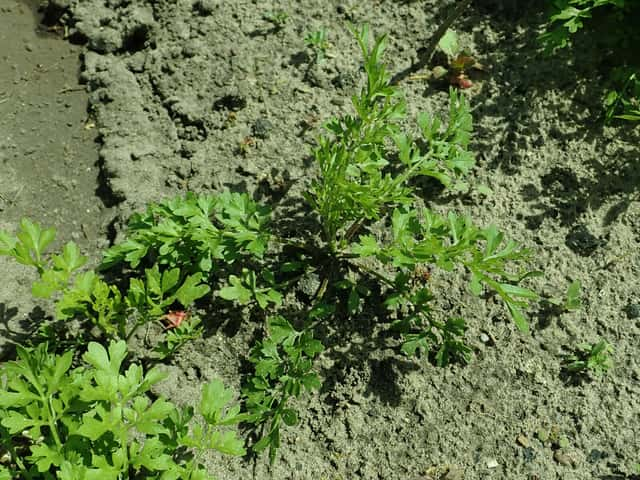
Brassicaceae
Garden cress (Lepidium sativum)
Lepidium sativum
One of the easiest plants to grow: in beds, on a windowsill or even on damp cotton wool. It likes cool weather (10-20 °C), good light with some shade in heat, and a mix that stays moist. In hot weather it bolts and the leaves get hotter. Sow again every 2-3 weeks for a steady supply.
Every 2 days
Bright indirect
5° - 25°C
% - %
Categories
What is Garden cress?
Garden cress (Lepidium sativum) is a easy-care plant from the Brassicaceae family. Garden cress (Lepidium sativum) is an annual herb in the cabbage and mustard family (Brassicaceae), originally from Persia and western Asia and now grown worldwide. It is remarkably fast: seeds germinate in 2-7 days and the leaves can be cut 2-3 weeks after sowing, or after about a week as sprouts....
Garden cress grows up to 50cm, watering every 2 days, 5°C – 25°C. It is suitable for indoor environments and safe for pets.
Unlike many tropical plants, Garden cress tolerates watering mistakes. Best for beginners. Unlike many popular species, Garden cress is safe to keep around pets. Without adequate drainage, root rot can develop within 7 days.
How to Care for Garden cress?
TLDR: Garden cress needs Bright indirect, watering every 2 days, and temperatures between 5-25°C with 40-70% humidity.
How Often Should You Water Garden cress?
Keep the mix evenly moist but not waterlogged: usually water every 1-2 days, or mist sprouts daily. Drought sharply reduces the harvest; overwatering encourages downy mildew.
How Much Light Does Garden cress Need?
Full sun to partial shade. In hot weather give it morning sun and afternoon shade to delay bolting. Indoors, use a bright window.
What Is the Best Soil for Garden cress?
Fertile, well-drained soil rich in organic matter, pH 6 to 7. For sprouts, a thin layer of compost, paper towel or cotton wool is enough.
What Pot Should You Use for Garden cress?
A shallow tray or pot with drainage holes, 5-10 cm deep; the roots are short.
What Is Garden cress and Where Does It Come From?
Garden cress (Lepidium sativum) is an annual herb in the cabbage and mustard family (Brassicaceae), originally from Persia and western Asia and now grown worldwide. It is remarkably fast: seeds germinate in 2-7 days and the leaves can be cut 2-3 weeks after sowing, or after about a week as sprouts. The leaves are light green and finely divided, with a peppery bite like watercress and mustard. Left uncut it sends up slender stems 15-50 cm tall and, in summer, tiny white or pale pink four-petalled flowers followed by round, flat seed pods. It is rich in vitamin C, vitamin K, iron and folate.
How to Propagate Garden cress?
Sowing
For sprouts, soak the seed for a few hours and sow on damp paper or cotton wool: they are ready in about a week.
- 1 Scatter seed on moist mix without covering (light helps germination)
- 2 Keep moist with a mister
- 3 Cut with scissors at 5-10 cm, 2-3 cm above the surface
- 4 Sow again every 2-3 weeks
Materials needed:
How Big Does Garden cress Grow?
TLDR: Garden cress can reach up to 50cm tall with Fast growth rate.
Max height
50cm
Growth rate
Fast
Plant Uses
Edible
Can be consumed
Medicinal
Medicinal properties
Medicinal Uses
- Leaves traditionally used as an antiscorbutic, diuretic and expectorant
- Seeds are used in traditional Indian and Middle Eastern medicine; consult a professional before use, especially during pregnancy
Culinary Uses
- Raw leaves and sprouts in salads, sandwiches and egg dishes
- Garnish for soups and plates
- Fresh or dried seed pods as a peppery seasoning
Is your plant showing symptoms?
Click on the symptom to discover possible causes:
What Diseases Commonly Affect Garden cress?
TLDR: Garden cress is susceptible to 4 known diseases. Monitor regularly for early detection.
Aphids
Aphids are small, soft-bodied, pear-shaped insects (1/16 to 1/8 inch long) that feed by sucking nutrient-rich sap from plants. They reproduce rapidly and can quickly weaken plants, causing distorted growth and transmitting plant viruses. Aphids come in various colors including green, black, red, yellow, brown, and gray. They secrete honeydew, a sticky substance that attracts ants and encourages sooty mold growth.
Flea beetle damage
Flea beetles are small, jumping insects that feed on the leaves of many vegetable crops. They chew numerous small, circular holes, creating a characteristic 'shothole' appearance. While established plants can often tolerate the damage, young seedlings are highly susceptible and can be stunted or killed if the infestation is severe.
Whiteflies
Whiteflies are small, soft-bodied, winged insects closely related to aphids and mealybugs. They are moth-like in appearance, about 1/16 inch long, triangular in shape, and gray-white in color. These sap-sucking pests feed on plant tissue, causing yellowing, stunted growth, and wilting. They also excrete honeydew, which attracts ants and promotes sooty mold growth. Whiteflies can transmit serious plant viruses.
Downy Mildew
Downy mildew is a fungal-like disease caused by oomycetes (water molds) that thrives in cool, wet conditions. It affects a wide range of plants, causing yellowing leaves with fuzzy white-gray growth underneath, leading to defoliation and reduced yields if left untreated.
Fun Facts
It is the "cress" in the British classic mustard and cress, often grown on cotton wool in schools
Its seeds germinate in a few days and are widely used in school germination experiments
Fresh leaves are very rich in vitamin C
Frequently asked questions
How long does garden cress take to grow?
Can I grow cress indoors?
Why did my cress flower so quickly?
Does cress grow back after cutting?
Compare with similar plants
| Attribute | Difficulty | Light | Watering | Pet Safe |
|---|---|---|---|---|
| Field Maple | Easy | Bright indirect | 14d | ✓ |
| Iberian Houseleek | Easy | Direct sun | 14d | ✓ |
| Silver Birch | Easy | Direct sun | 14d | ✓ |
| Common Blanketflower | Easy | Direct sun | 10d | ✓ |





