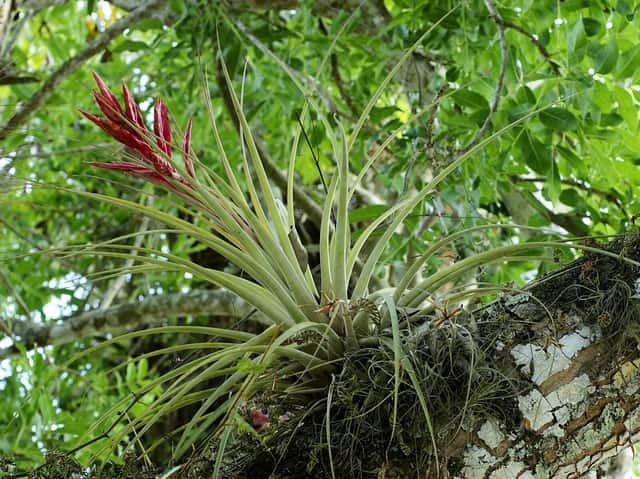
Bromeliaceae
Giant Airplant: Complete Care Guide
Tillandsia fasciculata
Mount it on something that does not hold water, such as wood, cork or stone, in very bright light but out of harsh midday sun. Water often and let it dry completely within a few hours. Keep it above 12 °C with good air movement.
Every 3 days
Bright indirect
12° - °C
% - %
Categories
What is Giant airplant?
Giant airplant (Tillandsia fasciculata) is a easy-care plant from the Bromeliaceae family. Giant airplant (Tillandsia fasciculata) is an epiphytic bromeliad native to Florida and Georgia, Mexico, Central America, the Caribbean and northern South America. It forms rosettes of stiff, leathery, grey-green leaves 30 to 70 cm long and, when flowering, a branched spike of showy red, orange or y...
Giant airplant grows up to 1.0m, watering every 3 days. It is suitable for indoor environments and safe for pets.
Unlike many tropical plants, Giant airplant tolerates watering mistakes. Best for beginners. Unlike many popular species, Giant airplant is safe to keep around pets. Without adequate drainage, root rot can develop within 7 days.
How to Care for Giant airplant?
TLDR: Giant airplant needs Bright indirect, watering every 3 days, and temperatures between 12-30°C with 40-70% humidity.
How Often Should You Water Giant airplant?
Spray or wet the plant thoroughly daily in hot weather and every 2-3 days in winter, or soak it for 20-30 minutes. It must dry fully within a few hours: water sitting in the base rots the rosette.
How Much Light Does Giant airplant Need?
Plenty of light but no strong direct sun, which scorches the leaves. Under grow lights it does well at 17,000-25,000 lux.
What Is the Best Soil for Giant airplant?
No soil: it is an epiphyte. Wire or glue it to wood, cork, stone or shells, and never cover the base with moss.
What Pot Should You Use for Giant airplant?
No pot: mount on a branch, cork or wood; if you use a container, keep it open and free of compost so water cannot collect
Care Schedule
Fertilize
Every 30 days
What Is Giant airplant and Where Does It Come From?
Giant airplant (Tillandsia fasciculata) is an epiphytic bromeliad native to Florida and Georgia, Mexico, Central America, the Caribbean and northern South America. It forms rosettes of stiff, leathery, grey-green leaves 30 to 70 cm long and, when flowering, a branched spike of showy red, orange or yellow bracts with small violet flowers. In the wild it clings to tree trunks, especially bald cypress, taking up water and nutrients through its leaves.
How to Propagate Giant airplant?
Pups (offsets)
The mother plant usually produces pups after flowering; leaving them attached creates an attractive clump.
- 1 Wait until the pup is at least one third the size of the mother plant
- 2 Detach it gently by twisting or cutting close to the base
- 3 Give the pup a dunk in water after separating it
- 4 Mount it in bright, indirect light
Materials needed:
How Big Does Giant airplant Grow?
TLDR: Giant airplant can reach up to 1.0m tall with Medium growth rate.
Max height
1.0m
Foliage
Evergreen
Plant Uses
Ornamental
Great for decoration
Is your plant showing symptoms?
Click on the symptom to discover possible causes:
What Diseases Commonly Affect Giant airplant?
TLDR: Giant airplant is susceptible to 2 known diseases. Monitor regularly for early detection.
Crown Rot
Crown rot is a serious fungal disease that attacks the crown (base) of the plant where the stem meets the soil. It is caused by various fungal pathogens including Phytophthora, Fusarium, and Rhizoctonia. The disease thrives in waterlogged conditions and can quickly spread to kill the entire plant if not addressed promptly.
Curculionidae
Curculionidae (weevils) are small beetles that feed on plants. Adults chew leaf margins, leaving crescent-shaped notches, primarily at night. The larvae live in the substrate and consume roots, causing decline, yellowing, and wilting even when the substrate is moist, and in severe cases, plant death. They frequently affect ornamentals and garden plants such as strawberries, citrus, roses, hydrangeas, azaleas, blueberries, begonias, and many potted plants.
Fun Facts
In Florida it is listed as endangered because of an invasive beetle, the Mexican bromeliad weevil.
The true flowers are violet; the showy colour comes from its red, orange or yellow bracts.
One of its old names is 'dog-drink-water', because the rosette holds water.
Frequently asked questions
How often should I water Tillandsia fasciculata?
Does it need soil?
Is giant airplant toxic to cats and dogs?
How should I feed it?
Compare with similar plants
| Attribute | Difficulty | Light | Watering | Pet Safe |
|---|---|---|---|---|
| Field Maple | Easy | Bright indirect | 14d | ✓ |
| Iberian Houseleek | Easy | Direct sun | 14d | ✓ |
| Silver Birch | Easy | Direct sun | 14d | ✓ |
| Common Blanketflower | Easy | Direct sun | 10d | ✓ |





